
Slip Angle and the Friction Ellipse: The Non-Linear Relationship Between Tire Slip and Cornering Force
Tire adhesion is governed by a non-linear relationship between longitudinal and lateral forces. Understanding the friction ellipse and slip angle explains how vehicles balance braking and cornering at the limit of grip.
By Hao Li

Share this story
In short
- Tire grip relies on controlled deformation and slip angle, not just static friction.
- The friction ellipse illustrates the absolute limit of combined braking and cornering forces.
- Exceeding the boundary of the friction ellipse results in a loss of traction and a slide.
When engineers at Delft University of Technology first mounted a pneumatic tire to a rolling test rig in the late 1980s, the sensors measuring lateral and longitudinal forces returned a dataset that defied simple geometry. As the steel drum spun against the rubber tread, the tire did not simply grip until it slipped.
Instead, the contact patch deformed, generating a non-linear curve of adhesion that peaked and then gradually fell away. That observation, quantified by researcher Hans Pacejka in 1989, formed the basis of the Magic Formula—a mathematical model that remains the foundation of modern vehicle dynamics.[5]
The fundamental mechanism of tire grip is not static friction, but controlled deformation. When a vehicle turns, the wheel points in a new direction, but the vehicle's mass continues forward. The difference between the direction the wheel is pointing and the actual direction of travel is known as the slip angle. A tire does not generate lateral cornering force by rolling perfectly straight; it generates force by slipping slightly across the road surface, twisting the rubber in the contact patch.[3][4]
At low slip angles—typically between 1 and 4 degrees for a standard passenger car—the relationship is linear: steering input directly translates to cornering force. However, as the slip angle increases past 5 degrees, the rubber reaches its elastic limit. The lateral force peaks and then begins to drop off, even if the driver applies more steering lock. This non-linear saturation point dictates a vehicle's maximum cornering speed, and it is highly dependent on the vertical load pressing the tire into the tarmac.[2]
This dynamic becomes significantly more complex when a driver demands both steering and braking simultaneously. The total grip available to a tire is finite, bounded by what engineers call the friction ellipse. The ellipse represents the absolute limit of adhesion, plotting longitudinal force on one axis and lateral force on the other. If a tire is using 100 percent of its available grip to brake, it has zero capacity left to turn.[1][4]
The friction ellipse illustrates why trail-braking—the technique of gradually releasing brake pressure as steering angle increases—is necessary to navigate a corner at the limit. As the driver eases off the brake pedal, longitudinal force decreases, freeing up capacity within the friction ellipse for the lateral force required to turn the vehicle. Exceeding the boundary of the ellipse results in a slide, as the tire's slip velocity relative to the road surface overcomes the rubber's coefficient of friction.[1][3]
While the friction ellipse is a useful conceptual tool, actual tire behavior is rarely perfectly symmetrical. The idealized ellipse assumes that longitudinal and lateral grip degrade at the same rate. In reality, the force-limiting behavior for combined braking and steering is highly dependent on the specific construction of the tire.
As noted in research published by SAE International, "Because of the complexity of nonlinear tire force behavior the Fy - Fx force relationship is not a true ellipse and the force limit is dependent on the kinematic slip angle and traction slip variables."[1]
To accurately model this behavior, the automotive industry relies on the Pacejka Magic Formula. The formula uses a semi-empirical transcendental function—incorporating sine and arctangent operations—to fit experimental data gathered from physical tire tests. By adjusting coefficients like the stiffness factor, shape factor, and peak value, engineers can generate a curve that precisely matches a specific tire's behavior under various loads.
For example, the Pacejka model defines specific baseline shape factors, such as a lateral force falloff coefficient of 1.3 and a longitudinal falloff of 1.65, demonstrating that a tire loses braking efficiency faster than cornering stability when pushed past the limit.[2]
The Magic Formula is critical for the development of modern electronic stability control and torque-vectoring systems. These systems continuously monitor wheel speed and steering angle, calculating the exact slip ratio of each tire in real time. If the system detects that a tire is approaching the peak of its Pacejka curve, it can independently apply braking force to individual wheels, manipulating the vehicle's yaw rate to keep the tires within their optimal slip angles.[2][5]
The Magic Formula is critical for the development of modern electronic stability control and torque-vectoring systems.
In electric vehicles, this modeling is even more critical. Electric motors can adjust torque delivery in as little as 10 milliseconds, far faster than the 100 to 200 milliseconds required by internal combustion engines. By integrating the Pacejka curves into the motor controller, an EV can precisely manage the longitudinal slip ratio, maximizing acceleration without breaking traction. This requires a highly accurate understanding of the tire's specific friction ellipse, as the instantaneous torque can easily overwhelm the available grip.[5]
Despite its ubiquity, the standard Magic Formula has limitations, particularly in modeling combined slip scenarios where lateral and longitudinal forces interact dynamically. When a tire is subjected to simultaneous heavy braking and sharp steering, the force coupling can deviate from the semi-empirical predictions. Researchers continue to refine these models, incorporating adaptive algorithms to better estimate friction on low-grip surfaces, ensuring that the digital representation of the tire matches the physical reality of the road.[1][5]
Key terms
- Slip Angle
- The difference between the direction a wheel is pointing and the actual direction the vehicle is traveling.
- Friction Ellipse
- A visual representation of a tire's maximum available grip, plotting longitudinal force against lateral force.
- Pacejka Magic Formula
- A mathematical model that uses sine and arctangent functions to accurately predict tire forces based on slip angle and vertical load.
- Contact Patch
- The physical area of the tire tread that is in direct contact with the road surface at any given moment.
- Slip Ratio
- The difference between the rotational speed of the tire and the actual forward speed of the vehicle, usually expressed as a percentage.
Frequently asked
What is a tire slip angle?
Slip angle is the angular difference between where the wheel is steered and where the tire is actually moving. It is required to generate the lateral force needed to turn a vehicle.
Why is it called the friction ellipse?
It is called an ellipse because a tire typically generates slightly more longitudinal grip (for braking and accelerating) than lateral grip (for cornering), making the boundary of maximum adhesion elliptical rather than perfectly circular.
What is the Pacejka Magic Formula used for?
The formula is used in vehicle dynamics simulations and electronic stability control systems to accurately predict how much grip a tire will produce under specific loads and slip angles.
Can a tire brake and turn at 100% capacity at the same time?
No. The total amount of grip is finite. If a tire is using all of its available friction to brake, it cannot generate any lateral force to turn the vehicle.
Viewpoints in depth
Vehicle Dynamicists
Focus on utilizing accurate tire models to optimize suspension geometry and maximize mechanical grip.
For chassis engineers, the tire is the single most important component on the vehicle, as it is the only physical connection to the road. Dynamicists use the friction ellipse to understand how weight transfer affects the total grip available at each corner. By tuning suspension stiffness and camber angles, they aim to keep the tire's contact patch as flat as possible, maximizing the vertical load and expanding the boundaries of the friction ellipse during aggressive maneuvers.
Control Systems Engineers
Rely on the Magic Formula to program electronic stability control and torque-vectoring algorithms.
Software engineers developing active safety systems view the tire through the lens of the Pacejka curves. Their goal is to prevent the vehicle from ever exceeding the peak of the slip angle curve. By continuously monitoring sensor data, the stability control system calculates the instantaneous slip ratio. If the system detects that a tire is losing lateral grip, it intervenes by applying targeted braking to other wheels, artificially inducing a yaw moment that corrects the vehicle's trajectory before the driver even realizes a loss of traction has occurred.
Tire Researchers
Emphasize the limitations of idealized models and the need for empirical testing to capture non-linear combined slip behavior.
Academic researchers and tire manufacturers caution against over-relying on simplified geometric models like the perfect friction circle. They point out that the interaction between longitudinal and lateral slip is highly complex and non-linear. When a tire is subjected to heavy braking, the carcass deforms, fundamentally altering its cornering stiffness. Researchers advocate for continuous empirical testing on specialized rigs to generate accurate, multi-dimensional maps of tire behavior that account for these transient, combined-slip conditions.
- Vehicle Dynamicists
- Focus on utilizing accurate tire models to optimize suspension geometry and maximize mechanical grip.
- Control Systems Engineers
- Rely on the Magic Formula to program electronic stability control and torque-vectoring algorithms.
- Tire Researchers
- Emphasize the limitations of idealized models and the need for empirical testing to capture non-linear combined slip behavior.
Perspectives this story doesn't cover
- Motorsport drivers who rely on physical feedback rather than mathematical models to find the limit of grip.
- Tire compound chemists who design the rubber mixtures that dictate the peak friction coefficients.
Sources
Source coverage
5 outlets
3 viewpoints surfaced





- [1]SAE MobilusTire Researchers
The Tire-Force Ellipse (Friction Ellipse) and Tire Characteristics
Read on SAE Mobilus → - [2]OpenVDControl Systems Engineers
Tire models
Read on OpenVD → - [3]Racecar EngineeringVehicle Dynamicists
Tyre dynamics
Read on Racecar Engineering → - [4]WikipediaTire Researchers
Circle of forces
Read on Wikipedia → - [5]Factlen Editorial Team
Synthesis by Factlen editorial team
Read on Factlen Editorial Team →
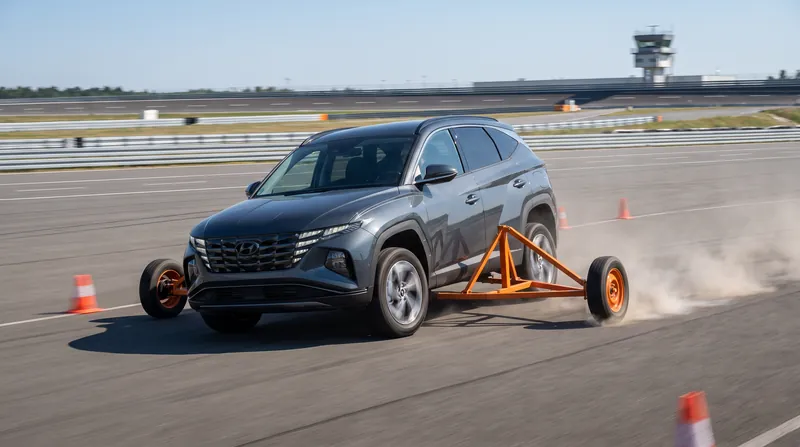
More in Transportation
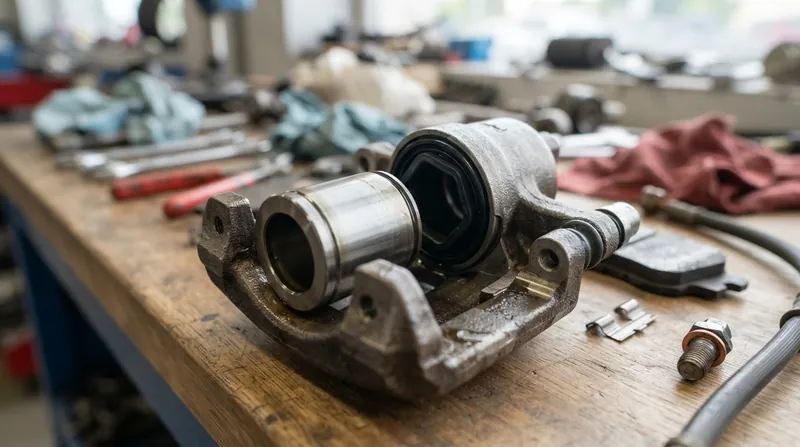
See all →Brake Hydraulics
Square-Cut Caliper Seals Deflect Under Fluid Pressure to Retract Brake Pistons Without Return Springs
6 sources
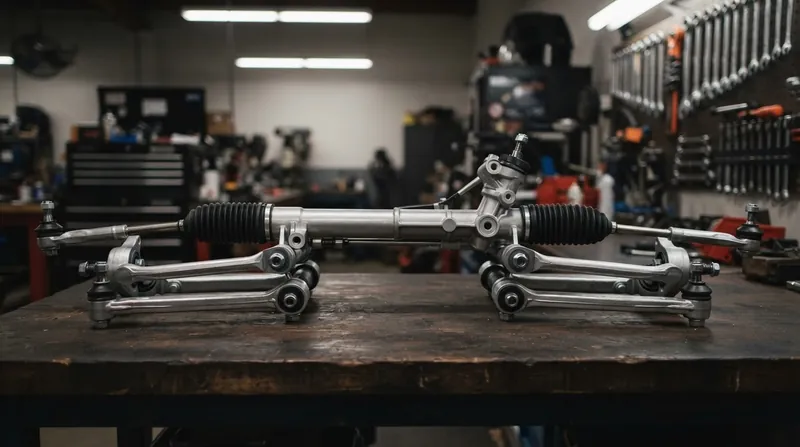
Steering Geometry
Positive Caster and Pneumatic Trail Generate the Self-Aligning Torque That Centers a Car's Steered Wheels
5 sources
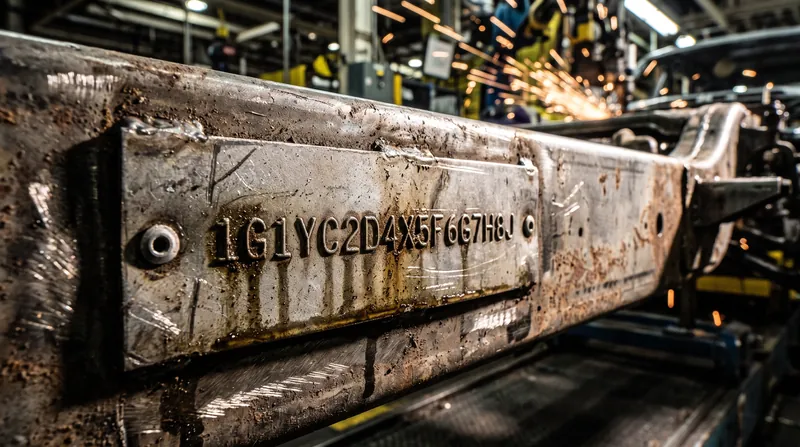
Vehicle Identification
The 17-Character ISO 3779 Code That Globally Identifies Every Vehicle's Origin, Attributes, and Serial Number
6 sources
Combustion Chemistry
The 0.7–1.0 Lambda Ratio and the Stoichiometric Air-Fuel Mixture That Define a Gasoline Engine's Peak Power and Efficiency
4 sources
Comments
Every angle. Every day.
Get Transportation stories with full source coverage and perspective breakdowns, free every day.