
Bipartisan Local Opposition Blocks $64 Billion in Data Center Projects Over Resource Strain and Noise
A rare bipartisan consensus is emerging across the United States as local communities successfully block or delay billions in AI data center construction. Driven by concerns over water usage, grid strain, and noise, residents are forcing tech companies to rethink how they build the physical infrastructure of artificial intelligence.
By Factlen Editorial Team
- Local Communities
- Prioritize quality of life, resource conservation, and democratic consent over rapid industrial expansion.
- Tech Developers
- Emphasize the necessity of physical infrastructure to maintain global AI leadership and economic competitiveness.
- Environmental Advocates
- Focus on the ecological impacts of data centers, particularly regarding water depletion and prolonged fossil fuel reliance.
- Local Policymakers
- Attempt to balance the promise of corporate tax revenue with the immediate demands and grievances of their constituents.
What's not represented
- · Utility Ratepayers
- · Construction Trade Unions
Why this matters
The physical footprint of the AI revolution is colliding with local democracy. As communities successfully demand a say in how their water, power, and land are used, tech developers are being forced to shift from a 'build first' mentality to one that requires genuine community consent and shared economic benefits.
Key points
- Local opposition has blocked or delayed approximately $64 billion in U.S. data center projects over the past two years.
- A recent Gallup poll shows 71 percent of Americans oppose local data center construction, uniting both Democrats and Republicans.
- Residents cite concerns over excessive water usage, strain on local power grids, and persistent noise from cooling systems.
- Communities are utilizing elections, recalls, and zoning boards to halt projects that lack local consent.
- New York recently enacted the nation's first statewide moratorium on new hyperscale data centers to study environmental impacts.
- Tech developers are increasingly adopting Community Benefits Agreements to secure a social license to operate.
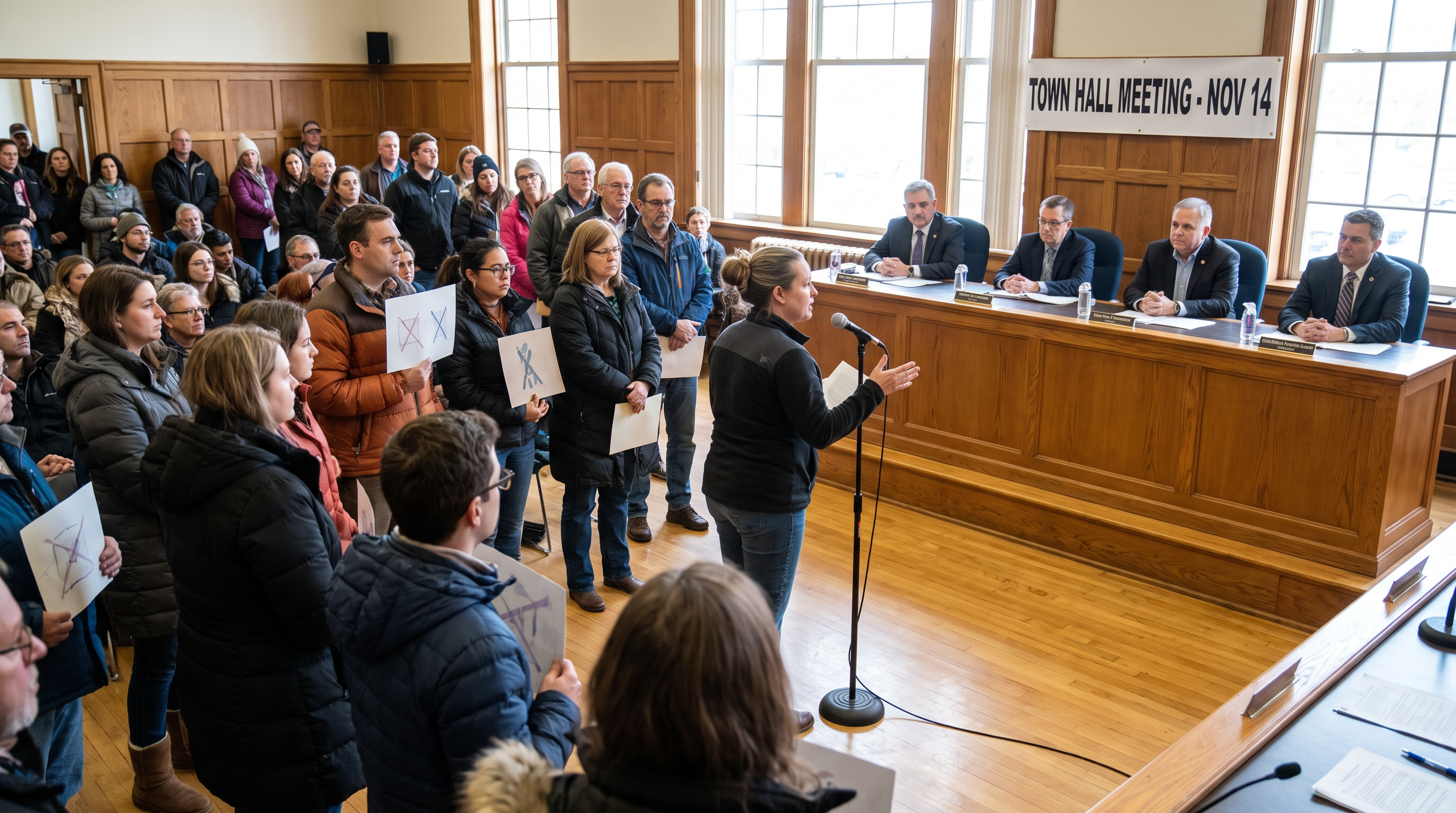
The artificial intelligence revolution is often described in abstract, ethereal terms—the cloud, neural networks, and seamless virtual assistants. But the physical infrastructure required to power these digital innovations is massive, resource-intensive, and increasingly unwelcome in American neighborhoods. Across the country, a rare and powerful bipartisan consensus has emerged as local residents successfully push back against the rapid expansion of hyperscale data centers. From rural farming communities to bustling suburban corridors, citizens are organizing to protect their local resources from the insatiable demands of the tech industry. This grassroots resistance is fundamentally reshaping the geography of the AI boom, proving that even the most well-funded technological advancements must ultimately answer to local democracy and community consent.[1][6]
The sheer scale of this grassroots resistance has caught the technology sector and its investors completely off guard. According to a comprehensive report by the industry research firm Data Center Watch, approximately $64 billion worth of U.S. data center projects were blocked, delayed, or canceled by community opposition over a two-year period ending in early 2025. The pace of these cancellations has only accelerated as public awareness grows. In the first quarter of 2026 alone, at least 75 distinct data center projects worth roughly $130 billion were stalled by local interventions. What was once viewed by developers as a minor permitting nuisance has evolved into the single largest financial risk facing the expansion of artificial intelligence infrastructure.[1][5]
What was once considered quiet, invisible infrastructure has rapidly become a national flashpoint, uniting Americans across the political spectrum. A March 2026 Gallup poll revealed that a staggering 71 percent of Americans oppose the construction of AI data centers in their local area. This resistance defies the typical ideological fault lines of modern American politics, uniting 75 percent of Democrats and 63 percent of Republicans in shared opposition. The data indicates that the closer a proposed project gets to a resident's backyard, the less relevant their national political affiliation becomes, creating unexpected alliances between progressive environmentalists and conservative property-rights advocates.[2][5][6]

"I'm not sure I've ever seen a chart where conservative Republicans are closer to liberal Democrats than liberal and moderate Republicans are," noted one climate communication expert analyzing the recent polling data. This cross-party alignment stems from a shared set of tangible, highly localized grievances. Regardless of how they vote in federal elections, residents share identical concerns about rising electricity bills, municipal water scarcity, persistent industrial noise, and the perception that their communities are bearing the heavy environmental costs while distant tech companies reap the financial profits.[1][5]
The core tension driving this backlash lies in the stark mismatch between who benefits from these facilities and who pays the daily price. Hyperscale data centers require enormous amounts of electricity to run specialized AI chips and millions of gallons of water to cool the constantly humming servers. While developers frequently tout the economic benefits of construction, critics are quick to point out that once the facilities are built, these massive, warehouse-sized buildings employ relatively few permanent workers. The promised economic windfall often fails to materialize for the average resident, leaving them with the downsides of heavy industry without the corresponding employment boom.[6][8]
For residents living adjacent to these facilities, the impacts are immediate, physical, and impossible to ignore. The constant, low-frequency hum of industrial cooling fans has led to severe noise complaints in multiple states, disrupting the quiet enjoyment of residential neighborhoods. Furthermore, the sheer energy demand of these facilities threatens to strain local power grids, forcing utilities to invest in expensive upgrades that are often passed down to residential customers in the form of higher monthly utility rates. In regions already grappling with seasonal drought, the prospect of a single commercial facility consuming millions of gallons of municipal water has sparked fierce and immediate backlash.[1][6][8]
For residents living adjacent to these facilities, the impacts are immediate, physical, and impossible to ignore.
Communities are not just voicing their complaints at public hearings; they are aggressively utilizing the levers of local democracy to halt development in its tracks. In Warrenton, Virginia—a state that serves as the undisputed epicenter of the U.S. data center industry—residents organized a sweeping and unprecedented electoral revolt in November 2024. Frustrated by a lack of transparency, voters ousted every single town council member who had supported a proposed Amazon data center. They replaced the incumbents with a slate of staunch opponents who immediately moved to amend zoning ordinances and block the project from moving forward.[5]
Similar democratic interventions have unfolded in municipalities nationwide, proving that the Virginia revolt was not an isolated incident. In Cascade Locks, Oregon, voters successfully recalled two Port Authority officials who had approved a $100 million data center, leading the newly seated board to cancel the project entirely just weeks later. In August 2025, St. Charles, Missouri, took the movement a step further, becoming the first municipality in the nation to enact a comprehensive citywide ban on data center construction. The unanimous city council vote followed massive public pushback against a secretive development known locally as "Project Cumulus."[4][5]

The movement reached a significant new milestone in July 2026, elevating the issue from local zoning boards to the highest levels of state government. New York Governor Kathy Hochul signed Executive Order 62, establishing the nation's first statewide moratorium on new hyperscale data center permits. The sweeping order pauses environmental approvals for any facility consuming 50 megawatts or more for up to one year, effectively halting the rapid proliferation of AI infrastructure across the state while regulators catch up to the technology.[3][7]
During this mandated pause, New York state agencies are tasked with developing a comprehensive regulatory framework to properly assess the cumulative impacts of data centers on energy demand, water quality, and ambient noise levels. Crucially, the directive also requires the creation of a formal "Community Investment Framework" to ensure that localities receive tangible, guaranteed benefits before any new large-scale projects can proceed. This state-level intervention represents a major victory for local activists who have long argued that the current permitting process is fundamentally broken.[3][7]
For the technology sector, this unprecedented wave of opposition is forcing a fundamental and costly strategic shift. Historically, developers treated community consent as a late-stage permitting formality, assuming that the promise of tax revenue would eventually smooth over any local friction. Now, industry analysts and financial experts warn that "permission to operate" has become a critical and scarce fourth input for AI infrastructure, standing alongside the acquisition of chips, power, and capital.[1]

Financial models across the tech industry are being rapidly rewritten to account for the political reality of local resistance. Developers are increasingly advised to price community support into their initial project underwriting. This means factoring in the substantial costs of power-grid upgrades, advanced closed-loop water-recycling systems, and state-of-the-art noise-mitigation technologies from the very first investment meeting, rather than attempting to retrofit solutions after the community has already mobilized in opposition.[1]
This shifting dynamic is also driving the widespread adoption of Community Benefits Agreements (CBAs)—legally binding contracts in which developers agree to fund local infrastructure, public parks, or educational programs in direct exchange for neighborhood support. By demanding these concrete concessions upfront, communities are ensuring that the immense wealth generated by the artificial intelligence boom does not entirely bypass the towns that host its physical footprint.[1][5][8]
Ultimately, the $64 billion in stalled projects represents local democracy functioning exactly as intended. Faced with an unprecedented industrial buildout that threatens to alter the character of their neighborhoods, citizens are demanding transparency, environmental accountability, and a fair share of the economic benefits. Rather than permanently halting technological progress, this robust local pushback is actively shaping a more sustainable, equitable, and community-focused path forward for the infrastructure that will power the next generation of global computing.[1][6][8]
How we got here
June 2023
Voters in Cascade Locks, Oregon, recall two Port Authority officials over their support for a $100 million data center.
November 2024
Residents of Warrenton, Virginia, vote out their entire town council to block a proposed Amazon data center.
August 2025
St. Charles, Missouri, becomes the first U.S. municipality to enact a citywide ban on data center construction.
March 2026
Polling reveals that 71 percent of Americans oppose the local construction of AI data centers.
July 2026
New York Governor Kathy Hochul signs an executive order establishing the nation's first statewide moratorium on new hyperscale data centers.
Viewpoints in depth
Local Residents & Activists
Prioritize quality of life, resource conservation, and democratic consent over rapid industrial expansion.
This coalition argues that the negative externalities of data centers—noise, water depletion, and grid strain—are borne entirely by the host community, while the benefits flow to distant tech companies. They emphasize that local zoning and planning boards must have the authority to reject projects that threaten municipal resources, and they demand legally binding Community Benefits Agreements for any approved construction.
Tech Developers & Cloud Providers
Emphasize the necessity of physical infrastructure to maintain global AI leadership and economic competitiveness.
Developers contend that hyperscale data centers are the foundational infrastructure of the 21st-century economy. They argue that local moratoriums and zoning bans threaten to bottleneck technological innovation and cede AI dominance to international rivals. However, facing mounting delays, many in the industry are beginning to acknowledge the need to proactively fund grid upgrades and adopt advanced water-recycling technologies to secure a social license to operate.
Local Government Officials
Caught between the promise of tax revenue and the immediate demands of their constituents.
Municipal and state leaders face a difficult balancing act. While data centers can significantly boost local property tax bases, the political cost of approving them over resident objections has proven severe, as evidenced by recent electoral wipeouts and recalls. Consequently, many officials are pivoting toward temporary moratoriums, buying time to study environmental impacts and draft comprehensive zoning regulations that protect ratepayers.
What we don't know
- How the New York statewide moratorium will influence legislative efforts in other states considering similar bans.
- Whether tech companies will successfully innovate cooling and power systems fast enough to alleviate local resource concerns.
- How the delay of $64 billion in infrastructure will impact the broader timeline of global artificial intelligence development.
Key terms
- Hyperscale Data Center
- A massive, highly efficient computing facility designed to support large-scale cloud computing and artificial intelligence operations, often consuming 50 megawatts of power or more.
- Moratorium
- A temporary, legally mandated pause on a specific activity—such as issuing building permits—to give lawmakers time to study impacts and draft new regulations.
- Peak Demand
- The maximum amount of electrical power a facility requires at any given time, used by utilities to determine if the local grid can support the infrastructure.
Frequently asked
Why do AI data centers require so much water?
Data centers generate massive amounts of heat from thousands of servers running simultaneously. They typically use evaporative cooling systems that can consume millions of gallons of local municipal water, especially during peak demand or in warmer climates.
Do these facilities create local jobs?
While data centers create a temporary surge in construction jobs during the building phase, they are highly automated and require very few permanent employees to operate once completed.
What is a Community Benefits Agreement?
A Community Benefits Agreement (CBA) is a legally binding contract between a developer and a local community. It requires the developer to fund specific local improvements, such as parks, infrastructure, or educational programs, in exchange for the community's support of the project.
Sources
Source coverage
8 outlets
4 viewpoints surfaced








[1]ForbesTech Developers
Local opposition is delaying AI data centers and forcing developers to price community support into every project
Read on Forbes →[2]GallupLocal Communities
Seven in 10 Americans Oppose Local Construction of AI Data Centers
Read on Gallup →[3]ESG DiveEnvironmental Advocates
New York has halted construction of large data centers for one year
Read on ESG Dive →[4]KSDKLocal Communities
St. Charles becomes 1st city in nation to ban data center construction citywide for a year
Read on KSDK →[5]Data Center WatchLocal Policymakers
$64 billion of data center projects have been blocked or delayed amid local opposition
Read on Data Center Watch →[6]Waging NonviolenceEnvironmental Advocates
The data center fight is going global
Read on Waging Nonviolence →[7]Facilities DiveLocal Policymakers
Behind the New York data center pause is legislation that could impact existing facilities
Read on Facilities Dive →[8]Harvard GazetteEnvironmental Advocates
Tech, data policy expert says concerns legitimate over rising power rates, water use, environmental issues amid mushrooming growth
Read on Harvard Gazette →
Every angle. Every day.
Get community stories with full source coverage and perspective breakdowns delivered to your inbox.