
146,000-Year-Old Stone Tools in China Reveal Ice Age Origins of Human Creativity
Sophisticated stone tools crafted by the extinct human relative Homo juluensis during a brutal ice age challenge the long-held belief that technological innovation only flourished in warm, hospitable climates.

We like to think of human progress as a luxury born of leisure. The standard story goes something like this: once our ancestors found a warm valley, settled down, and stopped worrying about freezing or starving, they finally had the free time to sit around and invent things.
It is a comforting narrative, one that suggests our best ideas come when we are comfortable. But a newly dated collection of stone tools from central China is throwing cold water—literally—on that cozy assumption, proving that sometimes, the most profound leaps in human ingenuity are forged in the absolute worst conditions imaginable.
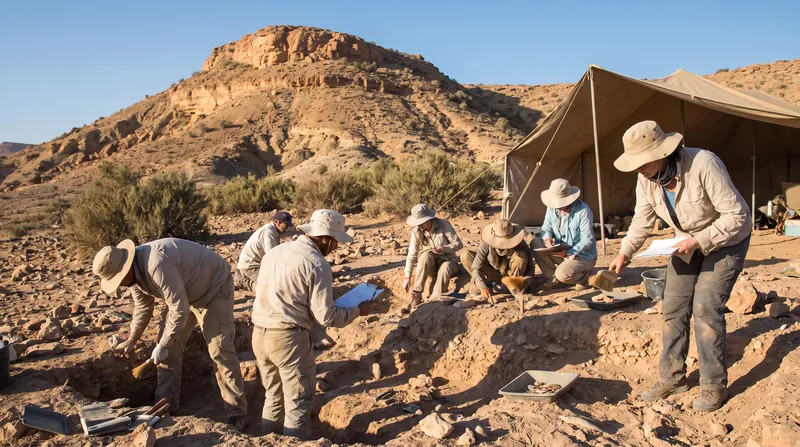
In a study published in the Journal of Human Evolution, archaeologists have revealed that a sophisticated cache of stone tools found at the Lingjing site in Henan Province dates back 146,000 years. That specific timestamp drops these artifacts squarely into the middle of a brutal glacial period. The tools were not made by modern Homo sapiens, but by Homo juluensis—a large-brained, extinct cousin of ours that roamed eastern Asia and likely crossed paths with our direct ancestors.[1][2][5]
At first glance, the disc-shaped stone cores left behind in the dirt might not look like a technological revolution. But look closer, and the cognitive leap becomes obvious. The toolmakers were not just smashing rocks together and hoping for a sharp edge. They were employing a highly organized, centripetal flaking system. By striking small stones against larger cores, they managed the rock as a three-dimensional object, carefully preparing one side as a striking platform to peel off precise, useful flakes from the other.[1][2][5]
This kind of asymmetrical, planned manufacturing requires a deep understanding of fracture mechanics and spatial geometry. It is a level of technological foresight that archaeologists usually associate with the Middle Paleolithic Neanderthals in Europe or early human ancestors in Africa. Finding it in eastern Eurasia, executed with such precision, shatters the long-held archaeological bias that East Asian hominins were somehow technologically lagging behind their western counterparts during the Middle Pleistocene.[1][2][4][5]
The timeline revision itself is a triumph of modern geochronology. For years, researchers believed the Lingjing tools were crafted around 126,000 years ago, during a relatively warm and forgiving interglacial window. That fit neatly into the old 'comfort breeds creativity' model. But the site also served as a butchering ground where Homo juluensis processed animals like wild horses and deer. Inside a fossilized deer-like rib bone, scientists found tiny, glittering calcite crystals.[1][2][3][5]
Those crystals act as a natural, prehistoric clock. Calcite contains trace amounts of uranium, which slowly and predictably decays into thorium over millennia. By measuring the ratio of uranium to thorium, the team, led by Yuchao Zhao of the Field Museum and Zhangyang Li of Shandong University, pushed the site's age back by 20,000 years. That 20,000-year shift is everything: it moves the toolmakers out of a temperate paradise and drops them into a harsh, unforgiving ice age.[1][2][3][4][5]
Surviving an ice age in northern China was not for the faint of heart. The landscape would have been bitterly cold, demanding complex social cooperation and advanced hunting strategies just to stay alive. The Lingjing tools were likely used to process animal hides for clothing and to butcher large game, extracting every possible calorie from the meat and marrow. The environmental stress did not suppress their cognitive development; it actively demanded it.[2][5]
As Zhao bluntly noted, hard times force adaptation. The Lingjing discovery forces us to rethink the mechanics of human evolution. Innovation is not just the dividend of plenty; it is often the desperate, brilliant response to adversity. For Homo juluensis, the freezing winds of the Middle Pleistocene were not a barrier to progress—they were the crucible that sparked a technological revolution.[2][3][5]
Key points
- Sophisticated stone tools found in central China have been dated to 146,000 years ago.
- The artifacts were crafted by Homo juluensis during a severe and unforgiving ice age.
- The discovery challenges the assumption that human creativity only flourishes during warm, stable climates.
- Uranium-thorium dating of calcite crystals inside fossilized bones provided the revised timeline.
How we got here
300,000–120,000 Years Ago
The late Middle Pleistocene era, a period previously thought to be technologically stagnant in East Asia.
146,000 Years Ago
Homo juluensis populations at the Lingjing site craft sophisticated stone tools during a severe glacial period.
Initial Excavations
Archaeologists uncover thousands of stone artifacts and animal bones at the Lingjing site, initially dating them to a warm interglacial period 126,000 years ago.
May 2026
Uranium-thorium dating of calcite crystals pushes the site's age back by 20,000 years, placing the tools squarely in an ice age.
- Evolutionary Anthropologists
- Focuses on the cognitive capabilities and complex lineage of Middle Pleistocene hominins.
- Climate Adaptation Theorists
- Argues that severe environmental stress and hardship are primary drivers of technological innovation.
- East Asian Archaeologists
- Challenges Eurocentric biases by highlighting independent technological advancements in ancient China.
Perspectives this story doesn't cover
- Indigenous populations' oral histories regarding ancient climate shifts
Sources
Source coverage
5 outlets
3 viewpoints surfaced




- [1]Popular ScienceEvolutionary Anthropologists
Our cousins 'Homo juluensis' knew how to adapt in the face of an ice age
Read on Popular Science → - [2]Field MuseumClimate Adaptation Theorists
Ice Age butcher's tools are a sign of ancient humans' creativity during hard times
Read on Field Museum → - [3]ScienceDailyEvolutionary Anthropologists
Ice age humans in China crafted surprisingly advanced stone tools 146,000 years ago
Read on ScienceDaily → - [4]Archaeology MagazineEast Asian Archaeologists
New Dates Obtained for Stone Tools in East Asia
Read on Archaeology Magazine → - [5]The DebriefClimate Adaptation Theorists
Something Sparked a Technological Revolution in China 146,000 Years Ago—Archaeologists Have Now Linked It to a Mysterious Extinct Human Species
Read on The Debrief →

More in Culture
See all →Paleoanthropology
Researchers Reconstruct Digital Face of 315,000-Year-Old Homo Sapiens
4 sources
Brain Organoids
Stanford Scientists Grow Human Cortical Organoids in Live Mice to Study Brain Disease
6 sources

Human Evolution
Massive Ancient DNA Study Reveals Natural Selection Has Accelerated in Recent Human Evolution
6 sources

Prehistoric Drug Use
25,000-Year-Old Teeth Push Back Timeline for Earliest Habitual Psychoactive Drug Use
4 sources

Comments
Every angle. Every day.
Get Culture stories with full source coverage and perspective breakdowns, free every day.