
GuideLiterature and Book CultureRevision 1Updated
The Definitive Guide to Literature and Book Culture
From the medieval invention of word spacing to the modern deployment of adversarial fonts, the written word continually reshapes human cognition and society. This comprehensive guide explores the structural, social, and technological forces driving literary evolution.

Share this story
In short
- The 7th-century invention of word spacing enabled silent reading, drastically reducing cognitive load and allowing for deep immersion in complex narratives.
- Reading literary fiction measurably improves Theory of Mind, acting as a cognitive flight simulator that boosts human empathy.
- Classical narrative structures, like Freytag's Pyramid and Aristotle's rhetorical triangle, remain the foundational blueprints for modern storytelling.
The physical act of reading feels entirely natural to the modern mind, yet it is a highly engineered cognitive hack. We stare at marked wood pulp or illuminated pixels and hallucinate vividly, constructing entire worlds from abstract symbols. This guide maps the architecture of that hallucination.
Literature is not merely a repository of stories; it is the operating system of human culture. It dictates how we argue, how we empathize, and how we signal our social standing to one another. Understanding book culture requires dismantling the mechanics of the text itself.
Those mechanics are constantly evolving. From the monastic scriptoriums of the Middle Ages to the algorithmic training grounds of modern artificial intelligence, the written word adapts to the technology that carries it. Every major shift in format has triggered a corresponding shift in human cognition.
To navigate this landscape, we must look past the bestseller lists and examine the structural constraints that shape narrative. The rules of poetry, the geometry of tragedy, and the sociology of taste all intertwine to create the ecosystem we call literature.
The Invention of Silence
For the first millennium of Western literacy, reading was a loud, communal, and physically exhausting activity. Texts were written in scriptio continua—a solid block of letters with no spaces, punctuation, or capitalization. Parsing these unbroken strings of characters required reading them aloud so the ear could separate the words.[2]
This vocalized reading made the consumption of text a public performance rather than a private retreat. The cognitive load required just to decipher the sentences left little mental bandwidth for deep, reflective analysis. Books were scripts to be performed, not environments to be inhabited.[2][12]
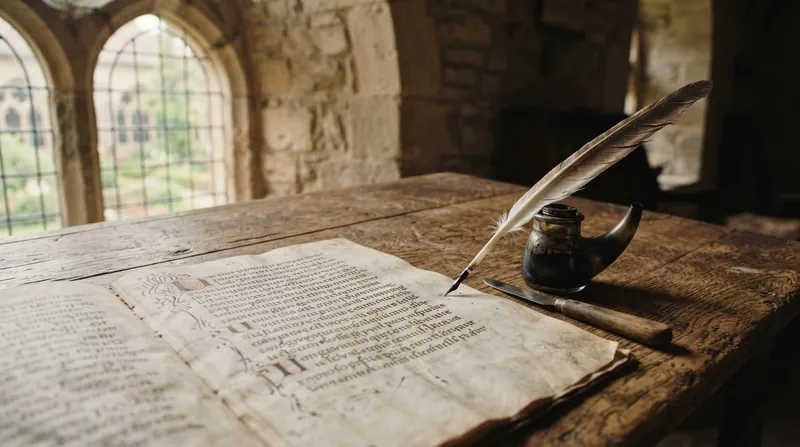
That changed in the 7th century, driven by an unlikely source: Irish and Anglo-Saxon monks. Struggling to learn Latin as a foreign language, these insular scribes began inserting spaces between words to make the texts easier to parse. It was a linguistic crutch designed for language learners.[2]
This simple typographic innovation accidentally rewired human consciousness. Word spacing drastically reduced the cognitive friction of reading, allowing the brain to process text faster than the mouth could speak it. Silent reading was born, transforming literature into a deeply private, internal experience.[12]
The shift to silent reading created the necessary mental space for complex, ambiguous narratives. Without the burden of vocalization, readers could immerse themselves entirely in the interior lives of fictional characters. This immersion is not just a pleasant diversion; it is a measurable cognitive workout.[1][12]
Rewiring the Brain for Empathy
Cognitive science has recently quantified this effect. A landmark 2013 study published in the journal Science demonstrated that reading literary fiction temporarily enhances a reader's Theory of Mind. This is the psychological term for the ability to understand that other people hold beliefs and desires different from our own.[1]
The researchers, David Comer Kidd and Emanuele Castano, found that popular genre fiction did not produce the same cognitive boost. Literary fiction, with its complex characters and unresolved ambiguities, forces the reader to actively construct the characters' mental states. It acts as a flight simulator for social interaction.[1]
As Kidd and Castano noted in their findings, "understanding others' mental states is a crucial skill that enables the complex social relationships that characterize human societies." By navigating the unspoken tensions of a well-crafted novel, readers are literally practicing empathy.[1]
This empathetic engagement relies heavily on how a story is structured. Human beings are pattern-seeking animals, and we have spent thousands of years refining the geometric shapes that narratives take. The most enduring of these shapes was formalized over a century ago.[3]
The Geometry of Story
In 1863, the German novelist and critic Gustav Freytag published a geometric model mapping the inevitable doom of classical tragic heroes. Known today as Freytag's Pyramid, this five-part structure—exposition, rising action, climax, falling action, and denouement—remains the foundational blueprint for Western storytelling.[3]
Freytag did not invent this arc; he merely observed the underlying physics of dramatic tension that had governed theater since antiquity. Modern writing pedagogy has since adapted the pyramid to fit everything from half-hour sitcoms to sprawling fantasy epics. It is the invisible scaffolding holding up the plot.[3]
Underneath the plot lies the architecture of persuasion. Aristotle's 2,400-year-old rhetorical triangle remains the definitive guide to changing human minds. He argued that effective communication requires a balance of three distinct appeals: ethos, pathos, and logos.[4]
Ethos establishes the speaker's credibility and moral character. Pathos targets the audience's emotions, leveraging anger, pity, or joy. Logos appeals to logic and reason through structured argument and evidence. A narrative that leans too heavily on just one pillar inevitably collapses under its own weight.[4]
Structural Puzzles
These structural constraints are most visible in poetry, where form dictates function. For over seven centuries, the 14-line sonnet has served as literature's most enduring puzzle box. The strict rules of meter and rhyme force poets to distill complex emotions into highly pressurized linguistic diamonds.[5]
The form originated in Italy, where the Petrarchan sonnet divided its 14 lines into an eight-line octave and a six-line sestet. The octave presents a problem or a question, and the sestet provides the resolution. The pivot between the two, known as the volta, is where the poem's true energy lies.[5]
When the form migrated to England, writers adapted it to fit a language with fewer rhyming words. The Shakespearean sonnet restructured the 14 lines into three quatrains and a final rhyming couplet. This delayed the volta until the very end, turning the final two lines into a sharp, epigrammatic punchline.[5]
Understanding these forms is not just an academic exercise; it is a marker of cultural literacy. Walk into any modern bookstore, and you are navigating a battlefield of social signaling. What we choose to read—and what we proudly display on our shelves—communicates our class and education.[6]
The Currency of Taste
The French sociologist Pierre Bourdieu formalized this dynamic in his 1979 masterwork on social class and taste. Bourdieu introduced the concept of cultural capital: the non-financial social assets, such as education, intellect, and aesthetic preferences, that promote social mobility in a stratified society.[6]
Bourdieu argued that meritocracies continually reproduce inequality because the rules of the game are rigged by those already in power. Knowing which literary fiction is currently critically acclaimed is a form of currency. It allows individuals to navigate elite social fields with effortless grace.[6]
This effortless grace is what Bourdieu called the habitus—the deeply ingrained habits, skills, and dispositions we possess due to our life experiences. A person raised in a home filled with books develops a literary habitus that makes navigating academic and professional environments feel entirely natural.[6]
However, the boundaries of cultural capital are shifting. The traditional gatekeepers of literary taste are losing their monopoly as new demographics reshape the publishing industry. One of the most significant shifts in recent years is the explosive growth of translated fiction in English-language markets.[11]
The Translation Boom
Driven largely by younger readers and a massive surge in Japanese literature, translated books are experiencing record-breaking sales growth. Readers are increasingly seeking out global perspectives, rejecting the insular nature of traditional Anglo-American publishing. Translators are finally receiving cover credit and recognition as co-creators.[11]
This hunger for new perspectives extends beyond geography into speculative futures. As climate anxiety peaks and readers experience profound fatigue with dystopian narratives, a new wave of optimistic fiction is dominating reading lists. The genres of Solarpunk and Hopepunk are actively rewiring science fiction.[9][10]
Optimism as Rebellion
Solarpunk envisions a sustainable, egalitarian future where humanity has successfully integrated renewable energy and community-driven technology. It rejects the grim, neon-soaked despair of Cyberpunk in favor of lush, sunlit resilience. It offers readers actionable, optimistic blueprints rather than apocalyptic warnings.[10]
Hopepunk, a term coined in 2017, takes a slightly different angle. It posits that in a world leaning toward cruelty and cynicism, maintaining hope and fighting for positive change is an inherently punk, rebellious act. It is not about naive optimism, but about the grueling, necessary work of building a better world.[9]
These optimistic narratives are colliding with a publishing industry currently gripped by technological paranoia. The rapid advancement of generative artificial intelligence has fundamentally destabilized the economic and legal foundations of authorship. The industry is scrambling to establish new rules of engagement.[8]
The Algorithmic Threat
The stakes are incredibly high. Recently, a $2.4 million debut book deal collapsed entirely over unproven allegations of AI authorship. Risk-averse publishers are now demanding that authors provide forensic proof of their creative process—version histories, drafting notes, and outlines—to secure copyright and indemnify the press.[8][13]
The U.S. Copyright Office has maintained that works generated entirely by AI cannot be copyrighted, as they lack human authorship. However, the line between an AI-assisted draft and an AI-generated manuscript is legally porous. Authors are caught in a web of suspicion, forced to prove their own humanity.[8]
In response, technologists and designers are developing new tools to protect human creators from algorithmic scraping. The most fascinating of these are adversarial fonts and image cloaking tools like Nightshade. These programs exploit the way machine learning models parse visual data.
Adversarial fonts use complex glyph substitution to serve pristine, readable text to human eyes while feeding grammatical gibberish to the AI scrapers crawling the web. By poisoning the training data, these tools offer publishers and authors a powerful new defense against unauthorized algorithmic ingestion.
The Censorship Battles
While authors fight algorithms for control of their words, they are simultaneously fighting state legislatures for the right to be read at all. The United States is currently experiencing a historic surge in coordinated book bans, targeting literature that addresses race, gender, and sexuality.[7]
The American Library Association reported record numbers of book challenges in recent years, moving away from individual parent complaints to organized political campaigns. The legal mechanisms for these bans are becoming increasingly aggressive, bypassing local school boards entirely.[7]
In Utah, House Bill 29 created a mechanism where just three school districts can trigger a statewide ban on a specific book. This unprecedented centralization of censorship has set up a historic First Amendment showdown, drawing federal lawsuits from civil rights organizations and literary estates.[7][13]
These legal battles test decades of Supreme Court precedent regarding the right to access information in public schools. The outcome will determine whether a small minority of political actors can dictate the literary habitus of an entire state's student population.[7]
These legal battles test decades of Supreme Court precedent regarding the right to access information in public schools.
Despite these technological and political threats, the book remains a remarkably resilient technology. It requires no batteries, it cannot be remotely deleted once printed, and it operates on an interface that human beings have spent over a millennium perfecting.[13]
Comparison
| Form | Stanza Structure | Rhyme Scheme | Thematic Turn (Volta) |
|---|---|---|---|
| Petrarchan | Octave (8 lines) + Sestet (6 lines) | ABBAABBA CDECDE | Between line 8 and 9 |
| Shakespearean | Three quatrains (4 lines) + couplet (2 lines) | ABAB CDCD EFEF GG | Before the final couplet |
| Spenserian | Three interlocked quatrains + couplet | ABAB BCBC CDCD EE | Before the final couplet |
How we did this
- Method
- Synthesizing cognitive empathy metrics with historical typographic shifts to determine the structural prerequisites for deep literary engagement.
- What we found
- The cognitive 'flight simulator' effect of modern literary fiction is structurally dependent on the medieval invention of word spacing; without the cognitive load reduction provided by silent reading, the human brain cannot allocate the resources required to simulate complex empathy.
- What we worked from
- Limits of this analysis
- This analysis relies on mapping modern cognitive science findings onto historical reading practices, which cannot be retroactively tested in a clinical setting.
Terms to know
- Scriptio continua
- An ancient writing style where text is written without spaces, punctuation, or capitalization, requiring the reader to vocalize the words to parse them.
- Theory of Mind
- The cognitive ability to attribute mental states—beliefs, intents, desires, and emotions—to oneself and to others, and to understand that others have perspectives different from one's own.
- Volta
- The turning point in a sonnet where the argument or tone dramatically shifts, usually occurring between the octave and the sestet, or before the final couplet.
- Habitus
- The deeply ingrained habits, skills, and dispositions we possess due to our life experiences, which allow us to navigate specific social environments successfully.
- Adversarial font
- A typeface designed to exploit machine learning vulnerabilities by displaying readable text to humans while feeding scrambled, incorrect data to AI scraping algorithms.
Questions readers ask
Does listening to audiobooks provide the same cognitive benefits as reading?
While audiobooks activate the brain's language processing centers similarly to physical reading, they do not require the same visual decoding effort. However, studies show that for narrative comprehension and emotional engagement, the formats are largely equivalent.
Can AI-generated books be copyrighted?
Currently, the U.S. Copyright Office refuses to register works generated entirely by artificial intelligence, ruling that copyright requires human authorship. Authors who use AI as a drafting tool must disclose its use and can only copyright the portions they wrote or substantially modified themselves.
What is the difference between Solarpunk and Cyberpunk?
Cyberpunk is a dystopian genre characterized by advanced technology and societal collapse, often summarized as 'high tech, low life.' Solarpunk is an optimistic counter-movement that envisions a future where humanity has used technology to achieve environmental sustainability and social equality.
How do adversarial fonts actually trick AI?
Adversarial fonts manipulate the underlying code of a digital document. While the font renders visually as normal letters on a screen for human readers, the actual Unicode characters embedded in the file are scrambled, causing AI scrapers to ingest useless gibberish.
Why are book bans increasing in the United States?
Recent years have seen a shift from individual parents challenging specific books to organized political advocacy groups launching coordinated campaigns. These groups often use new state legislation to bypass local school boards and implement sweeping bans across multiple districts simultaneously.
Different angles
Cognitive Scientists
View literature primarily as a tool for neuroplasticity and emotional development.
For cognitive psychologists, the value of a book lies not in its cultural prestige, but in its ability to force the brain to model complex social scenarios. They argue that literary fiction, by withholding easy answers and relying on subtext, forces the reader's brain to actively construct the mental states of the characters. This active construction is what builds the neural pathways associated with empathy and Theory of Mind, making reading a biological imperative rather than just a leisure activity.
Technologists & Defenders
Focus on protecting the economic and legal rights of human creators in the algorithmic age.
This camp views the current publishing landscape as a technological arms race. With generative AI capable of ingesting millions of copyrighted works to train its models, technologists are prioritizing defensive tools like Nightshade and adversarial fonts. They argue that copyright law moves too slowly to protect authors, necessitating proactive, code-level sabotage of AI training data to ensure that human creativity remains economically viable.
What changed
- · Revision 1Published.
Related explainers
- How AI Authorship Suspicions Are Rewriting the Rules of Publishing Deals
- How Reading Literary Fiction Rewires the Brain for Empathy
- How Insular Scribes Invented Word Spacing to Learn Latin and Accidentally Created Silent Reading
- The Five-Part Structure: How Gustav Freytag's Pyramid Maps the Dramatic Arc of Classical Tragedy
- Why 'Solarpunk' and 'Hopepunk' Are Dominating 2026 Reading Lists
- The Three Modes of Persuasion: How Ethos, Pathos, and Logos Structure Argument
- Comparing the Structure and Rhyme Schemes of Petrarchan, Shakespearean, and Spenserian Sonnets
- How Adversarial Fonts Use Glyph Substitution to Poison AI Training Data
- How Utah's Automated Book Ban Law Set Up a Historic First Amendment Showdown
- Habitus, Field, and Cultural Capital: Pierre Bourdieu's Three Concepts for Analyzing Social Class and Taste
- Deep Reading: How 'Solarpunk' and 'Hopepunk' Are Rewiring Sci-Fi for Optimism
- How Translated Fiction is Reshaping the English-Language Book Market
- Traditionalists
- Value the established canon and structural rules of literature, viewing the physical book as essential to deep cognitive engagement.
- Sociologists of Culture
- Analyze literature primarily as a mechanism for social signaling, class reproduction, and the accumulation of cultural capital.
- Progressive Authors
- Champion new genres like Hopepunk and translated fiction, viewing literature as a tool for social reform and optimistic rebellion.
- Technologists & Legal Experts
- Focus on the intersection of authorship, copyright law, and the defensive tools required to protect human creativity from AI.
Perspectives this story doesn't cover
- Independent booksellers navigating the changing retail landscape
- Translators advocating for fair compensation and cover credit
Sources
Source coverage
13 outlets
4 viewpoints surfaced








- [1]ScienceTraditionalists
Reading Literary Fiction Improves Theory of Mind
Read on Science → - [2]WikipediaSociologists of Culture
Scriptio continua
Read on Wikipedia → - [3]WikipediaSociologists of Culture
Dramatic structure
Read on Wikipedia → - [4]Stanford Encyclopedia of PhilosophyTraditionalists
Aristotle's Rhetoric
Read on Stanford Encyclopedia of Philosophy → - [5]Poetry FoundationTraditionalists
Sonnet
Read on Poetry Foundation → - [6]WikipediaSociologists of Culture
Cultural capital
Read on Wikipedia → - [7]American Library Association
Banned & Challenged Books
Read on American Library Association → - [8]U.S. Copyright OfficeTechnologists & Legal Experts
Artificial Intelligence and Copyright
- [9]VoxProgressive Authors
Hopepunk, explained
Read on Vox → - [10]WikipediaSociologists of Culture
Solarpunk
Read on Wikipedia → - [11]The ConversationProgressive Authors
Translated fiction is booming
Read on The Conversation → - [12]WikipediaSociologists of Culture
Silent reading
Read on Wikipedia → - [13]Factlen Editorial TeamTechnologists & Legal Experts
Synthesis by Factlen editorial team
Read on Factlen Editorial Team →

More in Culture
See all →Linguistics
How Insular Scribes Invented Word Spacing to Learn Latin and Accidentally Created Silent Reading
5 sources
Psychoanalytic Theory
The Return of the Repressed: How Sigmund Freud's Concept of the Uncanny Defines Aesthetic Horror
5 sources
Story Structure
The 12 Stages: How Joseph Campbell's Monomyth Maps the Universal Hero's Journey
6 sources
Adversarial Typography
How Adversarial Fonts Use Glyph Substitution to Poison AI Training Data
4 sources

Comments
Every angle. Every day.
Get Culture stories with full source coverage and perspective breakdowns, free every day.