full timeline
US military withdrawal from Iraq
The U.S.
Follow US military withdrawal from Iraq in the Factlen app and get an alert when there is news. Get the app
Share this story
Latest report
United States Completes Troop Pullout From Iraq, Concluding Operation Inherent Resolve
The U.S. military has officially withdrawn its final 2,500 troops from Iraq, meeting the September 30 deadline. The departure ends a 12-year deployment designed to defeat the Islamic State, shifting full security responsibility to Iraqi forces.
- The United States has officially withdrawn its final 2,500 troops from Iraq, meeting a mutually agreed September 30 deadline.
- The departure marks the formal conclusion of Operation Inherent Resolve, a 12-year mission launched to defeat the Islamic State.
- Iraqi officials celebrated the handover of military bases as a restoration of full national sovereignty.
- Security experts warn the exit creates an intelligence vacuum that could allow ISIS remnants to reconstitute in ungoverned areas.
Twelve years and three presidential administrations after returning to Baghdad to halt the advance of the Islamic State, the United States has ended its military presence in Iraq. The withdrawal of the final 2,500 American troops marks the formal conclusion of Operation Inherent Resolve.[1][3]
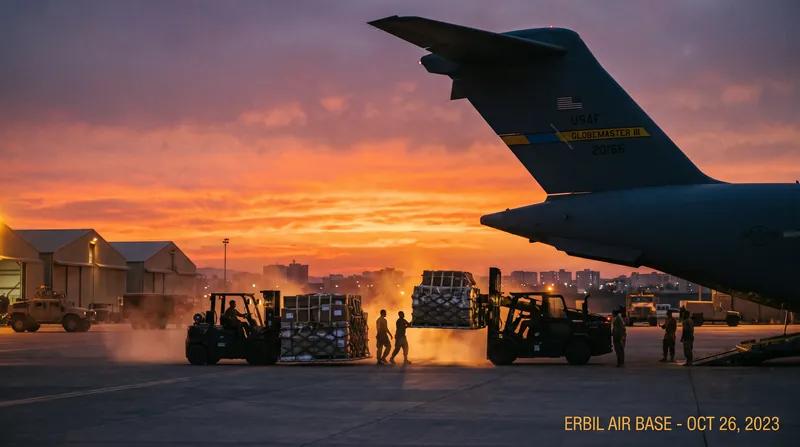
The Pentagon confirmed on September 30 that the last transport flights cleared Iraqi airspace, meeting a deadline set earlier this year by Washington and Baghdad. The departure closes a defining chapter of American military intervention, ending a deployment that cost billions of dollars and shaped regional geopolitics.[2][6]
U.S. Central Command declared the anti-ISIS mission officially complete, transferring remaining base facilities, including the sprawling Al Asad Airbase, to the Iraqi military. The handover was described as orderly, though it fundamentally alters the region's security architecture by removing the primary Western deterrent on the ground.[3]
"As of today, the United States has formally completed the withdrawal of our forces from the Republic of Iraq," a Pentagon spokesperson announced in Washington. "Operation Inherent Resolve has achieved its primary objective of degrading ISIS to a point where local forces can maintain security."[2]
Shifting the security burden
The immediate aftermath in Baghdad was marked by official ceremonies and street celebrations. Iraqi Prime Minister Mohammed Shia al-Sudani praised the transition, framing the American departure as a restoration of full national sovereignty and a testament to the maturity of the country's armed forces.[4]
For the Iraqi government, the departure removes a massive domestic political vulnerability. Baghdad has faced intense pressure from Iran-aligned political factions and armed militias to expel American forces, particularly following regional escalations and retaliatory strikes over the past three years.[4][5]
"This is a historic day for Iraq, as we take complete control of our territory and our destiny," an Iraqi government spokesperson told reporters in Baghdad. "Our security forces are now fully capable of defending the nation without foreign combat assistance."[4]
Across the capital, Iran-backed militia groups celebrated the withdrawal as a strategic victory. These factions, which have frequently targeted U.S. installations with drone and rocket attacks, view the exit as the culmination of their long-running pressure campaign against Western military presence.[4][5]
The lingering threat of resurgence
Despite the official declarations of victory, security analysts and regional experts are sounding alarms about a potential security vacuum. The Islamic State, while territorially defeated in 2019, maintains sleeper cells across the Syrian-Iraqi border and continues to launch sporadic asymmetric attacks.[5][6]
The U.S. military footprint had served as a critical intelligence and logistical hub for monitoring these extremist networks. Without American surveillance drones, signals intelligence, and rapid-reaction forces stationed in-country, tracking insurgent movements becomes significantly harder for local authorities.[5]
"The withdrawal removes the most effective counter-terrorism backstop in the region," a security analyst warned, according to The Media Line. "ISIS has been waiting for this exact scenario to begin reconstituting its networks in the ungoverned spaces of the desert."[5]
The pullout also raises immediate questions about the viability of the ongoing U.S. mission in neighboring Syria. Roughly 900 American troops remain stationed in eastern Syria, relying heavily on Iraqi airspace and supply lines that are now controlled entirely by Baghdad.[6]
Regional realignments and logistics
The departure from Iraq forces a broader recalibration of Washington's strategy in the Middle East. With the Iraqi anchor gone, the United States will increasingly rely on its bases in the Gulf states and Jordan to project power and deter Iranian influence across the region.[1][6]
For Tehran, the American exit represents a generational strategic goal achieved. Iran now faces fewer obstacles in consolidating its land bridge, which stretches from its western border through Iraq and Syria to Lebanon, allowing for the unimpeded movement of weapons and personnel.[5]
The withdrawal also impacts the broader coalition of allied nations that participated in Operation Inherent Resolve. European partners, including France and the United Kingdom, have historically tethered their own smaller deployments to the American logistical framework, forcing them to draw down their forces in tandem.[2]
"The U.S. departure effectively signals the end of the international coalition's physical presence on the ground," a European defense official told The Guardian. "Without American medevac and air support, maintaining independent European outposts in Iraq became operationally unfeasible."[2]
The diplomatic pivot
The logistical feat of the withdrawal involved moving thousands of tons of equipment, dismantling sensitive communications arrays, and transferring non-lethal assets to the Iraqi military. Convoys of armored vehicles and transport planes operated around the clock over the final two weeks to meet the September 30 mandate.[3]
The shift places a massive burden on the Iraqi Security Forces, which have received billions of dollars in American training and equipment over the past decade. Their ability to operate independently will be tested immediately by both ISIS remnants and autonomous militias operating outside state control.[3]
"The true test of Operation Inherent Resolve's legacy is not the withdrawal itself, but what happens in the next six months," a former U.S. Central Command official noted to Military.com. "We have handed over the keys; now we see if the house holds up."[3]
Moving forward, the focus shifts entirely to the diplomatic arena. The U.S. State Department is now tasked with maintaining influence in Baghdad through economic partnerships and civilian programs. It is a challenging pivot in a country where military might has long dictated political leverage.[1][6]
Sources
- [1]CBS News — U.S. military declares end of anti-ISIS Operation Inherent Resolve in Iraq Read on CBS News →
- [2]The Guardian — Pentagon says it has formally completed withdrawal of US troops from Iraq Read on The Guardian →
- [3]Military.com — US Central Command Removes Forces From Iraq, Ending Operation Inherent Resolve Mission Read on Military.com →
- [4]Middle East Eye — Iraq celebrates as last US troops withdraw from country Read on Middle East Eye →
- [5]The Media Line — US Completes Iraq Withdrawal as Iran Allies Celebrate, Experts Warn of ISIS Resurgence Read on The Media Line →
- [6]Los Angeles Times — U.S. troops leave Iraq, but future of Read on Los Angeles Times →
Key numbers
From: US Sets September 30 Deadline for Full Military Withdrawal from Iraq
Charts, maps and images
Timeline
October 2026
United States Completes Troop Pullout From Iraq, Concluding Operation Inherent Resolve
August 2026
US Sets September 30 Deadline for Full Military Withdrawal from Iraq