
full timeline
McCormick–Unilever food merger
The UK's Competition and Markets Authority has given Unilever and McCormick until November 18 to address competition concerns regarding their $45 billion food merger.
Follow McCormick–Unilever food merger in the Factlen app and get an alert when there is news. Get the app
Share this story
Latest report
UK Antitrust Regulator Warns Unilever Over $45 Billion McCormick Food Merger
The UK's Competition and Markets Authority has given Unilever and McCormick until November 18 to address competition concerns regarding their $45 billion food merger. The regulator warned that combining the two largest suppliers of dry ingredient mixes and sauces could substantially reduce competition for British retailers.
- The UK antitrust regulator warned that McCormick's $45 billion acquisition of Unilever's food business could substantially lessen grocery competition.
- The CMA's concerns center on the supply of dry ingredient mixes and sauces, where the merged entity would dominate the British market.
- The watchdog cleared the companies' overlapping mustard brands, ruling that American, English, and French styles do not directly compete.
- Unilever and McCormick have until November 18 to propose structural remedies, or they will face an in-depth Phase 2 investigation.
The UK Competition and Markets Authority has issued a formal warning regarding McCormick & Company's proposed $45 billion acquisition of Unilever's global food business. The regulator identified a realistic prospect of a substantial lessening of competition in the British grocery sector, specifically concerning dry ingredient mixes and sauces.[1][3]
The companies have been given a strict deadline of November 18, 2026, to propose acceptable remedies to the antitrust watchdog. If they fail to offer adequate concessions, the CMA will escalate the review to an in-depth Phase 2 investigation, which could lead to forced asset sales or a blocked deal.[2][4]
The transaction, structured as a Reverse Morris Trust, aims to create a combined condiments and flavorings giant valued at approximately $65 billion. It represents the second-largest transaction in the history of the packaged food sector, uniting McCormick's international spice portfolio with Unilever's established grocery brands.[1][5]
Market Overlap in Dry Sauces
The CMA's Phase 1 assessment, launched in September 2026, focused heavily on the supply of dry meal preparations and pour-over sauces to British supermarkets. McCormick currently dominates parts of this market through its Schwartz brand, a staple in UK retail for herbs, spices, and recipe mixes.[3][4]
Unilever competes directly in the same supermarket aisles with its Knorr and Colman's brands, which supply similar dry sauce packets and meal kits. The regulator concluded that merging these operations would combine the two largest branded suppliers in the United Kingdom.[1][4]
This combination would create an entity that would dwarf its remaining competitors in the dry grocery categories. The CMA noted in its decision that the merged business would be the largest supplier of dry ingredient mixes and dry sauces by a significant margin.[3][4]
During its review, the CMA evaluated whether alternative brands could provide enough competitive pressure to keep prices fair for consumers. The authority examined rival products, including Nestlé's Maggi dry ingredient mixes and Premier Foods' Bisto sauces, to gauge their market influence.[1][4]
However, the regulator determined that these alternatives, along with supermarket private-label brands, exert only a limited competitive constraint on McCormick and Unilever. Retailers would be left with few viable alternatives for stocking their dry sauce aisles if the two market leaders combined pricing power.[1][3]
The lack of significant market growth also means that new competitors are unlikely to enter the space or expand quickly enough to challenge the merged business. This concentration of market power forms the core of the CMA's objection to the current structure of the deal.[4]
The Mustard Exception
While dry mixes raised red flags, the CMA explicitly cleared the companies' overlapping mustard portfolios of any competition concerns. McCormick supplies American-style mustard to the UK market under its French's brand, while Unilever provides English-style mustard through Colman's and French-style mustard under Maille.[1][3]
The regulator found that British consumers do not view these different regional styles as interchangeable substitutes for one another. Because shoppers buy them for different culinary uses, supermarkets must stock all three varieties regardless of who manufactures them.[3][4]
"The CMA found no realistic prospect of competition concerns in relation to mustard," the regulator stated in its Wednesday release. The authority noted no evidence that the merged firm could leverage a dominant position in one mustard category to undermine competitors in another.[1]
Financial Stakes and Deal Structure
The proposed merger, first announced in March 2026, involves McCormick acquiring the majority of Unilever's food division for an estimated $44.8 billion. Under the terms of the agreement, Unilever and its shareholders will receive a $15.7 billion cash payment.[1][5]
Unilever shareholders will also retain a combined 65 percent ownership stake in the newly enlarged company, with Unilever directly holding a 9.9 percent stake. McCormick shareholders will hold the remaining 35 percent of the combined entity, which will maintain the McCormick name and executive leadership.[1]
The companies project that the combined operation will generate $20 billion in annual revenue by the 2025 fiscal year. Management also expects the integrated supply chains and distribution networks to generate approximately $600 million in annual cost savings.[1]
Global Regulatory Progress
Despite the regulatory setback in the United Kingdom, the megamerger has already cleared significant antitrust hurdles in other major markets. On October 5, 2026, the transaction received approval in the United States under the Hart-Scott-Rodino Act, passing the Federal Trade Commission's review.[1]
The deal is designed to expand McCormick's footprint in high-growth regions like Latin America and Asia, where Unilever maintains an extensive presence. Conversely, it will boost Unilever's brand penetration in North American dining rooms, where McCormick holds a stronger profile.[1]
Both companies expressed confidence that the transaction remains on track for its targeted completion date in mid-2027. In a statement following the CMA's announcement, Unilever described the regulatory intervention as an expected step in the process and committed to working constructively on a suitable remedy.[1]
McCormick echoed that sentiment, emphasizing the broader global momentum of the transaction. "We continue to make good progress on regulatory approvals globally, reinforcing our confidence in a timely closing," the Maryland-based spice manufacturer said in a separate statement.[1]
Next Steps and Potential Remedies
Unilever and McCormick now have a brief window to negotiate a solution that satisfies the CMA's concerns without derailing the broader merger. Acceptable remedies typically involve divesting specific brands or manufacturing facilities to a government-approved third-party buyer.[2][3]
Unilever had already anticipated potential regulatory friction in the British market. The company announced in August 2026 that it was exploring a sale of its Colman's brand, which makes mint sauce and recipe mixes alongside its famous mustard, to get ahead of potential antitrust objections.[1]
If the November 18 deadline passes without an agreed undertaking, the Phase 2 investigation will trigger a much deeper, months-long examination. This secondary phase involves rigorous scrutiny of internal business documents, pricing strategies, and evidence gathered directly from customers and competitors.[2][3]
An in-depth review can ultimately result in a deal being cleared unconditionally, cleared subject to mandatory asset sales, or blocked entirely in the UK market. The global food industry is now watching closely to see how much of their British portfolio the companies are willing to sacrifice.[3][4]
The scrutiny of dry ingredient mixes highlights the lucrative nature of convenience cooking products in modern supermarkets. Packets for chili con carne, parsley sauce, and other quick-meal preparations represent a high-margin category where brand loyalty remains unusually strong among British shoppers.[4]
Food sector analysts note that this merger is part of a broader wave of consolidation across the packaged goods industry. As companies contend with fluctuating inflation and shifting consumer tastes, massive scale has become the preferred strategy for protecting profit margins and negotiating power with retailers.[1]
The CMA's aggressive posture reflects a growing willingness among European regulators to challenge megamergers that threaten to consolidate pricing power. By drawing a hard line on seemingly niche categories like dry sauces, the watchdog is signaling that no market segment is too small to warrant protection.[3]
With the clock ticking toward the mid-November deadline, the pressure is on McCormick's executive team to structure a divestment package. Finding a suitable buyer for the overlapping UK assets who can maintain the brands' competitive vigor will be essential to satisfying the CMA's strict criteria.[2]
Sources
- [1]Food Dive — McCormick and Unilever's $45B food merger hits antitrust snag in UK Read on Food Dive →
- [2]The Grocer — CMA refers Unilever-McCormick for in-depth investigation Read on The Grocer →
- [3]New Food Magazine — CMA flags competition concerns over McCormick-Unilever foods deal Read on New Food Magazine →
- [4]FoodBev Media — CMA raises competition concerns over McCormick's Unilever Foods acquisition Read on FoodBev Media →
- [5]City A.M. — CMA dials up probe into Unilever's $65bn McCormick tie-up Read on City A.M. →
What to watch
- Unilever and McCormick have until November 18 to propose structural remedies to the UK's Competition and Markets Authority.
- The companies face an in-depth Phase 2 investigation if they do not address the regulator's competition concerns by the deadline.
Timeline
November 2026
UK Antitrust Regulator Warns Unilever Over $45 Billion McCormick Food Merger
August 2026
McCormick and Unilever Combine Food Businesses in $45 Billion Deal to Create Global Condiments Giant
AI
How the story developed
The transaction began on August 21, when McCormick and Unilever agreed to combine their food businesses. The cash-and-stock transaction was valued at $44.8 billion.
Under the terms of the agreement, McCormick is acquiring the majority of Unilever's food division. Unilever will receive $15.7 billion in cash, along with a 55.1 percent equity stake in the combined company for its shareholders.
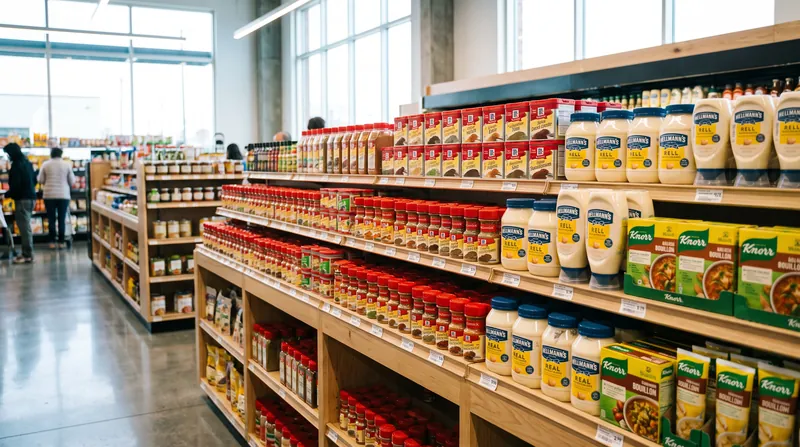
The merger brings together several prominent brands under one global umbrella. The combined portfolio includes Unilever's Hellmann's and Knorr, alongside McCormick's French's and Cholula.
Following the integration, the new entity is set to reorganize into four global divisions. The combined business is projected to generate an estimated $20 billion in annual revenue, and McCormick expects the merger to yield $600 million in annual cost savings by the third year of integration.