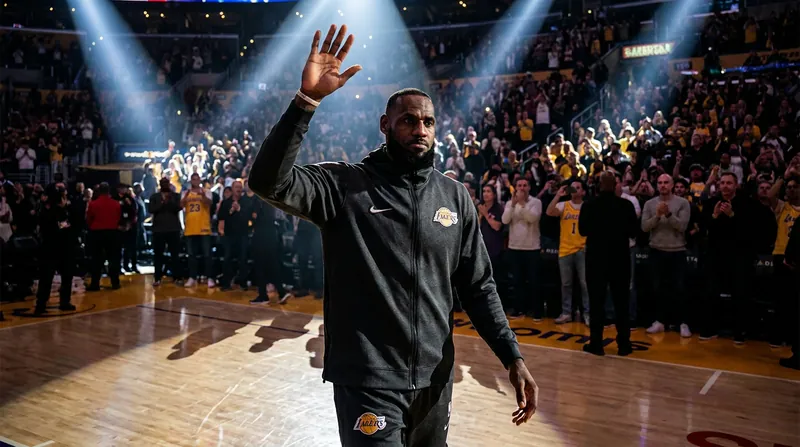
full timeline
LeBron James free agency
LeBron James's unprecedented 92% pay cut to join the Philadelphia 76ers exposes a massive loophole in the NBA's strict new salary cap rules.
Follow LeBron James free agency in the Factlen app and get an alert when there is news. Get the app
Share this story
Latest report
LeBron's Minimum Deal: Is the NBA's Salary Cap Now Just a Suggestion for Superstars?
LeBron James's unprecedented 92% pay cut to join the Philadelphia 76ers exposes a massive loophole in the NBA's strict new salary cap rules.
- LeBron James signed a two-year, $8 million veteran minimum contract with the Philadelphia 76ers.
- The deal represents a 92 percent pay cut from his previous $52.6 million salary with the Lakers.
- The veteran minimum exception allows the capped-out 76ers to add James without triggering severe luxury tax penalties.
- James's billionaire status and estimated $100 million in annual off-court earnings make the financial sacrifice viable.
- The move exposes a loophole in the NBA's new collective bargaining agreement, which assumed players would always maximize their basketball salaries.
The consensus around the NBA's new collective bargaining agreement was that it finally killed the superteam. Pundits and front offices alike believed the draconian "second apron" penalties—which freeze a high-spending team's ability to trade draft picks or sign free agents—would force talent to distribute evenly across the league. They were wrong.
The fatal flaw in that logic is the assumption that every superstar relies on their NBA paycheck. For a billionaire athlete with a sprawling off-court empire, the salary cap is not a hard ceiling. It is merely a suggestion.
On July 24, 2026, LeBron James proved exactly how fragile the NBA's parity rules truly are. Walking away from a $52.6 million player option with the Los Angeles Lakers, the 41-year-old superstar signed a two-year, $8 million veteran minimum contract with the Philadelphia 76ers.[1]
The numbers are staggering. James will earn just $3.88 million in the 2026-27 season, representing an unprecedented 92 percent pay cut from his previous salary. It is the largest voluntary financial sacrifice in the history of professional basketball, dropping his cap hit to a mere 2.35 percent of the league's total limit.[1]
By taking the absolute minimum allowed by his years of service, James bypassed every restriction designed to stop the 76ers from adding another star. Philadelphia was already capped out, having committed massive money to Joel Embiid, Tyrese Maxey, and newly acquired Jaylen Brown.[1]
Under the new CBA, a team in Philadelphia's financial bracket cannot offer mid-level exceptions or aggregate salaries in trades. But there is one loophole the league cannot close: any team, no matter how deep into the luxury tax, is legally permitted to sign a player to a veteran minimum contract.
The strongest counter-argument to the panic sweeping rival front offices is that this is a one-off anomaly. Skeptics rightly point out that no other active player possesses James's unique financial armor.
James's on-court career earnings sit near $590 million, but his off-court portfolio—anchored by a lifetime Nike deal, media production companies, and vast equity investments—generates an estimated $80 to $100 million annually. For a player whose net worth crossed the $1 billion threshold years ago, surrendering $48 million in basketball salary does not alter his lifestyle; it merely buys him a better roster.
In May, league insiders confidently reported that a hometown discount was "not in the cards at all," assuming James would squeeze out every last dollar before retiring. That conventional wisdom fundamentally misunderstood his endgame.[2]
This is not the first time James has weaponized his own market value to engineer a contender. In 2010, he took a roughly 12 percent discount to make the Miami Heat's superteam mathematically possible. The Philadelphia maneuver is simply the 2010 playbook executed at an extreme, late-career scale.
The immediate fallout for the 76ers is a minor logistical hurdle. Because James signed a two-year deal with a player option for 2027-28, Philadelphia does not receive the standard cap relief associated with one-year minimums. They currently sit roughly $572,000 above the first apron and will need to waive a non-guaranteed contract to balance the books.[1]
But that is a rounding error compared to the competitive advantage they just acquired. By slotting a player who averaged 20.9 points, 7.2 assists, and 6.1 rebounds last season into a $3.88 million roster spot, the 76ers have broken the math of team-building.[1]
The broader question for the NBA is whether this establishes a dangerous precedent. While James is currently the only active billionaire player, the next generation of superstars are entering a league flush with massive annual television revenue.
As player salaries and endorsement deals continue to explode, the threshold for "having enough money" will be reached earlier in careers. If future superstars realize that taking a veteran minimum in their late 30s is the ultimate cheat code to bypass the second apron and chase championships, the league's parity measures will unravel.
The NBA designed its financial rules to punish owners who spend recklessly, assuming the players' union would always fight for maximum contracts. They never accounted for a scenario where the player simply decides the money no longer matters.
For now, the league must watch as one of its greatest players joins a stacked Eastern Conference juggernaut for the price of a deep-bench role player. The salary cap was built to contain teams, but it cannot contain a player who is bigger than the system itself.
Sources
- [1]BasketNews — LeBron takes massive pay cut to join 76ers Read on BasketNews →
- [2]Lakers Daily — Report: LeBron taking veteran minimum isn't in cards 'at all' Read on Lakers Daily →
Key numbers
From: LeBron James Informs Lakers He Will Leave, Shakes Up NBA Free Agency
Charts, maps and images
Timeline
August 2026
LeBron's Minimum Deal: Is the NBA's Salary Cap Now Just a Suggestion for Superstars?
July 2026
LeBron James Informs Lakers He Will Leave, Shakes Up NBA Free Agency