full timeline
Large Hadron Collider particle physics research
CERN researchers have successfully measured a particle decay that occurs just once in every 10 billion events, confirming established theoretical predictions and narrowing the search space for…
Follow Large Hadron Collider particle physics research in the Factlen app and get an alert when there is news. Get the app
Share this story
Latest
On November 9, by 12:25 UTC, CERN researchers successfully measured a rare B-meson decay that occurs just once in every 10 billion events. The observed decay rate closely matches Standard Model predictions, ruling out several exotic theories of new physics. Researchers utilized advanced machine learning to identify invisible neutrinos by tracking missing energy in the collision debris.
On November 4, by 01:28 UTC, physicists at CERN found the first evidence of a beauty particle decaying into two muons. The result achieved a statistical significance of 3.2 sigma, providing strong evidence but falling short of a definitive five-sigma discovery. The decay allows scientists to probe the Zeptoverse, a microscopic realm where undiscovered particles linked to dark matter might hide.
How the story developed
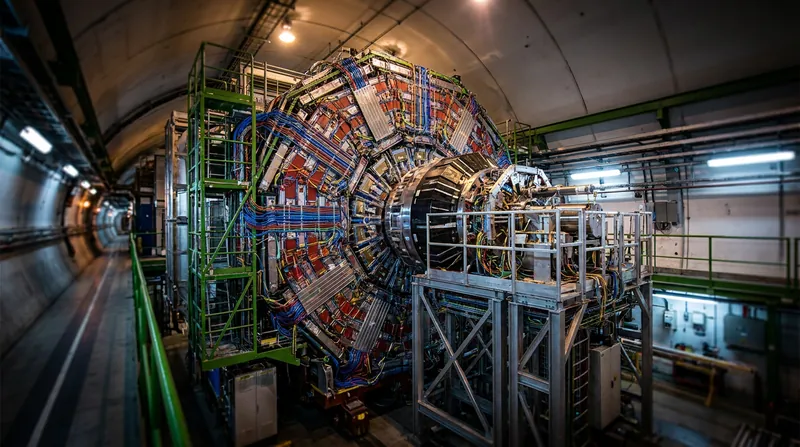
The search for extremely rare particle decays has been ongoing for 42 years. A major 2024 upgrade to the LHCb detector at the Large Hadron Collider made new observations possible.
On July 4, CERN's LHCb experiment observed B-mesons decaying in a way that violated the Standard Model of physics. Particles were found to decay into electrons 15 percent more often than muons, breaking the rule of lepton flavor universality.
The July anomaly crossed the five-sigma threshold, marking it as an official scientific discovery rather than a statistical fluke. The findings pointed to the existence of undiscovered particles, such as leptoquarks or Z-prime bosons.
The subsequent measurements set strict new constraints for future theoretical models and collider designs.
What to watch
- Other detectors at CERN and Japan's Belle II experiment are racing to independently verify the July data.
Charts, maps and images
Timeline
November 2026
LHCb Experiment Detects Ultra-Rare B-Meson Decay, Constraining New Physics Models
AIPhysicists Find First Evidence of Extremely Rare Particle Decay in 42-Year Search
July 2026
LHC Data Reveals Particle Behavior That Signals Physics Beyond the Standard Model