
full timeline
Ivonescimab lung cancer drug evaluation
The US Food and Drug Administration has declined to approve the bispecific antibody ivonescimab for first-line lung cancer treatment.
Follow Ivonescimab lung cancer drug evaluation in the Factlen app and get an alert when there is news. Get the app
Share this story
Latest report
FDA Rejects Summit Therapeutics' Lung Cancer Drug Ivonescimab Over Survival Data
The US Food and Drug Administration has declined to approve the bispecific antibody ivonescimab for first-line lung cancer treatment. The decision delays the US arrival of a highly anticipated drug class after the underlying clinical trial missed a key overall survival goal.
- The FDA rejected the biologics license application for ivonescimab in a specific first-line lung cancer setting.
- The underlying clinical trial missed a key overall survival goal, prompting the regulatory block.
- The decision derails the immediate US arrival of the highly anticipated PD-1xVEGF bispecific antibody class.
- Current FDA-approved immunotherapies remain highly effective and available for lung cancer patients.
Lung cancer treatment relies heavily on continuous innovation, and a new class of dual-targeting drugs recently promised a 34 percent improvement in progression-free survival overseas. For the hundreds of thousands of patients monitoring the pipeline, that timeline halted today. The regulatory hurdle proved too high for the initial data package.[2]
The US Food and Drug Administration rejected the biologics license application for ivonescimab. The medication, developed jointly by US-based Summit Therapeutics and China-based Akeso, targeted a narrow first-line setting for non-small cell lung cancer. The agency formalized the rejection through a complete response letter.[1][2][6]
According to Endpoints News, this regulatory block effectively derails the immediate US arrival of the highly anticipated PD-1xVEGF drug class. The decision forces developers to reevaluate their clinical trial strategies. It also leaves current standard-of-care regimens unchallenged in the immediate term.[2]
The rejection centers on specific clinical trial endpoints. Reuters reports that the FDA declined to approve the medication after the underlying study missed a key survival goal. In oncology, the distinction between delaying tumor growth and extending total lifespan dictates regulatory success.[4]
Initial reports and corporate press releases from Summit Therapeutics did not include direct quotations from FDA officials or company executives regarding the specific clinical deficiencies. The company acknowledged the update regarding its application without detailing the exact statistical shortfalls.[6]
Dual-Targeting Biological Mechanism
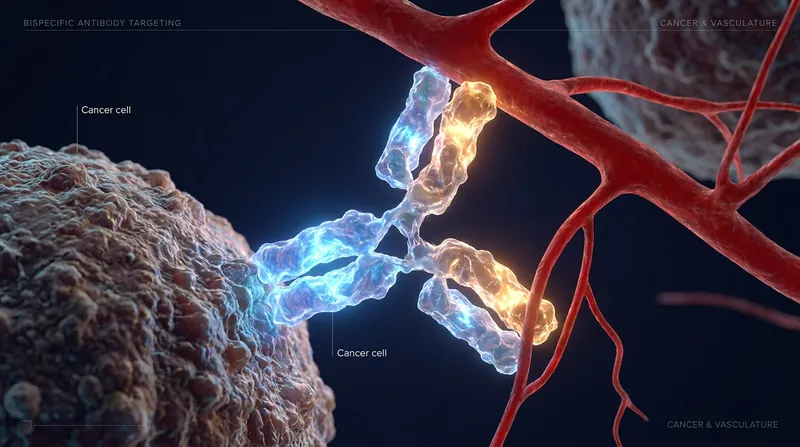
To understand the 2026 setback, patients must look at how ivonescimab operates at the cellular level. The drug is a bispecific antibody, meaning researchers engineered it to bind to two distinct cellular targets simultaneously. Traditional monoclonal antibodies typically block only one pathway.[1][3]
The first target is PD-1, a checkpoint protein found on immune cells. Tumors frequently exploit the PD-1 pathway to hide from the body's natural defenses. Blocking this checkpoint strips away the tumor's disguise, allowing T-cells to recognize and attack the malignant tissue.[3]
The second target is VEGF, a protein that stimulates the formation of new blood vessels. Tumors require a robust, continuous blood supply to grow and spread throughout the body. Inhibiting VEGF starves the cancer of the oxygen and nutrients it needs to expand.[3]
By combining these two blockades into a single molecule, researchers hoped to starve the tumor while simultaneously triggering an immune response. Early overseas data suggested this dual approach outperformed single-target therapies. The biological rationale remains sound, even as the regulatory execution falters.[1][2]
BioSpace notes that the rejection specifically impacts the drug's application in lung cancer. Non-small cell lung cancer accounts for roughly 85 percent of all lung cancer diagnoses globally. This massive patient population makes the disease a primary focus for pharmaceutical development and regulatory scrutiny.[3]
Survival Goals and Trial Demographics
The core of the FDA's decision rests on the critical distinction between different types of survival data. In phase 3 oncology trials, researchers typically measure both progression-free survival and overall survival. These two metrics tell different stories about a drug's efficacy.[4]
Progression-free survival tracks how many months a patient lives without their disease worsening on scans. Ivonescimab previously demonstrated strong results in this category during its HARMONi-2 trial in China. However, delaying tumor growth does not always translate to a longer life.[2][5]
Overall survival measures the total duration patients remain alive after starting the treatment. Reuters indicates that the ivonescimab trial missed this specific, rigorous survival goal. Regulatory agencies view overall survival as the definitive gold standard for approving new cancer therapies.[4]
A drug that shrinks a tumor but fails to extend a patient's total lifespan struggles to secure authorization in the United States. The FDA prioritizes treatments that offer a proven, measurable extension of life over those that only offer temporary stabilization.[4]
Furthermore, the geographic origin of the clinical data plays a significant role in FDA evaluations. NDTV Profit highlights that ivonescimab is a China-originated drug, relying heavily on overseas clinical trial populations. This reliance introduces demographic variables that complicate US regulatory reviews.[5]
The FDA maintains strict standards regarding the demographic diversity of clinical trials. The agency requires that study populations reflect the genetic and ethnic makeup of the US patients who will ultimately receive the medication. Data generated exclusively in one country rarely meets this standard.[2][5]
Industry Ripples and Next Steps
Summit Therapeutics now faces a complex regulatory pathway to salvage the drug's US prospects. The company must address the specific deficiencies outlined in the FDA's complete response letter. This process often takes months of negotiation and data reanalysis.[1][6]
Fierce Pharma reports that this rejection derails the broader US arrival of the PD-1xVEGF class. Several other pharmaceutical companies are currently developing similar bispecific antibodies. This FDA decision sets a strict regulatory precedent that competing drugmakers must now navigate.[1]
To secure future approval, Summit and Akeso will likely need to generate additional clinical data. This typically involves launching new, multi-regional phase 3 trials that include significant cohorts of US-based patients. These trials must be designed from the ground up to capture overall survival.[2][6]
These required studies must demonstrate a clear survival benefit against the current standard of care. In the first-line lung cancer setting, that standard is usually pembrolizumab. Beating a deeply entrenched and highly successful immunotherapy requires overwhelming statistical evidence.[2]
Running a new global oncology trial requires immense financial resources and years of patient follow-up. Industry analysts expect that any potential US launch for ivonescimab is now delayed until at least the late 2020s. The timeline for innovation is inherently slow.[1][2]
Despite the regulatory setback, the underlying science of bispecific antibodies remains a focal point for researchers. The dual-targeting approach still holds theoretical promise. The challenge lies entirely in executing clinical trials that meet the FDA's stringent, uncompromising survival metrics.[1][3]
Practical Guidance for Patients
For individuals navigating a recent lung cancer diagnosis, this regulatory news requires no immediate change in strategy. The US market already features multiple highly effective, FDA-approved immunotherapy options. Oncologists emphasize that delayed novel options do not diminish the power of current standard-of-care regimens.[2]
Patients currently enrolled in ongoing US-based clinical trials for ivonescimab should consult their trial coordinators. The FDA's rejection of a specific commercial application does not automatically halt all investigational research involving the drug. Clinical trials operate under separate regulatory oversight.[6]
The decision underscores the rigorous safety and efficacy standards protecting American patients. While the desire for rapid innovation is strong, the agency's insistence on proven overall survival ensures that new treatments offer genuine benefits. The regulatory bar remains intentionally high.[4]
Medical teams will continue to rely on established biomarker testing to guide treatment decisions. By analyzing a tumor's specific genetic mutations and PD-L1 expression levels, oncologists can match patients with the most effective available therapies. Precision medicine remains the standard approach.[3]
The rejection of ivonescimab represents a delay in one specific therapeutic avenue, not a failure of the broader immunotherapy revolution. The pipeline for lung cancer treatments remains robust. Dozens of novel compounds are currently advancing through rigorous clinical testing across the globe.[1]
Patients should focus on the therapies available today while researchers refine the treatments of tomorrow. The FDA's decision ensures that when the next generation of lung cancer drugs finally reaches the market, the survival benefits will be proven, measurable, and applicable to the US population.[4][5]
Sources
- [1]Fierce Pharma — FDA rejects Summit's ivonescimab, derailing US arrival of much-hyped PD-1xVEGF class Read on Fierce Pharma →
- [2]Endpoints News — FDA rejects Summit, Akeso's ivonescimab in narrow lung cancer setting Read on Endpoints News →
- [3]BioSpace — Summit's PD-1xVEGF rejected by FDA in lung cancer Read on BioSpace →
- [4]Reuters — US FDA declines to approve Summit lung cancer drug after trial misses key survival goal Read on Reuters →
- [5]NDTV Profit — US FDA Rejects Summit's China-Originated Lung Cancer Drug Read on NDTV Profit →
- [6]Summit Therapeutics — Summit Therapeutics Provides Update Regarding Ivonescimab Biologics License Application Read on Summit Therapeutics →
Charts, maps and images
Timeline
November 2026
FDA Rejects Summit Therapeutics' Lung Cancer Drug Ivonescimab Over Survival Data
July 2026
Landmark Trial: Bispecific Antibody Ivonescimab Achieves 34% Survival Advantage Over Standard Immunotherapy in Lung Cancer
AI
How the story developed
The evaluation of ivonescimab, a first-in-class bispecific antibody, reached a major milestone on July 5. The Phase 3 HARMONi-6 trial evaluated the drug in patients with advanced squamous non-small cell lung cancer.
Results from the trial showed that ivonescimab, when combined with chemotherapy, reduced the risk of death by 34 percent compared to the standard treatment of tislelizumab plus chemotherapy. This marked the first time a new regimen definitively beat a standard PD-1 inhibitor in this difficult-to-treat population.
The drug achieved a median overall survival of 27.89 months. According to the trial data, nearly 65 percent of patients survived past the two-year mark, and the drug demonstrated significant survival benefits regardless of a patient's PD-L1 biomarker expression levels.
During the evaluation, ivonescimab successfully targeted tumor blood vessels. It did so without triggering the severe bleeding risks that have been historically associated with VEGF inhibitors in squamous lung cancer.