
Why Slab Avalanches Only Form Between 30 and 45 Degrees of Steepness
Gravitational shear stress overcomes snowpack friction only above 30 degrees, while continuous sloughing above 45 prevents cohesive slabs from forming.
By Baran Demir

Share this story
In short
- Dry slab avalanches require a specific geometric window between 30 and 45 degrees to overcome friction without shedding mass prematurely.
- Below 30 degrees, the gravitational pull on the snowpack is too weak to overcome the mechanical friction of a collapsed weak layer.
- Above 45 degrees, snow continuously sloughs off the mountain during storms, preventing the accumulation of thick, interconnected slabs.
In 2009, avalanche researcher Ian McCammon analyzed thousands of backcountry slides and identified a striking geometric bullseye: 38 degrees. To the human eye, the difference between a 25-degree meadow and a 38-degree bowl is subtle. Yet to a winter snowpack, that slight tilt is the difference between static rest and catastrophic failure.
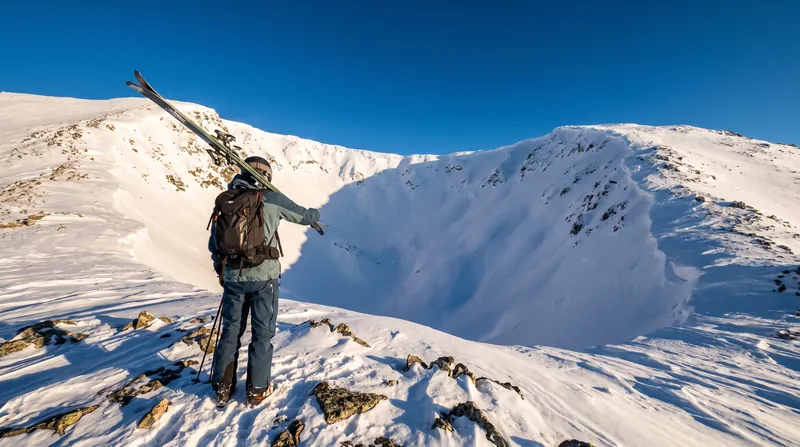
The mechanics of a slab avalanche rely entirely on a narrow window of steepness, generally falling between 30 and 45 degrees. Outside this specific range, the physics of snow simply refuse to cooperate with the formation of large, cohesive slabs. Understanding why requires looking at the invisible battle between gravitational shear stress and friction.
"The 'sweet spot' seems to be 38 or 39 degrees, and guess what? That's the same slope angles we all love to ski," notes Taos Avalanche Center director Andy Bond. This overlap between ideal recreational terrain and peak avalanche hazard is not a coincidence. Both rely on the exact same gravitational physics.
Below 30 degrees, gravity simply lacks the leverage to pull a cohesive slab down a mountain. When a weak layer of snow collapses beneath the surface, it creates a fracture, but the overlying slab still rests on the crushed debris. The slope is too flat to overcome the friction of the broken snow crystals.[1]
The 30-Degree Friction Floor
A 2009 study by researchers Alec van Herwijnen and Joachim Heierli measured this crack-face friction in the field. They found that frictional contact forces require a slope of at least 30 degrees to overcome. If the slope is 25 degrees, the weak layer might collapse with an audible sound, but the snowpack stays put.[1]
The collapse of this weak layer is often referred to as an anticrack. Unlike a traditional crack that pulls apart, an anticrack involves the volumetric collapse of porous snow crystals. The overlying slab drops vertically by a few millimeters, crushing the weak layer and bringing the slab into direct contact with the bed surface.[1]
If this vertical drop happens on a 20-degree meadow, the energy dissipates harmlessly into the ground. The friction between the crushed crystals and the slab above is too high for sliding to commence. The skier feels a sudden drop and hears a loud sound, but the snow remains anchored to the hillside.[1]
This means that while low-angle terrain can still experience small slush flows during extreme spring warming, dry slab avalanches are virtually non-existent. The friction angle holds the mass in place, acting as a mechanical brake. Backcountry travelers often use 30 degrees as a hard boundary for safe travel during high-danger periods.[1]
The 38-Degree Danger Zone
Once a slope tilts past 30 degrees, gravitational shear stress begins to outpace the static friction of the snowpack. Snow can still accumulate deeply on these pitches, building thick, cohesive slabs over the course of a winter season. The tension builds silently, waiting for a trigger to break the underlying bond.
When a skier or a heavy new storm overloads a buried weak layer on a 38-degree slope, the resulting fracture propagates outward. Seismic measurements show these cracks can travel at speeds up to 26 meters per second. Because the pitch exceeds the friction angle, the entire slab detaches and accelerates downhill.
The exact angle where this transition occurs can vary slightly based on the climate. In maritime snowpacks like the Pacific Northwest, warmer temperatures and wetter snow can bond to steeper surfaces, sometimes pushing the sweet spot slightly higher. In cold, dry continental snowpacks like Colorado, the 38-degree bullseye remains remarkably consistent.
Regardless of the region, the 30-to-45-degree window encompasses the vast majority of recreational avalanche incidents. This is the exact steepness of a typical black diamond ski run, offering the ideal pitch for linking turns in deep powder. The terrain that feels best to ski is mechanically identical to the terrain that kills.
The Steepness Ceiling
As terrain steepens beyond 45 degrees, a different mechanical limitation prevents the formation of massive slab avalanches. On these extreme pitches, gravity is so dominant that snow cannot accumulate deeply enough to form a cohesive, interconnected slab. The slope is simply too steep to hold a massive volume of winter precipitation.
Instead, the snow continuously sloughs off during and immediately after storms, shedding its mass in small, harmless point-release avalanches. This constant shedding acts as a natural pressure-release valve. It clears the slope before dangerous tension can build up in the snowpack, preventing the formation of a thick, unified block.
This sloughing process is highly visible on steep Alaskan spines or the jagged peaks of the Alps. As snow falls, it immediately cascades down the rock faces, forming deep piles of debris at the base of the cliffs. The steep upper faces remain relatively bare, incapable of holding a cohesive slab.
There are rare exceptions where extreme wind events can plaster snow onto a 50-degree face, creating a temporary, localized slab. However, these wind slabs are typically shallow and fail quickly, rather than building into the deep, persistent slabs found on 38-degree slopes. The gravitational shear stress simply clears the board too frequently.
While a skier might trigger a loose sluff that runs around their boots on a 50-degree couloir, they are highly unlikely to trigger a deep, propagating slab. The frequent sloughing reduces the risk of deep slab avalanches, though it introduces the separate hazard of being knocked off balance by moving surface snow.
Navigating the Geometric Trap
Because weather and snowpack conditions are constantly shifting, terrain remains the only fixed variable in avalanche safety. A buried layer of surface hoar might heal over a month, but a 39-degree bowl will always be exactly 39 degrees. This permanence makes slope angle the most reliable tool for risk management.
By measuring slope angles with an inclinometer, backcountry travelers can entirely opt out of the mechanical window where slab avalanches operate. Sticking to 28-degree trees during periods of high danger effectively neutralizes the risk. The snowpack might be entirely unstable, but gravity cannot overcome the friction floor.[1]
Avalanche forecasting centers rely heavily on this geometric reality when issuing daily bulletins. They highlight specific elevations and aspects, but the underlying assumption is always that the hazard applies to avalanche terrain. If a slope falls outside the 30-to-45-degree window, the mechanics of a slab release simply cannot function.
Avalanche forecasting centers rely heavily on this geometric reality when issuing daily bulletins.
Modern digital mapping tools now allow skiers to apply slope-angle shading to their GPS applications before ever leaving home. By highlighting all terrain between 30 and 45 degrees in bright colors, users can plan routes that avoid the danger zone entirely. This technological shift has revolutionized backcountry route planning.
To stay safe, education programs emphasize that recognizing this geometric trap is more important than digging snow pits. A traveler who cannot identify a weak layer can still survive a lifetime in the mountains by simply avoiding 38-degree slopes. The physics of friction and gravity offer a reliable, unchanging boundary.
Key terms
- Gravitational Shear Stress
- The component of gravity that pulls a mass parallel to the surface of a slope, attempting to slide it downhill.
- Crack-Face Friction
- The mechanical resistance that occurs when a collapsed weak layer of snow grinds against the bed surface beneath it.
- Anticrack
- A fracture in a porous material like snow where the volume collapses inward, causing the overlying slab to drop vertically.
- Point-Release Avalanche
- A small, fan-shaped slide of loose snow that starts from a single point and gathers mass as it moves, often called a sluff.
Reader questions
Can an avalanche happen on a completely flat surface?
While a slab cannot slide on a flat surface, a skier on flat terrain can remotely trigger an avalanche on an adjacent steep slope. The fracture propagates through the continuous weak layer across the flat ground until it reaches the incline, where gravity pulls the slab down.
Do trees prevent slab avalanches from releasing?
Trees only anchor the snowpack if they are densely packed enough to physically block the slab from moving, which requires a forest too thick to ski through. Open, gladed trees on a 38-degree slope offer no structural support and will avalanche just as easily as an open bowl.
Why do spring avalanches happen on lower angles?
During intense spring warming, liquid water lubricates the snowpack, drastically reducing the friction between layers. This allows heavy, wet loose avalanches and slush flows to slide on pitches as low as 25 degrees, bypassing the mechanical rules that govern dry winter slabs.
Where opinion splits
Snow Science Researchers
Focus on the mechanical properties of snow, crack propagation, and friction angles.
For physicists and snow scientists, an avalanche is a mathematical equation balancing shear stress against static friction. Researchers view the snowpack not as a single block of ice, but as a complex, porous matrix that behaves like both a solid and a granular fluid. By measuring the exact forces required to propagate an anticrack through a weak layer, they map the physical limits of where avalanches can exist, reducing a terrifying natural disaster to predictable geometric boundaries.
Avalanche Forecasters
Focus on communicating the 30-to-45-degree danger zone to the public and managing regional risk.
Forecasters use the mechanical limits of slope angle to issue actionable public safety warnings. Because they cannot test every snow slope in a mountain range, they rely on the 30-degree floor to draw a hard line between safe and dangerous terrain. Their daily bulletins emphasize that while the snowpack's stability changes by the hour, the underlying topography does not, making slope-angle identification the most critical skill they can teach to backcountry travelers.
Backcountry Skiers
Focus on navigating the tension between riding ideal powder pitches and managing personal safety.
For recreational travelers, the physics of avalanches present a frustrating paradox: the exact steepness required to form a slab avalanche is the exact steepness that provides the best skiing. A 38-degree pitch offers the perfect balance of speed and control in deep powder. Skiers must constantly weigh their desire to ride this mechanical sweet spot against the structural integrity of the snowpack, often opting for lower-angle, 28-degree glades when the risk of a slab release is too high.
- Snow Science Researchers
- Focus on the mechanical properties of snow, crack propagation, and friction angles.
- Avalanche Forecasters
- Focus on communicating the 30-to-45-degree danger zone to the public and managing regional risk.
- Backcountry Skiers
- Focus on navigating the tension between riding ideal powder pitches and managing personal safety.
Perspectives this story doesn't cover
- Search and Rescue Operators
Sources
Source coverage
2 outlets
3 viewpoints surfaced


- [1]Geophysical Research LettersSnow Science Researchers
Measurement of crack-face friction in collapsed weak snow layers
Read on Geophysical Research Letters → - [2]Factlen Editorial Team
Synthesis by Factlen editorial team
Read on Factlen Editorial Team →
More in Travel
See all →Glaciology
Lithostatic Ice Pressure Drives Viscoplastic Closure: Why Dry Glacier Crevasses Rarely Exceed 30 Meters
3 sources
Navigation Rules
Adding Ten Minutes per 100 Meters of Ascent: How Naismith's Rule Converts Mountain Elevation into Hiking Time
3 sources
Mountain Geography
The 1,500-Meter Threshold: How Topographic Prominence Actually Defines an Ultra-Prominent Peak
6 sources
Avalanche Safety
The Five-Level Scale and the Likelihood/Size Matrix: How the North American Public Avalanche Danger Scale Actually Quantifies Backcountry Risk
3 sources
Comments
Every angle. Every day.
Get Travel stories with full source coverage and perspective breakdowns, free every day.