
Cambial Cell Division Halts Below a 6.4°C Growing Season to Fix the Global Alpine Treeline
The abrupt disappearance of forests at high altitudes is not caused by freezing, but by a microscopic thermal limit on wood formation. Trees lose the ability to build new cells when the seasonal mean temperature drops below 6.4 degrees Celsius.
By Kabir Mehra

Share this story
In short
- The alpine treeline is dictated by a tree's inability to build new wood, not by a failure to photosynthesize or survive the winter cold.
- Cambial cell division, the process that thickens trunks, effectively halts when ambient temperatures drop below 5 degrees Celsius.
- Because trees stand upright and couple to the cold atmosphere, they require a seasonal mean of 6.4 degrees Celsius to ensure enough warm hours for tissue formation.
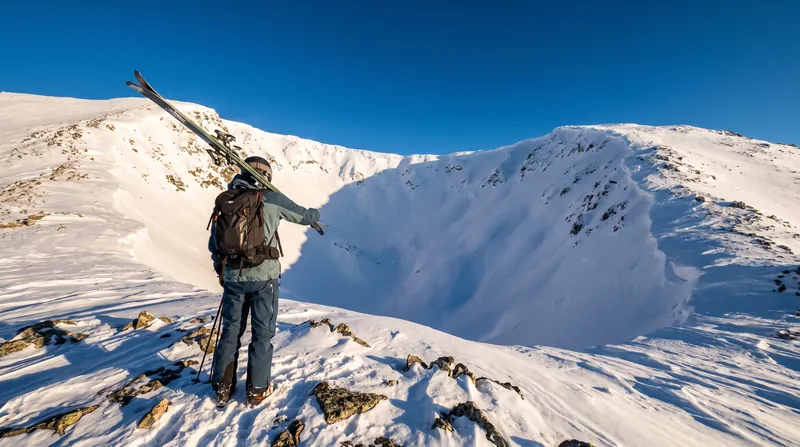
When you hike past the 3,000-meter mark in the Rockies or the 2,000-meter line in the Alps, the dense coniferous forest abruptly vanishes. The trees do not thin out gradually over miles; they stop at a hard, invisible boundary, leaving you entirely exposed to the wind among low shrubs and shattered rock.
This sudden transition dictates the practical realities of mountain travel—where you can string a hammock, find shelter from an incoming storm, or gather deadwood in the backcountry. Historically, hikers and guides assumed the high-altitude cold simply froze the trees to death or starved them of the carbon needed to survive.
However, the alpine treeline is not a boundary of survival, but a strict boundary of construction. The trees can still photosynthesize in the thin air and survive the deep freezes of winter, but their cellular machinery completely loses the ability to build new structural wood.[3]
Specifically, the process of cambial cell division—the microscopic manufacturing line that thickens trunks and extends heavy branches—halts when the growing season's mean temperature drops below 6.4 degrees Celsius. The tree can make food, but it cannot spend it.[1][3]
The Cellular Threshold for Wood Formation
To understand why the forest stops so suddenly, you have to look inside the trunk at the vascular cambium. This thin, highly active layer of dividing cells sits just beneath the bark, responsible for producing the xylem and phloem that make up the tree's structural wood and transport systems.[2]
"The timing of cambial reactivation plays an important role in determination of the amount and quality of wood and the environmental adaptivity of trees," notes a 2013 review in Physiologia Plantarum.[2]
The review highlights that cumulative elevated temperatures from late winter to early spring are strictly required to trigger this cellular division. While a pine or spruce can continue to photosynthesize and acquire carbon at temperatures near freezing, it cannot invest that carbon into new tissue.[2]
The cambial cells require a minimum ambient temperature of approximately 5 degrees Celsius just to begin dividing. Below that absolute threshold, the cell doubling time increases exponentially, effectively shutting down the biological assembly line for the season.[2][3]
The tree is left with a massive surplus of sugars it cannot use. Without the ability to build the structural biomass required to support a heavy trunk and a wide canopy, the upright tree life form becomes physically impossible to maintain.[3]
Why 6.4 Degrees Dictates the Global Map
If the cellular machinery stops at 5 degrees Celsius, the treeline itself aligns with a slightly warmer seasonal average. A comprehensive 2025 analysis published in the Proceedings of the National Academy of Sciences mapped over 2,000 records of treeline species across 38 distinct mountain regions.[1]
The researchers confirmed that the global alpine treeline perfectly tracks a growing season mean air temperature of 6.4 degrees Celsius, plus or minus 0.7 degrees. This specific thermal threshold effectively explains the uppermost elevation for upright tree growth from the subarctic to the equator.[1]
The 6.4-degree seasonal mean provides the necessary thermal buffer for survival. It guarantees that enough individual daytime hours will spike above the 5-degree cellular minimum to allow the tree to accumulate a viable, protective layer of wood before the harsh winter returns.[1][4]
"Heat limitations appear to restrict the establishment of all genera, effectively defining treeline positions," the PNAS authors concluded in their 2025 global synthesis.[1]
They found that heat conditions at these boundaries sit about 35 percent below the thermal optima for the specific tree species involved. The cold does not kill the tree; it simply prevents it from growing fast enough to remain a tree.[1]
The Architectural Penalty of Standing Tall
This temperature limit raises an obvious question for anyone looking up a mountain slope: if it is too cold for trees to grow, why are the meadows above the treeline choked with thriving alpine shrubs, grasses, and bright wildflowers?[3]
The answer lies in the severe architectural penalty of the tree life form. A tree, by definition, stands upright, pushing its canopy two meters or more into the air. This height couples the tree's foliage and branches directly to the cold, fast-moving ambient atmosphere.[3]
Low-stature alpine plants avoid this atmospheric coupling entirely. By hugging the ground, they trap solar radiation and create a microclimate within the aerodynamic boundary layer, where daytime temperatures can soar 10 to 15 degrees higher than the surrounding air.[3]
Christian Körner, the pioneering University of Basel botanist who formalized this growth limitation hypothesis in 1998, demonstrated that trees simply cannot decouple from the high-altitude atmosphere. Their height forces them to endure the exact air temperature, which remains too cold for tissue formation.[3]
How Moisture and Geography Modulate the Line
While the 6.4-degree isotherm sets the absolute ceiling for wood formation, local conditions frequently force the treeline lower down the mountain. The 2025 PNAS study revealed a dual-control mechanism where moisture gradients drive the taxonomic variation among different mountain ranges globally.[1]
In arid regions like the American Southwest or the Andes, severe drought stress can halt tree growth hundreds of meters below the thermal limit. A tree cannot build new cells without adequate hydraulic pressure, regardless of how warm the afternoon sun gets.[1]
Wind also plays a brutal mechanical role on exposed alpine ridges. Severe gales strip away the insulating boundary layer, desiccate the needles, and physically batter the apical meristems, creating the twisted, stunted krummholz forms that mark the chaotic transition zone.[3]
Human land use has artificially depressed the treeline across much of Europe and Asia. Centuries of alpine cattle grazing and logging cleared the upper forests, and the slow rate of cambial growth means these ecosystems require decades of uninterrupted warmth to reclaim their natural thermal boundary.[3]
Human land use has artificially depressed the treeline across much of Europe and Asia.
What This Means for Future Treelines
As global temperatures rise, the 6.4-degree isotherm is steadily migrating uphill, theoretically opening new high-altitude real estate for rapid forest expansion. Hikers returning to familiar trails are already noticing saplings taking root in meadows that were entirely barren twenty years ago.[1]
However, the upward march of the forest is not keeping pace with the warming climate. Trees are long-lived organisms with slow demographic cycles, and they must compete with established alpine turf that fiercely defends its soil against germinating seeds.[1]
Furthermore, the newly warmed elevations often lack the deep, developed soils required to support a massive root system. A spruce seed might find the air warm enough for cambial division, but it cannot build a heavy trunk on bare granite.[3]
For the backcountry traveler, the treeline will remain a stark, defining feature of the mountain landscape for generations. It stands as a visible, physical manifestation of a microscopic temperature limit—the exact elevation where the cellular assembly line finally powers down.[4]
How we did this
- Method
- Deriving the thermal buffer required for upright wood formation by comparing the global treeline seasonal mean temperature against the absolute cellular threshold for cambial division.
- What we found
- The 6.4°C global treeline mean is not the temperature at which cells stop dividing, but rather the seasonal average required to guarantee that enough individual daytime hours exceed the 5°C absolute cellular threshold to allow a tall, air-coupled canopy to accumulate structural wood.
- What we worked from
- Global treeline growing season mean temperature: 6.4°C — Proceedings of the National Academy of Sciences
- Minimum temperature for cambial cell division: 5°C — Physiologia Plantarum
- Limits of this analysis
- This analysis isolates the thermal limit of wood formation, but local treelines can be depressed below this theoretical maximum by moisture deficits, wind mechanoregulation, or historical land use.
Terms to know
- Vascular cambium
- A thin layer of dividing cells located just beneath the bark that produces the structural wood and inner bark of a tree.
- Cambial cell division
- The microscopic manufacturing process where cambium cells multiply to thicken a tree's trunk and extend its branches.
- Aerodynamic boundary layer
- The thin layer of still air immediately above the ground that traps solar radiation and remains significantly warmer than the ambient atmosphere.
- Apical meristem
- The growth tissue found at the very tips of a plant's shoots and roots, responsible for vertical elongation.
Questions readers ask
Why do some trees look twisted and stunted near the treeline?
This formation, known as krummholz, occurs when severe winter winds physically batter the apical meristems and desiccate the needles. The mechanical damage forces the tree to grow horizontally within the protective boundary layer of the snowpack.
Will global warming push the treeline higher up the mountains?
Yes, the thermal isotherm is migrating uphill, but the actual forest expansion lags decades behind the temperature shift. Trees must wait for adequate soil formation and overcome fierce competition from established alpine grasses before they can take root at higher elevations.
Do different tree species have different temperature limits?
While individual species have varying thermal optima for ideal growth, the absolute minimum threshold for cambial cell division is remarkably consistent across genera. The 6.4-degree seasonal mean acts as a universal ceiling for the upright tree life form.
Different angles
Cellular Biologists
Focus on the microscopic metabolic limits that prevent tissue formation in cold environments.
Researchers studying plant anatomy at the cellular level emphasize that carbon acquisition is rarely the limiting factor in high-altitude environments. They point to the vascular cambium, demonstrating that while photosynthesis can proceed near freezing, the enzymatic reactions required to divide cells and build lignin demand higher kinetic energy. For these biologists, the treeline is simply the geographic manifestation of a metabolic bottleneck, where the tree becomes a carbon sink that cannot spend its own reserves.
Alpine Ecologists
Examine how the physical architecture of the tree life form interacts with the mountain atmosphere.
Field ecologists view the treeline through the lens of microclimates and aerodynamic coupling. They argue that the crucial difference between a stunted shrub and a mature pine is where their foliage sits relative to the soil. By measuring temperatures within the boundary layer, they show that low-stature plants survive at higher elevations because they effectively live in a different, warmer climate than the upright trees standing just a few meters away.
Climate Modelers
Track the upward migration of the thermal isotherm and its delayed impact on forest expansion.
Scientists projecting future biomes focus on the lag between rising temperatures and actual forest movement. While their models show the 6.4-degree isotherm advancing rapidly up mountain slopes, they caution that demographic inertia, poor soil development, and competition from established alpine turf will delay the physical treeline shift by decades or even centuries. They view the current treeline as a relic of past climates rather than a perfect reflection of today's warming atmosphere.
- Cellular Biologists
- Focus on the microscopic metabolic limits that prevent tissue formation in cold environments.
- Alpine Ecologists
- Examine how the physical architecture of the tree life form interacts with the mountain atmosphere.
- Climate Modelers
- Track the upward migration of the thermal isotherm and its delayed impact on forest expansion.
Perspectives this story doesn't cover
- Indigenous mountain communities observing long-term ecological shifts
- High-altitude forestry managers
Sources
Source coverage
4 outlets
3 viewpoints surfaced




- [1]Proceedings of the National Academy of SciencesAlpine Ecologists
Taxonomic variability of tree species at global alpine treelines
Read on Proceedings of the National Academy of Sciences → - [2]Physiologia PlantarumCellular Biologists
Temperature regulation on the timing of cambial reactivation and xylem differentiation in trees
Read on Physiologia Plantarum → - [3]ResearchGateClimate Modelers
Worldwide positions of alpine treelines and their causes
Read on ResearchGate → - [4]Factlen Editorial TeamAlpine Ecologists
Synthesis by Factlen editorial team
Read on Factlen Editorial Team →
More in Travel
See all →Glaciology
Lithostatic Ice Pressure Drives Viscoplastic Closure: Why Dry Glacier Crevasses Rarely Exceed 30 Meters
3 sources
Navigation Rules
Adding Ten Minutes per 100 Meters of Ascent: How Naismith's Rule Converts Mountain Elevation into Hiking Time
3 sources
Mountain Geography
The 1,500-Meter Threshold: How Topographic Prominence Actually Defines an Ultra-Prominent Peak
6 sources
Avalanche Safety
The Five-Level Scale and the Likelihood/Size Matrix: How the North American Public Avalanche Danger Scale Actually Quantifies Backcountry Risk
3 sources
Comments
Every angle. Every day.
Get Travel stories with full source coverage and perspective breakdowns, free every day.