
Walmart Hits 100th Location for 400kW Ultrafast EV Charging Network
Walmart has opened its 100th company-owned EV fast-charging site, rapidly expanding a 400kW network that aims to make electric road trips and apartment-dweller ownership more feasible.
By Noor Saidi

Share this story
For a family mapping out a weekend road trip or an apartment renter weighing whether to finally buy an electric vehicle, the biggest hurdle isn't the sticker price of the car. It is the sheer logistical friction of keeping it powered.
That calculus shifted significantly this week. Walmart has quietly transformed its sprawling asphalt parking lots into a formidable piece of national infrastructure, opening its 100th company-owned and operated EV fast-charging site in Monument, Colorado.[1][7]
This milestone, reached in under two years, spans 20 states and fundamentally alters the road-trip experience. Instead of forcing drivers to detour to isolated highway rest stops with broken screens and no amenities, the network anchors high-speed charging to places where people already need to go.[1][5]
The strategy hinges on a concept known as "dwell time." When a driver plugs in at a Supercenter, they aren't just sitting in their car watching a battery percentage tick upward. They are buying groceries, using clean restrooms, or grabbing a coffee.
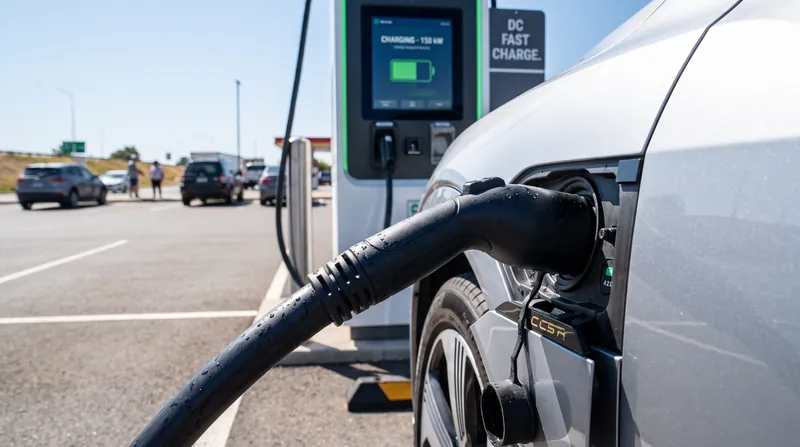
For the consumer, the most critical detail is the hardware itself. Walmart has bypassed the slower, older-generation chargers and standardized on 400-kilowatt (kW) units. These ultra-fast dispensers are supplied exclusively by Switzerland-based ABB E-mobility and Italian manufacturer Alpitronic.[2][4]
While many of today's EVs cannot yet accept a full 400 kW charge, this infrastructure is heavily future-proofed. For a compatible vehicle, this immense power delivery means adding hundreds of miles of range in just 15 to 20 minutes—the exact duration of a standard errand run.[4]
Crucially for the buyer's peace of mind, Walmart has eliminated the anxiety of plug compatibility. The new stations are equipped with both the Combined Charging System (CCS1) and the Tesla-designed North American Charging Standard (NACS).[1][4]
This dual-cable approach means that whether a driver owns a Chevrolet Blazer, a Ford F-150 Lightning, or a Tesla Model Y, they can pull up and plug in without fumbling for expensive aftermarket adapters.[1][4]
The user experience is equally streamlined, bypassing the fragmented ecosystem of third-party charging apps. Drivers initiate and pay for their sessions directly through the standard Walmart app—the same one they use to order groceries for pickup.[1][7]
Financially, the integration offers a tangible perk for regular shoppers. While base charging rates are competitive, Walmart+ members receive an automatic 10% discount, effectively lowering the per-mile cost of an EV road trip.[7]
Interestingly, while the deployment is accelerating across American suburbs, the engineering backbone is distinctly European. Alpitronic, which dominates roughly 30% of Europe's DC fast-charging market, provides dispensers that can route power to multiple vehicles simultaneously without requiring massive, separate power cabinets.[2]
This rapid deployment—612 stalls energized in the first half of 2026 alone—places Walmart second only to Tesla in new port installations. It signals a broader market shift where retail giants are becoming the primary custodians of the EV transition.[2]
However, the rollout is not without its localized hurdles. Expanding this high-power infrastructure into rural markets requires significant grid upgrades, and maintaining a high uptime across thousands of unattended outdoor screens and cables remains a formidable operational challenge.
Despite these hurdles, the trajectory is clear. Walmart aims to bring these stations to thousands of locations by 2030. Given that 90% of Americans live within 10 miles of a Walmart, this network could serve as a primary charging solution for apartment dwellers who lack home charging.[3]
Ultimately, this buildout changes the baseline requirements for EV ownership. By seamlessly blending the necessity of charging with the routine of weekly errands, the retail giant is making the electric road trip less of an expedition and more of an everyday convenience.[6]
Viewpoints in depth
Retail Charging Advocates
Proponents who argue that retail-anchored charging is the most viable path to mass EV adoption.
This camp emphasizes that the traditional gas station model doesn't translate well to electric vehicles due to longer "dwell times." By placing chargers at big-box retailers, drivers can multitask, turning a 20-minute wait into productive errand time. They argue this model is especially crucial for apartment renters who cannot charge at home, as it integrates charging into their existing weekly grocery routines without requiring dedicated trips.
European Hardware Manufacturers
Industry players who view the US retail buildout as a massive export opportunity for established European technology.
Companies like Alpitronic and ABB see the American market as ripe for rapid deployment, leveraging hardware that has already been stress-tested across Europe. They note that while the US is moving quickly to install chargers in retail parking lots, the underlying engineering—such as dispensers that handle multiple vehicles without bulky external power cabinets—relies heavily on European innovation and manufacturing scale.
Rural EV Drivers
Consumers outside major metropolitan areas who remain skeptical about the accessibility of high-speed charging.
While celebrating the expansion, this group points out that the initial 100 locations are still a drop in the bucket compared to Walmart's nearly 4,700 US stores. They emphasize that true road-trip feasibility requires dense networks along remote interstate corridors, not just in suburban retail hubs. Furthermore, they raise concerns about the local grid capacity in rural towns, questioning whether utility providers can support multiple 400kW chargers operating simultaneously.
Key points
- Walmart has opened its 100th company-owned EV fast-charging site in Monument, Colorado, expanding its proprietary network to 20 states.
- The stations feature ultra-fast 400kW hardware supplied by European manufacturers ABB and Alpitronic.
- Dispensers are equipped with both CCS1 and NACS connectors, ensuring compatibility with nearly all modern electric vehicles without adapters.
- The entire charging experience, including payment and a 10% discount for members, is managed directly through the standard Walmart app.
What we don’t know
- How quickly local utility companies can upgrade grid infrastructure to support 400kW charging at rural Walmart locations.
- Whether Walmart will eventually open its network to commercial electric delivery fleets or restrict it entirely to passenger vehicles.
- The long-term maintenance and uptime reliability of the proprietary software and hardware as the network scales to thousands of locations.
How we got here
2023
Walmart announces plans to build its own national EV fast-charging network across thousands of its retail locations by 2030.
April 2025
The retailer officially opens its first company-owned and operated EV charging station.
First Half 2026
Walmart rapidly accelerates its buildout, deploying 612 charging stalls and becoming the second-largest installer of new ports behind Tesla.
August 2026
The company activates its 100th proprietary charging site at a Supercenter in Monument, Colorado.
- Retail Integration Advocates
- Argue that placing chargers at major retail hubs is the most efficient way to solve the public charging puzzle.
- Hardware & Infrastructure Analysts
- Focus on the technical deployment, equipment origins, and the speed of the network rollout.
- Consumer EV Advocates
- Evaluate the network based on pricing, ease of use, and its impact on everyday road trips and apartment dwellers.
Perspectives this story doesn't cover
- Local Utility Providers managing the grid strain of multi-megawatt retail charging installations.
- Independent Gas Station Owners facing competitive pressure from big-box retail charging.
Sources
Source coverage
7 outlets
3 viewpoints surfaced







- [1]The EV ReportRetail Integration Advocates
Walmart has opened its 100th company-owned and operated electric vehicle fast-charging site
Read on The EV Report → - [2]The Next WebHardware & Infrastructure Analysts
Walmart has opened its 100th EV fast-charging station
Read on The Next Web → - [3]WardsAutoConsumer EV Advocates
Walmart's own EV charging network picks up the pace with 100th station
Read on WardsAuto → - [4]ElectrekHardware & Infrastructure Analysts
Walmart's 400 kW EV charging network just hit 100 stores
Read on Electrek → - [5]ElectricDrivesConsumer EV Advocates
The Walmart EV charging network reaches 100 locations
Read on ElectricDrives → - [6]Inside RetailRetail Integration Advocates
Walmart has reached a milestone in its EV charging network
Read on Inside Retail → - [7]Walmart CorporateRetail Integration Advocates
Walmart Celebrates 100th EV Fast-Charging Site
Read on Walmart Corporate →
More in Automotive & Transportation
See all →EV Charging Tech
The 30-Second Rule: How the SAE J2894 Standard Defines the Maximum Time an EV Can Sustain Peak DC Fast Charging Power
5 sources
F-150 Recall
Ford Begins Mailing Recall Letters to 223,000 F-150 Owners Over Fuel Tank Detachment Risk
4 sources
Tire Physics
The 5-to-1 Ratio: How Tire Aspect Ratio Dictates Cornering Stiffness and Ride Comfort
9 sources
Aerodynamics
The 20 Percent Fuel Economy Gain: How Slipstreaming Reduces Aerodynamic Drag for Following Vehicles
8 sources
Comments
Every angle. Every day.
Get Automotive & Transportation stories with full source coverage and perspective breakdowns, free every day.