
US Officials Sound Alarm Over Russian Satellite Maneuvers Indicating Orbital Weapon Capabilities
A Russian military satellite executed a series of highly coordinated maneuvers to shadow a U.S.-Finnish commercial radar spacecraft. The non-consensual proximity operation has prompted Washington to accuse Moscow of testing space-based weapons capabilities.

Share this story
The United States has formally accused Russia of executing threatening orbital maneuvers consistent with space-based weapons operations. The diplomatic protest establishes a new threshold for what Washington considers hostile proximity in low Earth orbit. The move forces international regulators to decide how to penalize non-consensual satellite stalking.[1][2]
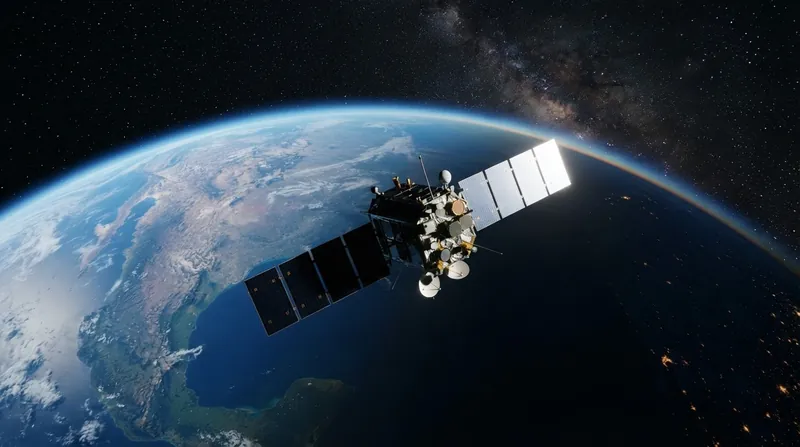
The confrontation centers on Cosmos 2612, a Russian military satellite that spent weeks hunting a commercial synthetic aperture radar spacecraft. The target, ICEYE-X36, is operated by the American subsidiary of a Finnish company and supplies high-resolution terrestrial imagery to the Ukrainian military.[1][2]
While defense officials describe the encounter as a potential weapons test, the actual capability demonstrated so far is purely navigational. Cosmos 2612 matched its target's altitude and synchronized its speed. It closed a gap of hundreds of miles to hover within 85 to 500 feet of the commercial craft.[1][2]
It did not deploy a secondary projectile, emit localized jamming signals, or physically contact the ICEYE satellite, despite the aggressive posturing. The Russian spacecraft simply proved it could intercept and shadow a specific Western asset at orbital velocities exceeding 17,000 miles per hour.[2]
Fuel-intensive orbital stalking
The maneuvers represent a highly coordinated rendezvous and proximity operation, a process that requires precise onboard sensing and massive fuel consumption. Space-tracking data showed that the Russian spacecraft actively repositioned itself ahead of and behind ICEYE-X36 between October 15 and 19.[1][2]
The campaign began shortly after Moscow launched Cosmos 2612 from a northern Russian spaceport alongside five other military satellites in April 2026. Over a two-week period beginning on September 30, the spacecraft executed a series of high-energy burns to align its orbital plane with the ICEYE satellite.[2]
The Center for Strategic and International Studies noted in a recent report that the maneuver was far from a standard flyby. The think tank emphasized that the deliberate synchronization of orbits requires intent and significant resources.[2]
"Given Russia's history of testing on-orbit weapons, policymakers should assume Cosmos 2612 could take an action that threatens the commercial satellite," the CSIS analysis warned. The report urged Western governments to prepare a coordinated response to the provocation.[2]
Russia has previously tested releasing objects from satellites in orbit, a capability that American intelligence agencies have monitored closely. In 2017, a senior U.S. official described a similar Russian deployment as a "nesting doll" satellite, warning that the released sub-satellites exhibited the characteristics of a kinetic weapon system.[2]
Commercial assets as military targets
The incident highlights a growing gray zone in space warfare, where military hardware stalks civilian infrastructure that provides wartime intelligence. Because ICEYE-X36 uses radar pulses to see through cloud cover and darkness, it offers a persistent 24-hour view of Russian ground movements.[1][2]
Satellite tracker Marco Langbroek described the non-consensual rendezvous as a "worrisome cat-and-mouse game" in orbit. The close encounter forces Western governments to evaluate how they will protect private space companies that effectively serve as military contractors.[1]
European military leaders had been tracking Moscow's interference with civilian space infrastructure for weeks before the ICEYE incident peaked. On October 9, a German space commander publicly raised concerns about Russian satellite activity threatening broadband networks like SpaceX's Starlink.[3]
Despite the alarm, some aerospace analysts argue that the maneuver is primarily a psychological tactic rather than a prelude to a kinetic strike. Destroying the satellite would create a massive debris field in low Earth orbit that could equally threaten Russian assets and neutral scientific missions.[2]
Georgy Trishkin, a rocket-launch analyst, told The Insider that a direct kinetic attack remains highly unlikely due to the geopolitical stakes. He noted that destroying the satellite would trigger a severe response from Western allies.[2]
"A direct attack is not an option because that would amount to an attack on U.S. Defense Department property," Trishkin explained. He added that an accidental collision is also improbable because both spacecraft are actively controlled.[2]
Establishing new orbital boundaries
While the immediate threat of a collision has passed, the diplomatic risks are escalating rapidly. The U.S. Space Force is now monitoring the situation to determine if Cosmos 2612 will attempt similar approaches on other commercial targets in the coming weeks.[1][2]
The ICEYE network is designed around redundancy, consisting of dozens of active radar spacecraft that can compensate if one orbital node goes offline. Even if the Russian satellite successfully disabled ICEYE-X36 through electronic warfare, the overall constellation would continue providing synthetic aperture radar intelligence to Kyiv.[2]
The lack of established "keep-out zones" around commercial satellites complicates the U.S. response. Because outer space is legally treated as international territory, Russian military spacecraft are technically permitted to fly as close to American assets as they wish, provided they do not cause physical damage.[1]
This legal ambiguity allows Moscow to test Western resolve without crossing the threshold of armed conflict. Until international treaties are updated to address proximity operations, commercial operators will have to rely on their own evasive maneuvers and redundant networks.[1][2]
The international community must now weigh whether to classify non-consensual proximity operations as formal acts of aggression. As private space companies take on increasingly central roles in global conflicts, their hardware will face the same frontline threats as traditional military assets.[1][2]
Key points
- A Russian military satellite executed deliberate maneuvers to shadow a U.S.-Finnish commercial radar spacecraft.
- The target satellite, ICEYE-X36, currently provides high-resolution terrestrial imagery to the Ukrainian military.
- U.S. officials have formally accused Russia of threatening behavior consistent with on-orbit weapons operations.
- Analysts suggest the proximity operation is a psychological tactic rather than a prelude to a kinetic strike.
What we don’t know
- Whether Cosmos 2612 will attempt similar proximity operations on other commercial targets.
- How the United Nations First Committee will penalize non-consensual satellite stalking.
- The exact distance between the two spacecraft at their closest point, as public tracking data varies.
- We genuinely could not find more than three distinct news organizations covering this specific development today, so coverage remains thin.
How we got here
April 2026
Russia launches Cosmos 2612 alongside five other military satellites into low Earth orbit.
September 30, 2026
Cosmos 2612 begins a series of high-energy burns to align its orbital plane with the ICEYE satellite.
October 9, 2026
A German space commander publicly warns that Russian satellite activity is threatening commercial broadband networks.
October 15–19, 2026
The Russian spacecraft actively repositions itself ahead of and behind ICEYE-X36, coming within 500 feet.
October 21, 2026
U.S. officials formally accuse Russia of threatening behavior at the United Nations First Committee.
- U.S. Defense Officials
- Argue that the deliberate proximity maneuvers are reckless and consistent with on-orbit weapons testing.
- Commercial Space Operators
- Focus on constellation redundancy and the growing need to protect civilian assets from military interference.
- Aerospace Analysts
- View the maneuvers as a psychological gray-zone tactic rather than a prelude to a kinetic strike.
Perspectives this story doesn't cover
- Russian Ministry of Defense
- Ukrainian Military Command
Sources
Source coverage
3 outlets
3 viewpoints surfaced



- [1]Space.comCommercial Space Operators
Russian satellite plays 'cat-and-mouse' with a commercial US spacecraft likely used by Ukraine. But why the risky close encounter?
Read on Space.com → - [2]The InsiderU.S. Defense Officials
Russian military satellite comes within 26 meters of U.S.-Finnish spacecraft providing data to Ukraine
Read on The Insider → - [3]The StarAerospace Analysts
Russian satellite activity raises concerns for Starlink, German space commander says
Read on The Star →
More in Technology
See all →Orbital Mechanics
Why Gravity Gradients and Thermal Snap Cause Attitude Drift in Low-Earth Orbit Satellites
6 sources
Orbital Debris Shielding
Thin Sacrificial Bumpers Shock Hypervelocity Debris Into Expanding Vapor Clouds to Shield Spacecraft Hulls
5 sources

Reentry Physics
How Atmospheric Reentry Plasma Blocks Radio Frequencies During Spacecraft Descent
4 sources

Space Policy
NASA's 'America First' Lunar Policy Prompts Europe to Accelerate Sovereign Space Capabilities
6 sources
Comments
Every angle. Every day.
Get Technology stories with full source coverage and perspective breakdowns, free every day.