
Comparing Dry Cask Storage, Reprocessing, and Deep Repositories for Spent Nuclear Fuel
An analysis of the engineering, economic, and policy frameworks governing the long-term management of spent nuclear fuel.

Share this story
In short
- Spent nuclear fuel is initially cooled in water pools before transitioning to passive, air-cooled dry cask storage.
- Dry casks are highly resilient to natural disasters and sabotage, providing safe interim storage for decades.
- Reprocessing extracts reusable uranium and plutonium but carries a significant economic premium and proliferation risks.
For communities hosting nuclear power plants and citizens relying on the zero-carbon electricity they generate, the ultimate fate of spent nuclear fuel is more than an abstract engineering puzzle. It is a defining factor in the long-term viability of their local infrastructure, energy costs, and environmental safety. As the world increasingly turns to nuclear energy to meet decarbonization targets, the physical reality of managing the byproduct of fission remains a critical systems challenge that requires coordination across decades.[5]
When a fuel assembly is removed from a light-water reactor after several years of operation, it is no longer efficient for generating electricity, but it remains intensely radioactive and thermally hot. This spent nuclear fuel consists primarily of uranium, alongside plutonium and various fission products. The immediate requirement is to cool the material and shield the radiation, a task initially handled by submerging the assemblies in deep pools of water at the reactor site.[1]
Water is an excellent neutron absorber and coolant, but spent fuel pools are designed for temporary storage, not permanent isolation. After several years, the thermal heat and radioactivity decay to a level where the fuel can be safely transferred to dry cask storage. This transition is a fundamental node in the nuclear infrastructure chain, moving the material from active, water-cooled management to passive, air-cooled containment.[1][3]
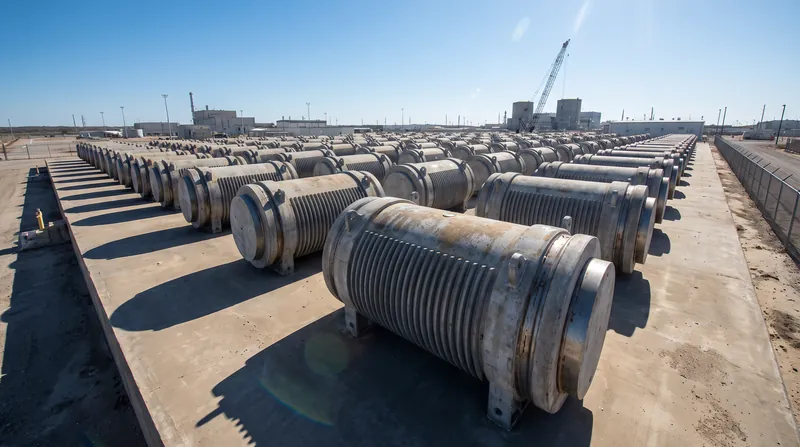
Dry cask storage systems are massive, highly engineered containers typically constructed from steel and concrete. The steel cylinders provide a leak-tight containment boundary and confine the radioactive materials, while the outer concrete overpacks provide physical protection and radiation shielding. According to the U.S. Nuclear Regulatory Commission, these passive systems rely on natural convective air flow to dissipate the remaining decay heat, requiring no moving parts or active power to maintain safety.[1]
The safety profile of dry cask storage is robust. The National Research Council has evaluated the security of commercial spent nuclear fuel storage, concluding that dry casks are highly resilient against extreme natural events and potential sabotage. Because the fuel is solid—typically ceramic uranium dioxide pellets encased in metal tubes—and the casks are heavily shielded, the risk of a widespread radiological release from a dry storage facility is exceptionally low.[3]
However, dry casks are explicitly an interim solution. While the NRC grants initial licenses for up to 40 years, with renewals allowing for 60 years or more of operational life, the materials inside will remain hazardous for tens of thousands of years. This temporal mismatch between the design life of the storage containers and the half-life of the isotopes they hold forces policymakers to look further down the chain toward permanent solutions.[1]
One alternative to indefinite storage is reprocessing, a closed fuel cycle strategy that treats spent fuel not as waste, but as a resource. Through complex chemical separation processes, the remaining uranium and newly generated plutonium are extracted from the fission products. These recovered elements can then be fabricated into mixed-oxide (MOX) fuel and returned to a reactor to generate more electricity, theoretically closing the loop.[2][4]
While reprocessing reduces the physical volume and long-term radiotoxicity of the final high-level waste, it introduces significant economic and proliferation complexities. Economic models from the Belfer Center for Science and International Affairs indicate that reprocessing and recycling plutonium in light-water reactors can carry a fuel cycle cost premium of up to 80% compared to the direct disposal of spent fuel. The chemical separation process is capital-intensive and requires heavily shielded, remote-operated facilities.[2]
Furthermore, reprocessing does not eliminate the need for a permanent disposal site. The chemical process generates its own stream of high-level liquid waste, which must be vitrified—turned into glass—and eventually buried. Thus, while reprocessing alters the isotopic composition and volume of the waste, it does not solve the fundamental requirement for long-term geological isolation, leaving the ultimate infrastructure challenge intact.[2][4]
The international scientific consensus for the final node in the spent fuel management chain is the deep geological repository (DGR). This approach involves excavating a network of tunnels and disposal galleries hundreds of meters underground in stable rock formations, such as granite, clay, or salt. The International Atomic Energy Agency outlines this as the reference endpoint for both direct disposal and the waste products of reprocessing.[4]
A DGR relies on a multiple-barrier concept to isolate the radionuclides from the biosphere. The engineered barriers include the solid fuel matrix itself, long-lived metal disposal canisters (often copper or steel), and a buffer material like bentonite clay that swells when wet to seal the canister in place. These engineered layers are then enveloped by the ultimate natural barrier: the stable geological formation, which has remained unchanged for millions of years.[4]
Implementing a DGR is less a technical challenge than a sociopolitical one. The engineering principles of deep geological disposal are well understood, and countries like Finland are already constructing operational facilities. The Finnish Onkalo repository, excavated deep into stable bedrock, demonstrates that the multiple-barrier concept can be successfully sited and built when supported by transparent public engagement and sustained national policy.[4][5]
Conversely, other nations have struggled to site repositories due to intense local opposition and shifting political mandates. When a permanent repository is delayed, the interim storage phase is indefinitely extended. This forces utilities to expand their dry cask storage pads, effectively turning reactor sites into de facto long-term waste management facilities, a scenario that strains local community agreements and complicates the decommissioning of older plants.[1][5]
The management of spent nuclear fuel is best understood as an integrated system rather than a series of isolated choices. The IAEA emphasizes that countries developing new nuclear power programs must establish a clear national policy for the entire back end of the fuel cycle, recognizing that interim storage, reprocessing, and geological disposal are interdependent variables. A delay or policy shift in one node cascades through the entire infrastructure chain.[4]
The management of spent nuclear fuel is best understood as an integrated system rather than a series of isolated choices.
Ultimately, the mechanics of spent fuel management demonstrate that the nuclear industry possesses the technical capability to safely isolate high-level waste. Dry casks provide a secure, passive bridge for the coming decades, while deep geological repositories offer a permanent endpoint. The primary challenge lies in aligning the economic realities of the fuel cycle with the political durability required to execute infrastructure projects that span generations.[5]
How we did this
- Method
- A comparative normalisation of lifecycle management timeframes and economic trade-offs across dry cask storage, reprocessing, and deep geological disposal, synthesizing distinct institutional assessments into a single unified matrix of operational viability.
- What we found
- While reprocessing reduces the physical volume of high-level waste, its substantial economic premium and the eventual unavoidable requirement for a deep geological repository mean that extended dry cask storage remains the most economically and operationally viable interim strategy for nations developing new nuclear programs, acting as a necessary bridge rather than a final solution.
- What we worked from
- Dry cask storage licensing duration: Up to 60 years — U.S. Nuclear Regulatory Commission
- Reprocessing cost premium: Up to 80% higher than direct disposal — Belfer Center for Science and International Affairs
- Geological repository requirement: Hundreds of meters underground — International Atomic Energy Agency
- Limits of this analysis
- This analysis relies on historical economic models for reprocessing which may not account for future advancements in fast-reactor technologies or shifts in uranium market prices.
Jargon, explained
- Dry Cask Storage
- A method for storing spent nuclear fuel in massive, passive steel and concrete containers that use natural air circulation to dissipate heat.
- Reprocessing
- A chemical operation that separates usable uranium and plutonium from the fission products in spent nuclear fuel so they can be recycled into new fuel.
- Deep Geological Repository (DGR)
- An underground facility excavated hundreds of meters deep into stable rock formations, designed to permanently isolate high-level radioactive waste.
- Vitrification
- The process of mixing liquid high-level radioactive waste with glass-forming chemicals and melting it into a solid, stable glass matrix for long-term disposal.
- Half-life
- The time required for half of the radioactive atoms in a specific isotope to decay into a more stable form.
Common questions
Is spent nuclear fuel a liquid or a solid?
Spent commercial nuclear fuel is a solid. It consists of small, ceramic uranium dioxide pellets stacked inside long metal tubes, which are bundled together into fuel assemblies.
How long does spent fuel stay in water pools?
Fuel assemblies typically remain in water-filled spent fuel pools for at least five years to allow the initial intense heat and radioactivity to decay before they can be moved to dry casks.
Can dry casks withstand natural disasters?
Yes. Dry casks are heavily engineered with steel and concrete to withstand extreme events, including earthquakes, floods, tornadoes, and projectile impacts, without releasing radioactive material.
Does reprocessing eliminate the need for a repository?
No. While reprocessing reduces the volume of high-level waste and extracts reusable fuel, the chemical process still generates highly radioactive byproducts that require permanent geological disposal.
Competing readings
Direct Disposal Advocates
Proponents of moving spent fuel directly from interim storage to geological repositories without reprocessing.
This perspective argues that the direct disposal of spent nuclear fuel is the most economically sound and proliferation-resistant strategy. By avoiding the chemical separation of plutonium, direct disposal minimizes the risk of weapons-usable material being diverted. Advocates point to the high capital costs of reprocessing facilities and argue that the 'once-through' fuel cycle is the most pragmatic approach for the vast majority of nuclear-powered nations.
Closed Fuel Cycle Proponents
Advocates for reprocessing spent fuel to extract usable isotopes and reduce long-term waste volume.
Supporters of reprocessing view spent fuel as a valuable energy resource rather than a waste product. They emphasize that extracting uranium and plutonium for reuse in mixed-oxide (MOX) fuel or advanced fast reactors can significantly extend global fuel supplies. Furthermore, by removing the long-lived transuranic elements, reprocessing reduces the volume and the necessary isolation timeframe of the final high-level waste, potentially simplifying the engineering requirements for geological repositories.
Interim Storage Pragmatists
Experts focused on optimizing and extending the lifespan of dry cask storage systems.
This camp emphasizes that because deep geological repositories take decades to site and construct, extended interim storage is the immediate operational reality. They focus on advancing the materials science of dry casks, monitoring for stress corrosion cracking, and developing consolidated interim storage facilities. Their goal is to ensure that spent fuel can be safely managed on the surface for a century or more, providing policymakers the necessary time to resolve the sociopolitical challenges of permanent disposal.
- Direct Disposal Advocates
- Proponents of moving spent fuel directly from interim storage to geological repositories without chemical reprocessing.
- Closed Fuel Cycle Proponents
- Advocates for reprocessing spent fuel to extract usable isotopes and reduce long-term waste volume.
- Interim Storage Pragmatists
- Experts focused on optimizing and extending the lifespan of dry cask storage systems as a bridge to permanent solutions.
Perspectives this story doesn't cover
- Local communities hosting legacy nuclear waste sites
- Anti-nuclear environmental advocacy groups
Sources
Source coverage
5 outlets
3 viewpoints surfaced





- [1]U.S. Nuclear Regulatory CommissionInterim Storage Pragmatists
Backgrounder on Dry Cask Storage of Spent Nuclear Fuel
Read on U.S. Nuclear Regulatory Commission → - [2]Belfer Center for Science and International AffairsDirect Disposal Advocates
The Economics of Reprocessing vs. Direct Disposal of Spent Nuclear Fuel
Read on Belfer Center for Science and International Affairs → - [3]National Academies PressInterim Storage Pragmatists
Safety and Security of Commercial Spent Nuclear Fuel Storage: Public Report
Read on National Academies Press → - [4]International Atomic Energy Agency
Options for Management of Spent Fuel and Radioactive Waste for Countries Developing New Nuclear Power Programmes
Read on International Atomic Energy Agency → - [5]Factlen Editorial Team
Synthesis by Factlen editorial team
Read on Factlen Editorial Team →
More in Energy
See all →Nuclear Policy
Taiwan Clears First Regulatory Hurdle to Restart Maanshan Nuclear Plant Amid Chipmaker Demand
3 sources
Nuclear Policy
Italy's Senate Approves Framework Law for Return to Nuclear Power After 40-Year Ban
5 sources

Nuclear Export Strategy
US, Japan, and South Korea Launch Trilateral Plan to Accelerate Global SMR Deployment
7 sources

Nuclear Fuel Cycle
IAEA 'Red Book' Finds Uranium Minable at Reasonable Cost Is Shrinking Despite Growing Total Resources
5 sources
Comments
Every angle. Every day.
Get Energy stories with full source coverage and perspective breakdowns, free every day.