
Comparing Kinematic Trade-Offs in MacPherson Strut, Double Wishbone, and Multi-Link Systems
Automakers constantly balance manufacturing cost and interior space against dynamic handling. Understanding the kinematic differences between suspension architectures reveals why vehicle platforms behave the way they do.

Share this story
In short
- MacPherson struts dominate the industry due to their low cost and compact packaging, but sacrifice ultimate cornering grip.
- Double wishbone suspensions use unequal arm lengths to keep the tire flat during cornering, requiring significantly more space.
- Multi-link systems deconstruct the suspension into independent arms, offering the highest degree of tuning flexibility at the cost of complexity.
At the heart of every automotive platform design lies a fundamental geometric conflict: the demand for maximum interior cabin space and manufacturing efficiency directly opposes the mechanical requirements for optimal tire contact and dynamic handling. Resolving this tension dictates the physical architecture of the vehicle.[2]
The sole purpose of a suspension system is to manage the kinetic energy of a moving mass while keeping the tire's contact patch—an area roughly the size of a human hand—flat against the pavement. How a vehicle achieves this under the lateral loads of cornering and the vertical loads of uneven terrain depends entirely on its kinematic linkages.[2][6]
For decades, the automotive industry has relied on three primary independent suspension architectures to solve this problem: the MacPherson strut, the double wishbone, and the multi-link system. Each represents a distinct node in the larger engineering chain, trading cost and packaging volume for kinematic control.[6]
The MacPherson strut, developed in the 1940s, remains the most ubiquitous front suspension design in global passenger vehicles. Its brilliance lies in its consolidation of components: the shock absorber itself acts as the upper steering pivot and a structural member of the chassis.[4]
By eliminating the need for an upper control arm, the MacPherson architecture frees up significant lateral space in the engine bay. This makes it the default choice for transverse-engine, front-wheel-drive vehicles where packaging constraints are severe. It is highly manufacturable, cost-effective, and simple to assemble on a production line.[4][6]
However, this simplicity introduces a downstream kinematic consequence. Because the strut is fixed at the top, as the suspension compresses during hard cornering, the tire leans outward relative to the road surface—a phenomenon known as positive camber gain. This lifts the inner edge of the tire, reducing the contact patch and limiting ultimate mechanical grip.[2][4]
To resolve the camber limitations of the strut, high-performance and luxury architectures utilize the double wishbone suspension. This system employs two distinct A-shaped arms—one upper and one lower—to connect the wheel hub to the chassis, with the shock absorber operating independently of the structural linkages.[5][7]
The geometric advantage of the double wishbone lies in its unequal arm lengths. By designing the upper arm to be shorter than the lower arm, engineers create a negative camber curve. As the chassis rolls outward in a corner and the suspension compresses, the shorter upper arm pulls the top of the wheel inward, keeping the tire perfectly flat against the road.[5][7]
The trade-off for this dynamic superiority is a severe packaging penalty. The upper wishbone intrudes directly into the space typically occupied by a transverse engine or wide powertrain components. Furthermore, the increased component count adds unsprung mass, manufacturing complexity, and cost to the vehicle platform.[5][6]
The multi-link suspension represents the most advanced evolution of kinematic control. Rather than relying on rigid A-arms, a multi-link system deconstructs the geometry into three to five independent lateral and longitudinal control arms.[3]
This disaggregation allows engineers to tune each axis of wheel movement independently. They can optimize for anti-dive under heavy braking, anti-squat under acceleration, and precise toe control during cornering, all without compromising ride quality. It is the definitive architecture for balancing luxury compliance with high-speed stability.[3][5]
The downstream consequence of multi-link architecture is extreme complexity. The sheer number of bushings, ball joints, and linkages requires precise manufacturing tolerances and significantly increases the cost of both initial production and long-term maintenance.[3]
The transition to electric vehicle architectures is currently forcing a re-evaluation of these historical trade-offs. The integration of heavy lithium-ion battery packs increases vehicle curb weights by 20 to 30 percent, placing unprecedented lateral and vertical loads on the suspension network.[1]
Simultaneously, the removal of the internal combustion engine eliminates the primary packaging constraint that necessitated the MacPherson strut. With a flat skateboard chassis and compact electric drive units mounted low between the wheels, the spatial penalty of upper control arms is largely negated.[1][8]
Consequently, the industry is witnessing a structural shift. To manage the increased mass and preserve tire longevity under high torque loads, automakers are increasingly migrating toward double wishbone and multi-link architectures for mass-market electric platforms, utilizing the newly available packaging space to prioritize kinematic control over component reduction.[1][8]
How we did this
- Method
- A kinematic and packaging comparison across suspension architectures to determine the optimal deployment strategy for modern electric vehicles, normalizing for the increased mass and altered center of gravity inherent to battery packs.
- What we found
- While MacPherson struts dominate ICE vehicles due to engine bay constraints, the lower center of gravity and flat skateboard chassis of EVs fundamentally shift the packaging penalty, making double wishbone and multi-link architectures disproportionately more viable for mass-market electric platforms than they were for internal combustion equivalents.
- What we worked from
- Kinematic camber control characteristics of double wishbone systems: Negative camber gain curve — Transactions of the Canadian Society for Mechanical Engineering
- Packaging constraints and load distribution for EV retrofits: 20-30% increased curb weight — MDPI
- Limits of this analysis
- Suspension tuning (spring rates, damping) and bushing compliance can significantly alter real-world feel, meaning a well-tuned MacPherson can still outperform a poorly tuned multi-link system.
Jargon, explained
- Kinematics
- The study of motion and geometry in mechanical systems without considering the forces that cause the motion.
- Camber Angle
- The vertical tilt of the wheel relative to the road surface; negative camber tilts the top of the tire inward toward the vehicle.
- Unsprung Mass
- The weight of the vehicle's components that are not supported by the suspension, including wheels, tires, and brakes.
- Contact Patch
- The physical area of the tire tread that is in direct contact with the road surface at any given moment.
Common questions
Why do most front-wheel-drive cars use MacPherson struts?
Transverse engines take up the width of the engine bay, leaving no room for the upper control arms required by other suspension types. The MacPherson strut solves this by acting as both the shock absorber and the upper pivot.
Is a multi-link suspension always better than a double wishbone?
Not necessarily. While multi-link offers more independent tuning variables for comfort and handling, a well-engineered double wishbone provides excellent camber control with fewer moving parts and bushings to wear out.
Why are electric vehicles changing suspension choices?
EVs are significantly heavier, requiring better suspension geometry to manage tire wear. Concurrently, their compact motors free up the space needed for more complex suspension arms that were previously blocked by large engines.
Competing readings
The Manufacturing Perspective
Focuses on the economic and spatial advantages of the MacPherson strut.
For high-volume automakers, the vehicle assembly process is a primary driver of design. The MacPherson strut is favored because it can be pre-assembled as a single module with the spring, shock, and hub, then bolted into the chassis in one motion on the production line. This drastically reduces assembly time and component costs while maximizing the interior volume available for passengers and cargo.
The Dynamics Perspective
Prioritizes mechanical grip and handling predictability through advanced geometry.
Engineers focused on vehicle dynamics view the suspension as a tool to manipulate the tire's contact patch. From this viewpoint, the spatial penalties of double wishbone and multi-link systems are entirely justified by their kinematic superiority. By controlling camber gain and toe angles under heavy lateral loads, these architectures ensure the vehicle remains stable and predictable at the limits of adhesion, a critical factor for both performance driving and emergency avoidance maneuvers.
The EV Architecture Perspective
Views electric powertrains as a catalyst for rethinking legacy suspension constraints.
The architecture of an electric vehicle fundamentally alters the traditional suspension equation. Because EVs lack a bulky engine block between the front wheels, the primary spatial constraint that necessitated the MacPherson strut is removed. Concurrently, the massive weight of the battery pack requires more robust kinematic control to prevent rapid tire degradation. This allows EV platform architects to deploy sophisticated multi-link and double wishbone setups in mass-market vehicles that would have previously been restricted to luxury segments.
- Packaging & Cost Engineers
- Prioritize manufacturing efficiency, component reduction, and maximum interior cabin volume, heavily favoring MacPherson strut architectures.
- Vehicle Dynamics Engineers
- Focus on kinematic control, tire contact patch optimization, and handling predictability, advocating for double wishbone and multi-link systems.
- EV Platform Architects
- View the transition to electric powertrains as an opportunity to utilize newly freed engine bay space for advanced suspension geometries.
Perspectives this story doesn't cover
- Tire Manufacturers
- Aftermarket Suspension Tuners
Sources
Source coverage
8 outlets
3 viewpoints surfaced






- [1]MDPIEV Platform Architects
Comparative Analysis of MacPherson and Double Wishbone Suspensions for an Electric Off-Road Vehicle Retrofit
Read on MDPI → - [2]CHMODKINNPackaging & Cost Engineers
Principles for Selecting Suspension Types
Read on CHMODKINN → - [3]CHMODKINNPackaging & Cost Engineers
Types of Multi-Link Suspensions
Read on CHMODKINN → - [4]CHMODKINNPackaging & Cost Engineers
Types of MacPherson Strut Suspensions
Read on CHMODKINN → - [5]Dowway VehicleVehicle Dynamics Engineers
Multi-Link vs Double Wishbone Suspension: The Truth
Read on Dowway Vehicle → - [6]HDC ManufacturingPackaging & Cost Engineers
Types of Car Suspension: MacPherson, Multi-Link & Double Wishbone Compared
Read on HDC Manufacturing → - [7]Transactions of the Canadian Society for Mechanical EngineeringVehicle Dynamics Engineers
NUMERICAL KINEMATIC ANALYSIS OF THE DOUBLE WISHBONE MOTOR-VEHICLE SUSPENSION SYSTEM
Read on Transactions of the Canadian Society for Mechanical Engineering → - [8]Factlen Editorial TeamEV Platform Architects
Synthesis by Factlen editorial team
Read on Factlen Editorial Team →
More in Transportation
See all →Fleet Renewal
Aeroflot Finalizes Order for 90 Russian-Made MC-21-310 Jets in Major Import Substitution Deal
3 sources
Railroad Consolidation
STB Denies Motions to Dismiss Union Pacific-Norfolk Southern Merger, Allowing Review to Proceed
6 sources
Suspension Physics
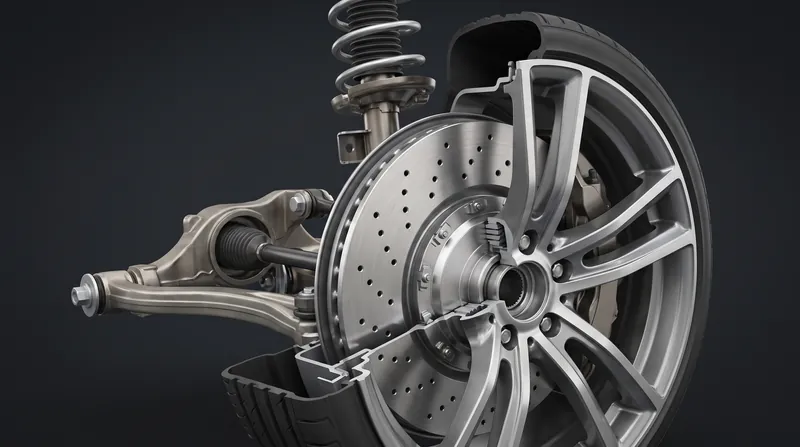
How Lower Unsprung Mass Improves Tire Grip But Worsens High-Frequency Ride Comfort
5 sources
Vehicle Dynamics
The 10-20% Slip Ratio: How Anti-lock Braking Systems Maximize Deceleration While Maintaining Steering Control
7 sources
Comments
Every angle. Every day.
Get Transportation stories with full source coverage and perspective breakdowns, free every day.