
The Math Behind the Madness: How the Champions League's Swiss Model Actually Works
UEFA's shift from a traditional group stage to a 36-team single league has fundamentally altered the math of European football. Here is a breakdown of the new qualification thresholds, tiebreakers, and why the 'easy group' is a thing of the past.
By Meera Iyer

Share this story
In short
- The Champions League now uses a 36-team single league table instead of eight groups of four.
- Each team plays eight matches against eight different opponents, drawn evenly across four seeding pots.
- The top eight teams advance directly to the Round of 16, bypassing an extra playoff round.
The tension heading into the Champions League autumn is palpable, driven by a fundamental disagreement: traditionalists argue UEFA has ruined a perfect competition, while executives insist the new format will save European football from predictability. For two decades, the formula was simple: draw three opponents, play them home and away, secure ten points, and rest your stars for the final two matchdays.[1][6]
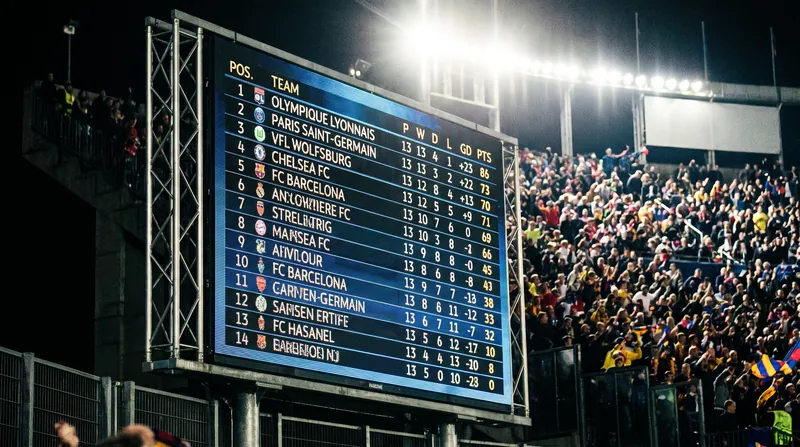
That era is officially dead. To resolve the growing threat of a breakaway Super League and the boredom of dead-rubber group matches, UEFA tore up the script. The introduction of the "Swiss model" has replaced the eight distinct groups of four with a massive, high-stakes 36-team single league table.[2][6]
The shift was designed to inject jeopardy into a group stage that had grown increasingly predictable. By expanding the field and scrambling the fixture list, the new format ensures that the biggest clubs in Europe collide earlier and more often.
But how does the math actually work? Instead of playing three teams twice, each club now plays eight different opponents—four at home and four away.[1][2]
The 36 teams are divided into four seeding pots of nine. In the old system, a Pot 1 team would avoid all other Pot 1 teams. Now, every club must play two opponents from each of the four pots.[2]
This is where the structural math changes the tournament's DNA. Because a Pot 1 team must play two other Pot 1 teams, 25% of their league phase fixtures are guaranteed heavyweight clashes.[6]
The "easy group" is mathematically extinct. A top-seeded club can no longer coast through six matches against lower-tier opposition; they are forced to test their depth against elite rivals while simultaneously navigating grueling domestic challenges like the Premier League.[5]
Progression to the knockout rounds is no longer a simple top-two finish. The single 36-team table creates a massive scramble for positioning, with the top eight teams automatically advancing to the Round of 16.[2]
Teams finishing between ninth and 24th enter a high-stakes, two-legged playoff round to secure the remaining eight spots.[3]
Meanwhile, the bottom twelve teams—those finishing 25th through 36th—are eliminated entirely. Crucially, there is no longer a safety net; the old rule that dropped third-place teams into the Europa League has been abolished.[1]
So, what is the magic number to survive? Statistical simulations suggest that 16 points—equating to five wins and a draw from eight matches—is the threshold to virtually guarantee a top-eight finish and bypass the playoff round.[6]
For teams aiming just to survive and reach the playoff round (top 24), the threshold drops to around nine or ten points. Three wins and a draw from eight matches should be enough to keep a European campaign alive into the new year.
The single table also revolutionizes the importance of tiebreakers. With 36 teams competing for 24 spots over just eight matches, massive clusters of teams will inevitably finish level on points.[2]
UEFA's primary tiebreaker is overall goal difference in the league phase, followed by total goals scored, and then away goals scored.[2]
This means a 4-0 blowout against a Pot 4 team in October could be the exact margin that separates an automatic Round of 16 berth from a grueling February playoff tie.
There is no longer such a thing as a "dead rubber." Even if a team has secured qualification, running up the score in matchday eight is vital for seeding, as the playoff draw is seeded based on league phase placement.[3]
The Swiss model, borrowed from chess tournaments, fundamentally alters the risk calculus for managers. Squad rotation must be balanced against the constant need for goal difference.[4]
Key terms
- Swiss Model
- A tournament format where teams do not play every other participant, but instead play a set number of fixtures against opponents of varying ranks within a single league table.
- Seeding Pots
- The four tiers of nine teams used to draw opponents; each club must play exactly two teams from each pot.
- League Phase
- The new term for the opening round of the tournament, which replaced the traditional 'Group Stage' starting in the 2024-25 season.
- Knockout Phase Play-offs
- The two-legged ties played by teams finishing 9th to 24th to determine who joins the top eight in the Round of 16.
Reader questions
Do eliminated teams still drop down to the Europa League?
No. Under the new format, any team that finishes 25th or lower in the league phase is eliminated from all European competitions for the remainder of the season.
How many points are needed to reach the top eight?
Statistical models indicate that 16 points—roughly five wins and a draw from eight matches—will almost certainly secure a top-eight finish and a direct bye to the Round of 16.
Do teams play the same opponent home and away?
No. Each team plays eight entirely different opponents during the league phase, with four matches hosted at home and four played away.
How are ties broken in the league phase standings?
If teams finish level on points, the primary tiebreaker is overall goal difference in the league phase, followed by total goals scored and away goals scored.
Where opinion splits
Elite Club Managers
Top-tier managers are concerned about the physical toll and the inability to rest players.
For the managers of Europe's wealthiest clubs, the Swiss model is a double-edged sword. While it delivers the blockbuster matchups fans crave, it mathematically eliminates the 'easy group' scenario. Because Pot 1 teams are now forced to play two other Pot 1 teams, the intensity of the league phase is significantly higher. Furthermore, the reliance on goal difference as the primary tiebreaker means managers can rarely afford to rotate their squads, even after securing qualification, leading to fears of player burnout across a grueling eight-match opening round.
Mid-Tier and Emerging Clubs
Smaller clubs view the expanded format as a historic opportunity for progression and exposure.
For clubs outside the traditional elite, the 36-team table offers a lifeline. In the old format, drawing two giants in a four-team group was a death sentence. Now, playing eight different opponents across all four seeding pots guarantees a more balanced schedule. More importantly, the qualification threshold has been lowered; finishing 24th out of 36 is enough to reach the knockout playoffs. This keeps the European dreams of mid-tier clubs alive deep into January, providing crucial broadcast revenue and invaluable experience on the continent's biggest stage.
Football Traditionalists
Purists lament the loss of the classic home-and-away group dynamic and the simplicity of the old system.
A vocal contingent of supporters and traditionalists argue that the Swiss model is an overly complex solution to a problem that didn't exist. The charm of the old group stage was the home-and-away narrative—the chance for a team to avenge a bitter away defeat in front of their own fans a fortnight later. By stripping away the return fixtures and throwing 36 teams into a single, chaotic table, critics argue the format feels more like a disjointed exhibition series than a cohesive tournament, requiring a supercomputer just to understand the standings on matchday eight.
- Elite Club Managers
- Concerned about player burnout, fixture congestion, and the inability to rest stars due to goal-difference tiebreakers.
- Mid-Tier and Emerging Clubs
- Supportive of the format because it offers a fairer schedule and keeps their knockout hopes alive longer.
- Football Traditionalists
- Critical of the complex 36-team table and the loss of the classic home-and-away group stage narrative.
Perspectives this story doesn't cover
- Domestic League Executives
- Player Unions
Sources
Source coverage
6 outlets
3 viewpoints surfaced



- [1]WikipediaMid-Tier and Emerging Clubs
UEFA Champions League
Read on Wikipedia → - [2]WikipediaMid-Tier and Emerging Clubs
2025–26 UEFA Champions League
Read on Wikipedia → - [3]WikipediaMid-Tier and Emerging Clubs
2026–27 UEFA Champions League
Read on Wikipedia → - [4]WikipediaMid-Tier and Emerging Clubs
Swiss-system tournament
Read on Wikipedia → - [5]Yahoo SportsElite Club Managers
Aston Villa v Arsenal: Team News, Predicted Lineup and Score Prediction
Read on Yahoo Sports → - [6]Factlen Editorial TeamFootball Traditionalists
Synthesis by Factlen editorial team
Read on Factlen Editorial Team →
More in Sports
See all →Champions League Qualification
The Four Access Paths and the Two European Performance Spots: How the 36 Teams Qualify for the Champions League League Phase
4 sources

Football Finance
The 10% National TV Rights Split and the Two Proportionality Factors: How the Champions League Market Pool is Calculated
5 sources

Champions League Records
Erling Haaland Reaches 59 Champions League Goals in 59 Games, Closing in on Lionel Messi's Age Record
6 sources

Coefficient Rules
The 20% Association Floor and the Five-Year Rolling Average: How the UEFA Club Coefficient Actually Works
7 sources
Comments
Every angle. Every day.
Get Sports stories with full source coverage and perspective breakdowns, free every day.