
Slovenia's Lučka Rakovec Completes Inspirational Return to the Wall After Thyroid Cancer Battle
After losing two seasons to a thyroid cancer diagnosis, Slovenian climber Lučka Rakovec has made a stunning return to the IFSC World Cup circuit, headlining a 2026 season defined by athletes overcoming major physical setbacks.

Share this story
The 2026 IFSC World Cup season is defined by gravity-defying dynos and sub-five-second speed runs, but the most compelling victories taking place on the wall have nothing to do with podium placements. Across the international circuit, a wave of elite climbers is making triumphant returns from severe, career-threatening medical setbacks.
At the forefront of this narrative is 24-year-old Slovenian lead specialist Lučka Rakovec. A fixture on the European competition circuit since her early teens, Rakovec was forced into an abrupt and terrifying hiatus when she was diagnosed with thyroid cancer at the age of 23.
The diagnosis arrived after routine blood work for a suspected virus revealed massive deviations in her hormone levels. For an athlete who had dedicated 15 years to the sport, the news was a devastating shock that immediately halted her competitive aspirations and forced her to step away from the wall entirely.[2]
Rakovec underwent a total thyroidectomy, a procedure that removed the entire gland responsible for regulating heart rate, blood pressure, and body temperature. The physical recovery was grueling, but the mental toll of the disease proved equally challenging for the young Olympian hopeful.
Stripped of her primary outlet, Rakovec battled profound exhaustion, anxiety, and a sense of isolation. She confessed in an emotional interview with the IFSC that the day-to-day reality of hormone regulation and cancer recovery weighed heavily on her mental health, noting that she actually felt worse when she was forced to stay away from climbing.[2]
The turning point in her recovery came when she cautiously returned to the gym. Starting with just an hour of low-intensity movement a day, Rakovec discovered that the physical act of climbing provided a sanctuary from her diagnosis. The wall demanded absolute focus, offering a rare space where she could forget about her illness and reconnect with her body.[2]
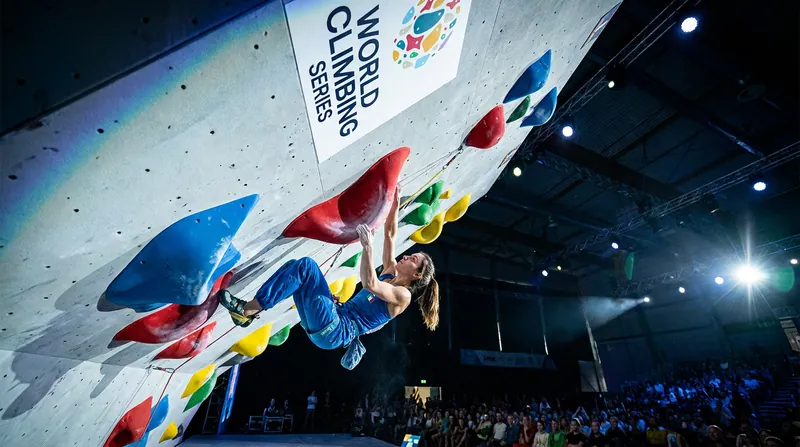
That therapeutic escape gradually evolved back into elite training. Defying expectations, Rakovec made a stunning return to the World Cup circuit, stepping out under the bright lights of the Innsbruck Lead qualifiers. Despite overwhelming nerves, she broke the ice on her first route and ultimately secured an incredible eighth-place finish in the finals.[2]
Her successful return has injected a profound sense of perspective into the Slovenian national team. Her partner and fellow World Cup competitor, Luka Potočar, noted that her resilience has been a massive source of inspiration for the entire roster as they navigate the grueling 2026 European Championship schedule.
Rakovec herself acknowledges that the ordeal fundamentally changed her approach to the sport. She now prioritizes listening to her body and protecting her long-term health, approaching each competition with zero expectations and a renewed, pure joy for the process of climbing.[2]
Rakovec's story is the most dramatic, but she is far from the only athlete demonstrating remarkable physical resilience this season. The grueling nature of modern sport climbing—with its dynamic, high-impact bouldering sequences and relentless lead routes—routinely pushes the human body to its absolute limits, requiring athletes to navigate complex recoveries.
French Olympian Julia Chanourdie has also made a celebrated return to the Lead wall this summer. After suffering a severe ankle sprain that derailed her early-season momentum, Chanourdie underwent intensive rehabilitation to regain the explosive lower-body power required for elite competition.
Chanourdie's persistence paid off rapidly. She recently secured a third-place finish at the European Cup in Lead, proving that her time away from the wall had not dulled her tactical execution or endurance.
Meanwhile, German veteran Alexander Megos has provided a masterclass in managing chronic injuries while remaining at the pinnacle of the sport. Megos has been battling a persistent, nagging finger injury that severely limited his ability to crimp on microscopic holds during the early qualifying series.[1]
Rather than withdrawing, Megos adapted. He adjusted his training volume, utilized specialized taping techniques, and relied on his vast reservoir of experience to navigate the Olympic Qualifying Series. By climbing smarter and accepting that he was not at 100 percent, Megos successfully secured his ticket to the Paris Games and continues to be a formidable presence in the 2026 World Cup rankings.[1]
The collective returns of Rakovec, Chanourdie, and Megos underscore a shifting culture within professional climbing. Federations and athletes are increasingly prioritizing sustainable rehabilitation and mental health support over rushing back for immediate ranking points.
As the 2026 season progresses toward the World Championships in Seoul, the loudest cheers from the crowd are no longer reserved solely for the athletes who top the final boulder. They are echoing for the climbers who fought their way back from the hospital bed to the starting mat, proving that the greatest crux of their careers was conquered long before they ever tied into the rope.
Key points
- Slovenian climber Lučka Rakovec has returned to the IFSC World Cup after a two-year battle with thyroid cancer.
- Rakovec reached the Lead finals in Innsbruck in her first competition back, finishing eighth.
- French Olympian Julia Chanourdie has successfully returned to the Lead podium following a severe ankle sprain.
- German veteran Alexander Megos continues to compete at an elite level while managing a chronic finger injury.
- The 2026 season highlights a growing emphasis on sustainable rehabilitation and mental health in sport climbing.
How we got here
Late 2023
Lučka Rakovec is diagnosed with thyroid cancer after routine blood tests reveal severe hormone deviations.
Early 2024
Rakovec undergoes a total thyroidectomy and steps away from all climbing to focus on her physical and mental recovery.
Mid 2024
Rakovec cautiously returns to the climbing gym, using one hour of easy movement a day as a mental escape from her illness.
June 2025
Rakovec makes her emotional return to the IFSC World Cup in Innsbruck, finishing 8th in the Lead finals.
July 2026
Rakovec continues her strong form on the European circuit, headlining a season of major injury comebacks alongside Chanourdie and Megos.
- Athletes in Recovery
- The climbers who have battled back from severe medical setbacks.
- Sports Media and Analysts
- The journalists documenting the resilience of the international field.
- Coaching and Support Teams
- The federations and partners guiding athletes through rehabilitation.
Perspectives this story doesn't cover
- Medical professionals specializing in climbing-specific rehabilitation and oncology.
- Younger climbers navigating the pressure to compete through early-career injuries.
Sources
Source coverage
2 outlets
3 viewpoints surfaced


- [1]Olympics.comAthletes in Recovery
Alexander Megos on managing finger injury ahead of sport climbing qualifiers
Read on Olympics.com → - [2]IFSC OfficialAthletes in Recovery
Lučka Rakovec's Emotional Return to the Lead Final in Innsbruck
More in Sports
See all →Standings
Matteo Zurloni and Ludovico Fossali Propel Italy Into the Top Tier of the 2026 Men's Speed Standings
3 sources
Injury
Hannes Van Duysen Completes Gritty Return from Off-Season Elbow Surgery to Reach World Cup Finals
6 sources
Injury
2026 Sport Climbing Injury Report: Leonardo Strikes Gold in Chamonix as Köhler and Raboutou Prove the Power of Rehab
3 sources
Standings
The Race for the Top Five: Laura Rogora and Annie Sanders Surge in the 2026 Women's Lead Standings
3 sources
Comments
Every angle. Every day.
Get Sports stories with full source coverage and perspective breakdowns, free every day.