
India Seeks Role in France's Sixth-Generation Fighter Program Following German Exit
New Delhi has formally initiated efforts to join the French-led Future Combat Air System, aiming to secure advanced aerospace technology and counter China's rapid military modernization.
By Layla Zaher

- Indian Defense Establishment
- Prioritizes technology transfer and securing a long-term counter to China's air power.
- French Industrial Base
- Seeks capital and market scale to sustain a sovereign fighter program while protecting intellectual property.
- Aerospace Analysts
- Focuses on the technical feasibility and the timeline gap between India's current needs and the 2040 delivery.
Summary
- India's Ministry of Defence has formally initiated efforts to join the French-led Future Combat Air System (FCAS).
- The move follows the June collapse of the Franco-German partnership over the manned fighter component of the program.
- FCAS centers on a sixth-generation fighter that commands swarms of autonomous drones through an AI-driven "combat cloud."
- The partnership aims to bridge India's technology gap and counter China's rapid development of next-generation aircraft.
- A major hurdle remains negotiating industrial workshare, as France fiercely protects its aerospace intellectual property.
The architecture of global air power is shifting from individual aircraft to networked combat environments, and the nations that control these digital ecosystems will dictate the next half-century of security. The transition to sixth-generation warfare is not merely about speed or stealth; it requires a "system of systems" where a manned fighter commands swarms of autonomous drones through a secure, artificial intelligence-driven network. For nations outside the United States and China, developing this infrastructure requires massive capital and shared industrial bases.
In a move that fundamentally alters the European and Asian defense landscape, India has formally initiated efforts to join France's Future Combat Air System (FCAS). On August 7, 2026, India's Ministry of Defence informed its parliamentary panel that it had begun concerted efforts to co-join the French-led sixth-generation fighter program. The initiative marks a strategic pivot for New Delhi, which is seeking to secure a foundational role in the next era of air warfare rather than simply purchasing finished aircraft.[2][3][4][6]
The opportunity for India emerged from the wreckage of Europe's most ambitious joint defense project. In June, France and Germany abandoned their collaborative effort to develop the manned fighter component at the center of the FCAS program. The fracture followed prolonged disagreements between France's Dassault Aviation and Airbus Defence and Space over project leadership, industrial workshare, and intellectual property rights. Germany's withdrawal left Paris searching for a new primary partner to share the immense developmental costs of a sovereign European fighter ecosystem.[1][4][7]
For New Delhi, the timing of the Franco-German split offers a critical opening. The Indian Air Force is currently operating at a severe deficit, fielding only 29 fighter squadrons against an authorized strength of 42. This shortage leaves the military below the capacity deemed necessary for a potential two-front conflict. While analysts note that joining a program slated for completion around 2040 will not resolve India's immediate aircraft deficit, it signals a long-term strategy to bridge a widening technological gap.[1][2][7]
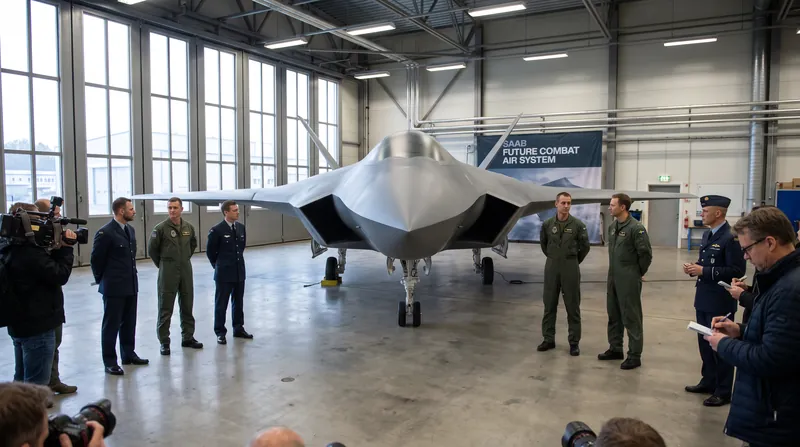
The mechanism of the FCAS program represents a departure from traditional aviation design. The architecture is centered around a Next-Generation Fighter (NGF)—a highly stealthy, crewed aircraft that functions as a flying command center. Rather than engaging targets directly in highly contested airspace, the NGF is designed to operate from a distance, coordinating a fleet of unmanned "remote carriers."[1][7]
These remote carriers are autonomous drones of varying sizes that can fly ahead of the manned fighter to execute strikes, conduct electronic warfare, or absorb enemy anti-aircraft fire. By distributing the combat capabilities across multiple platforms, the system increases survivability and extends the operational reach of the human pilot.[4]
By distributing the combat capabilities across multiple platforms, the system increases survivability and extends the operational reach of the human pilot.
Tying these platforms together is the "combat cloud," a secure, high-bandwidth data network. The combat cloud utilizes artificial intelligence to instantly process sensor data from satellites, ground stations, and the aircraft themselves, distributing a unified picture of the battlefield across the entire fleet. Mastering this networked architecture is the defining challenge of sixth-generation development.[1][2][4]
India's pursuit of FCAS runs parallel to its domestic aerospace efforts. The country is currently developing its own fifth-generation Advanced Medium Combat Aircraft (AMCA), with a prototype flight targeted for later this decade. However, the defense ministry has recognized that the leap to sixth-generation capabilities—particularly in advanced engine development, mission computing, and autonomous teaming—requires a collaborative partnership to manage the technological and financial burdens.[1][3][4]
The strategic imperative for New Delhi is heavily influenced by regional dynamics. China is rapidly modernizing its air power and is reportedly testing two next-generation fighter prototypes, unofficially designated as the J-36 and J-50. By aligning with France, India aims to secure access to the advanced capabilities necessary to counter China's accelerating aerospace advancements and prevent a permanent technological overmatch in the Indo-Pacific.[1][2]
The foundation for this new partnership is built on an already deep bilateral defense relationship. France is currently the only Western European nation with a fully sovereign, end-to-end modern fighter ecosystem, and India is one of its most significant customers. The Indian Air Force operates French Rafale fighters, and the Indian Navy recently approved the purchase of 26 Rafale-Marine aircraft. Furthermore, the two nations have collaborated on naval infrastructure, completing the delivery of six Scorpène-class submarines to India in 2025.[1][4]
Despite this established trust, the path to a joint FCAS program carries significant industrial uncertainty. The primary hurdle will be negotiating the exact terms of cooperation. India is seeking deep industrial exposure, including access to design processes, source code, and technology transfer, rather than conventional licensed production.[4][6]
Whether France will accommodate these demands remains the central open question. Dassault Aviation's fierce protection of its intellectual property was the exact catalyst that fractured the original partnership with Germany. Integrating India's private sector and state-owned defense contractors into the highly guarded French aerospace supply chain will require complex diplomatic and commercial compromises.[4]
If successful, the architecture of an India-France FCAS partnership would establish a formidable new defense technology axis. By pooling resources, Paris secures the capital and scale required to sustain its sovereign defense industry, while New Delhi gains the technological leap necessary to secure its airspace. Ultimately, the collaboration would reduce both nations' reliance on American and Russian platforms, reshaping the global defense market for the next half-century.
Definitions
- Future Combat Air System (FCAS)
- A French-led defense program to develop a sixth-generation network of manned fighters and unmanned drones.
- Combat Cloud
- A secure, high-speed digital network that uses artificial intelligence to share battlefield data across multiple aircraft and systems.
- Remote Carriers
- Unmanned autonomous drones designed to fly alongside manned fighters to conduct strikes, jam radar, or absorb enemy fire.
- Advanced Medium Combat Aircraft (AMCA)
- India's domestic program to develop a fifth-generation stealth fighter jet.
- Sixth-Generation Fighter
- A conceptual class of combat aircraft characterized by advanced stealth, artificial intelligence, and the ability to command swarms of drones.
Sources
Source coverage
7 outlets
3 viewpoints surfaced






- [1]Defense NewsFrench Industrial Base
India seeks role in France's sixth-generation fighter program
Read on Defense News → - [2]South China Morning PostIndian Defense Establishment
Why India is eyeing France's next-generation combat aircraft tech amid jet shortage
Read on South China Morning Post → - [3]The Economic TimesIndian Defense Establishment
India has formally initiated efforts to join a sixth-generation fighter aircraft development programme
Read on The Economic Times → - [4]WIONIndian Defense Establishment
India is seeking to join France's FCAS sixth-generation fighter programme
Read on WION → - [5]Aviation A2ZAerospace Analysts
Most Populated Country in the World Eyes France's 6th-Generation Fighter Program
Read on Aviation A2Z → - [6]Defence Industry EuropeAerospace Analysts
India seeks to join France-led FCAS programme
Read on Defence Industry Europe → - [7]MigFlugFrench Industrial Base
France Lost Germany. It May Have Found India.
Read on MigFlug →
Comments
Every angle. Every day.
Get defense security stories with full source coverage and perspective breakdowns delivered to your inbox.