
FIFA President Gianni Infantino Confirms 64-Team World Cup Expansion Will Be 'Looked At'
Following the transition to a 48-team format for the 2026 tournament, FIFA will evaluate the feasibility of expanding the men's World Cup to 64 teams to further increase global participation.
By Xia Wu

Share this story
FIFA President Gianni Infantino has officially confirmed that the global governing body will examine the feasibility of expanding the men's World Cup to 64 teams following the conclusion of the 2026 tournament. The announcement marks a potential paradigm shift for international soccer, signaling FIFA's intent to continue broadening the tournament's footprint.
Speaking on the future of the sport's marquee event, Infantino emphasized that every nation should have the realistic opportunity to dream of competing on the biggest stage, prompting immediate discussions across the global soccer landscape about the logistical and competitive implications of such a massive undertaking.[1][3]
The prospect of a 64-team field arrives just as the soccer world is bracing for its first major structural change in decades. The upcoming 2026 World Cup, co-hosted by the United States, Canada, and Mexico, will debut a 48-team format, a significant jump from the 32-team structure that had been in place since the 1998 tournament in France.
This intermediate step has already required a sprawling, multi-nation hosting arrangement to accommodate the sheer volume of matches and traveling fanbases. By floating the idea of adding another 16 teams to the roster, FIFA is testing the waters for an event scale that would fundamentally alter how host bids are constructed and evaluated in the future.
At the heart of Infantino's expansion rationale is a philosophy of global inclusion and development. FIFA currently boasts 211 member associations, meaning that even with the expanded 48-team field, less than a quarter of the world's national teams qualify for the pinnacle event.
Proponents of the 64-team model argue that World Cup qualification is the single biggest catalyst for domestic soccer investment, infrastructure development, and youth participation in emerging nations. By lowering the barrier to entry, FIFA hopes to accelerate the sport's growth in populous, underrepresented regions across Africa, Asia, and Oceania, transforming the World Cup into a truly universal festival.[1][5]
Beyond the romanticism of global inclusion, the financial mechanics of a 64-team tournament present a compelling incentive for FIFA's member associations. The World Cup is the primary economic engine for global soccer, generating billions in broadcasting rights, corporate sponsorships, and ticketing revenue.
A larger tournament translates directly to more matches, broader global television audiences, and expanded inventory for commercial partners. This increased revenue pool is subsequently redistributed to national federations through FIFA's development programs, providing crucial funding for grassroots initiatives and national team operations in countries that lack the lucrative domestic league structures found in Europe.[3]
However, the logistical reality of hosting a 64-team World Cup presents an unprecedented challenge that could permanently reshape the bidding process. An event of this magnitude would likely require between 16 and 20 world-class stadiums, alongside dozens of elite training base camps, massive hotel infrastructure, and robust domestic transportation networks capable of moving millions of fans.
Analysts suggest that a 64-team format would effectively eliminate the possibility of a single nation hosting the tournament, outside of perhaps the United States or China. Instead, multi-national co-hosting bids—similar to the 2030 arrangement spanning multiple continents—would become the mandatory standard for future World Cups.[4]
The most intense pushback against further expansion is expected to come from player welfare organizations and elite European clubs. The global soccer calendar is already facing unprecedented congestion, with the introduction of the expanded 32-team FIFA Club World Cup and the revamped UEFA Champions League format adding significant physical demands on top-tier athletes.
FIFPRO, the global players' union, has repeatedly warned about the physical and mental toll of the expanding schedule, citing increased injury rates and shortened offseasons. Adding more teams to the World Cup could extend the tournament's duration or compress the rest periods between matches, escalating the ongoing tension between international governing bodies and domestic leagues.[2][4]
Interestingly, from a purely mathematical and formatting perspective, a 64-team World Cup could resolve some of the structural awkwardness introduced by the 48-team model. The 2026 tournament will feature 12 groups of four, with the top two teams and the eight best third-place finishers advancing to a Round of 32.
A 64-team field would allow for a perfectly symmetrical tournament: 16 groups of four teams, where exactly the top two advance to a clean, 32-team knockout bracket. This structure would eliminate the complex tiebreakers required for third-place advancement and ensure that the final group stage matches remain highly competitive and suspenseful.[1][4]
The history of the World Cup is defined by continuous, albeit gradual, expansion. The inaugural 1930 tournament in Uruguay featured just 13 invited teams. The competition grew to 16 teams in 1934, expanded to 24 teams in 1982 to accommodate more nations from outside Europe and South America, and settled into the beloved 32-team format in 1998.
Each expansion was initially met with skepticism regarding the potential dilution of quality, yet each ultimately succeeded in bringing new vibrant soccer cultures—from South Korea's historic 2002 run to Morocco's captivating journey in 2022—onto the global stage.[2][5]
The geopolitical dynamics within FIFA's voting structure make the 64-team proposal highly viable. The Confederation of African Football (CAF) and the Asian Football Confederation (AFC) represent a massive voting bloc within the FIFA Congress, and both regions stand to gain the most from additional qualification slots.
For decades, European and South American nations have dominated the tournament's representation. A move to 64 teams would likely democratize the allocation of spots, providing guaranteed pathways for emerging soccer markets in the Global South and ensuring that the tournament's demographic makeup more accurately reflects the modern global population.[5]
While Infantino's comments have set the wheels in motion, any formal move toward a 64-team World Cup remains years away. FIFA will first need to conduct extensive feasibility studies, analyzing the logistical, commercial, and physical impacts of the proposed expansion.
The global soccer community will closely monitor the execution of the 48-team 2026 World Cup, using it as a vital stress test for the sport's infrastructure. If the North American tournament proves successful both commercially and operationally, the push for a 64-team festival in the 2030s will likely gain unstoppable momentum, forever changing the scale of the world's most popular sporting event.[1][3]
The essentials
- FIFA President Gianni Infantino confirmed the organization will evaluate expanding the World Cup to 64 teams.
- The move would follow the upcoming 2026 tournament, which is already expanding from 32 to 48 teams.
- Proponents argue expansion will drive investment and participation in emerging soccer nations across Africa and Asia.
- Critics, including player unions, warn that a larger tournament will exacerbate an already congested and physically demanding global calendar.
Timeline
1930
The inaugural FIFA World Cup is held in Uruguay with 13 invited teams.
1982
The tournament expands from 16 to 24 teams to include more nations outside of Europe and South America.
1998
The World Cup expands to the widely popular 32-team format in France.
2026
The tournament will debut a 48-team format across the United States, Canada, and Mexico.
July 2026
Gianni Infantino confirms FIFA will look at expanding the tournament to 64 teams for future editions.
- Global Development Advocates
- Argue that expanding the tournament is essential for democratizing the sport and funding grassroots infrastructure in emerging nations.
- Player Welfare Advocates
- Warn that adding more matches to an already congested global calendar will lead to increased injuries and diminished player health.
- Commercial and Logistical Analysts
- Focus on the immense financial windfall of a larger tournament, balanced against the near-impossible infrastructure demands placed on host nations.
Perspectives this story doesn't cover
- Host city organizing committees
- Lower-tier domestic leagues
Sources
Source coverage
5 outlets
3 viewpoints surfaced





- [1]ESPNGlobal Development Advocates
Infantino: 64-team World Cup will be 'looked at'
Read on ESPN → - [2]BBC SportPlayer Welfare Advocates
Thousand welcome home Cape Verde footballers after stunning World Cup run
Read on BBC Sport → - [3]ReutersCommercial and Logistical Analysts
Infantino opens door to 64-team World Cup to boost global inclusion
Read on Reuters → - [4]The AthleticPlayer Welfare Advocates
What Does It All Mean? Once a Year, French Students Try to Explain.
Read on The Athletic → - [5]Al JazeeraGlobal Development Advocates
Netherlands vs Morocco: FIFA World Cup Round of 32: Prediction, team news
Read on Al Jazeera →

More in Sports
See all →Executive Compensation
US Filings Reveal Undisclosed $1.76 Million World Cup Payment to FIFA President
4 sources

Pitch Geometry
Enforcing Law 14's 9.15-Metre Buffer: Why Soccer's Penalty Arc Extends Four Yards Beyond the Box
4 sources

Nations League
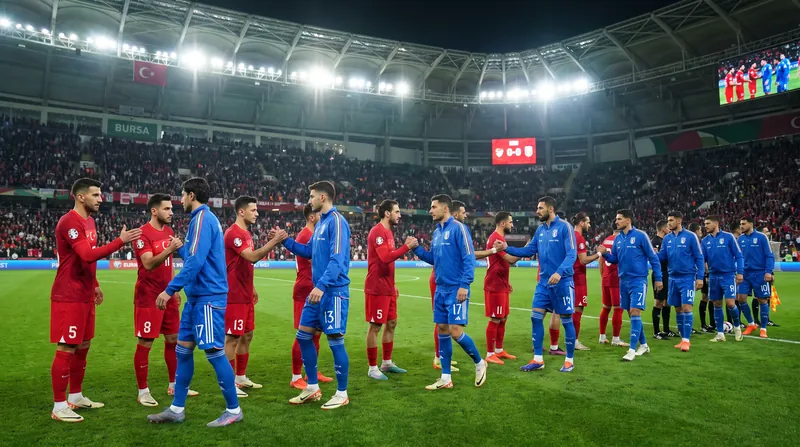
Can Turkey Finally Break Their Winless Curse Against Italy in Nations League Clash?
6 sources
Nations League
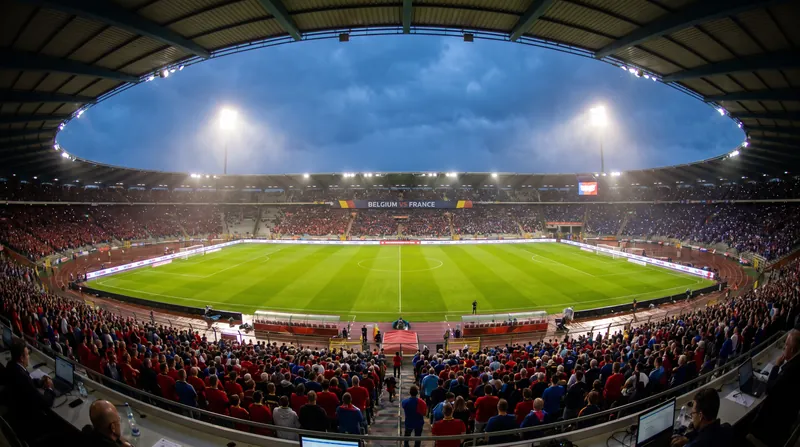
France and Belgium Face Early Nations League Test Without Mbappé and Courtois
5 sources
Comments
Every angle. Every day.
Get Sports stories with full source coverage and perspective breakdowns, free every day.