
Federal Judge Dismisses Remaining Proud Boys Seditious Conspiracy Charges Following Trump Clemency Directive
U.S. District Judge Timothy J. Kelly dismissed the seditious conspiracy cases against four Proud Boys members, citing the Justice Department's request under President Trump's clemency orders. While granting the dismissal, the judge issued a stark warning about the erasure of accountability for the January 6 Capitol attack.
By Adel Khoury
Share this story
Late Friday night, the federal government's landmark prosecution of the far-right Proud Boys came to an abrupt and final end. U.S. District Judge Timothy J. Kelly dismissed the remaining seditious conspiracy charges against four prominent members of the group, closing the book on one of the most high-profile cases stemming from the January 6, 2021, attack on the U.S. Capitol. The dismissal clears Ethan Nordean, Joseph Biggs, Zachary Rehl, and Dominic Pezzola of their remaining legal jeopardy.
The ruling was not unexpected, but rather the final mechanical step in a sweeping reversal of federal law enforcement policy. The case's collapse became a foregone conclusion earlier this year when President Donald Trump utilized his executive clemency powers to dismantle the Justice Department's sprawling January 6 docket. While Trump issued full pardons to over 1,500 rioters, he initially only commuted the sentences of these four men, ending their 10-to-18-year prison terms but leaving the underlying convictions active.
To fully erase the cases, Trump's executive orders directed the Department of Justice to actively seek the dismissal of all ongoing January 6 prosecutions. Faced with a directive from the commander-in-chief, federal prosecutors filed a motion to dismiss the Proud Boys' charges with prejudice, meaning they can never be refiled. Judge Kelly, a Trump appointee who presided over the original trial, was left to rule on a motion where both the defense and the prosecution were suddenly in agreement.
In a scathing seven-page ruling, Judge Kelly made it abundantly clear that his decision was compelled by constitutional architecture, not by agreement with the administration's actions. The judicial branch, he explained, cannot force the executive branch to pursue a criminal prosecution it has decided to abandon. Because the Justice Department holds the sole authority to prosecute federal crimes, the court had no choice but to grant the dismissal.
However, Kelly used the order to issue a stark warning about the historical and democratic implications of erasing the convictions. "No one should mistake the Court's granting of the Government's motion for its agreement with those decisions," he wrote. He emphasized that the dismissal was rooted entirely in the separation of powers, rather than any reassessment of the defendants' actions or the merits of the original jury verdicts.
The judge took the opportunity to firmly define the reality of what occurred on January 6, pushing back against narratives that have sought to downplay the violence. Kelly referred to the riot as a "perilous event" and a direct assault on the constitutional imperative for the peaceful transfer of power between presidents. He noted that the mob's actions resulted in injuries to more than 140 police officers and caused an estimated $3 million in damage to the Capitol complex.
"It was an attack on a coordinate branch of government—Congress—that the Founders saw fit to give a place of primacy in Article I of the Constitution," Kelly wrote in his order. He added a solemn warning for the future: "Moving forward, if this Nation's experiment in self-government is to last another 250 years, the American people—no matter their partisan preferences—will have to act together to preserve, protect and defend that miracle through our constitutional framework".
The dismissal unwinds years of complex investigative and legal work by the Biden-era Justice Department. In May 2023, a Washington, D.C., jury found Nordean, Biggs, and Rehl guilty of seditious conspiracy—a rarely used Civil War-era statute that criminalizes plots to overthrow the government or prevent the execution of its laws by force. Pezzola was acquitted of the seditious conspiracy charge but was convicted of several other felonies, including assaulting a police officer and shattering a Capitol window with a stolen police shield.
The sentences handed down by Judge Kelly at the time reflected the severity of the convictions. The four men received prison terms ranging from 10 to 18 years. Enrique Tarrio, the former national chairman of the Proud Boys who was convicted alongside them, received a 22-year sentence—the longest of any Capitol riot defendant. Tarrio's conviction was vacated entirely last year after he received a full pardon from Trump, bypassing the commutation process applied to his subordinates.
The reaction from the defendants and their supporters was swift and triumphant. Tarrio took to the social media platform X shortly after the ruling was issued on Friday night to celebrate the dismantling of the government's case. "We took the worst they threw at us the raids, the solitary, the lies and we stood tall," Tarrio wrote. "Trump dropped the pardons and now the rest is crumbling. Justice is SERVED!".
For the Trump administration, the dismissals represent the fulfillment of a major campaign promise. The president has long defended the rioters, framing the Justice Department's pursuit of them as a "national injustice" and a partisan weaponization of the legal system. By ordering the DOJ to drop the cases, the administration argues it is restoring fairness and ending what it characterizes as political persecution.
Conversely, democracy advocates and institutionalists view the systematic dismantling of the January 6 prosecutions as a dangerous precedent. Critics argue that using executive power to shield political supporters from the consequences of violent actions undermines the rule of law and signals that future attempts to subvert elections will go unpunished. The erasure of convictions for individuals who physically assaulted law enforcement officers has drawn particular outrage from police unions and civil rights groups.
The legal fallout from Trump's clemency directives is not yet complete. A different federal judge is currently weighing a nearly identical Justice Department request to throw out the seditious conspiracy convictions of leaders from the Oath Keepers, another extremist group involved in the Capitol breach. Given the binding nature of the separation of powers doctrine cited by Judge Kelly, legal experts expect those charges to be dismissed as well.
Ultimately, Judge Kelly's reluctant dismissal serves as a definitive marker of how executive power can reshape the historical and legal record. While the court's order formally clears the Proud Boys of their seditious conspiracy charges, the judge's accompanying seven-page rebuke ensures that the judicial branch's original assessment of the January 6 attack remains permanently etched into the federal docket.
Key points
- U.S. District Judge Timothy J. Kelly formally dismissed the seditious conspiracy charges against four Proud Boys members.
- The dismissal was requested by the Justice Department following President Trump's executive clemency orders.
- Judge Kelly warned that the ruling was compelled by the separation of powers and was not an endorsement of the DOJ's decision.
- The judge reiterated that the January 6 attack was a 'perilous event' that injured over 140 police officers.
What we don’t know
- Whether the separate federal judge overseeing the Oath Keepers' case will issue a similarly critical ruling when dismissing their charges.
- How the systematic erasure of these convictions will impact the long-term independence and operational morale of the Justice Department.
How we got here
Jan 2021
A violent mob breaches the U.S. Capitol in an attempt to halt the certification of the 2020 election.
May 2023
A federal jury convicts several Proud Boys leaders of seditious conspiracy and other felonies.
Jan 2025
President Trump issues mass pardons for over 1,500 rioters and commutes the sentences of the Proud Boys leaders.
July 2026
Judge Timothy J. Kelly formally dismisses the remaining charges at the request of the Justice Department.
- The Judiciary & Institutionalists
- Federal judges emphasize that while they must respect the separation of powers, the dismissal does not validate the attack on the Capitol.
- The Trump Administration & Allies
- The administration and its supporters view the original prosecutions as a partisan weaponization of the justice system.
- Democracy & Accountability Advocates
- Civil rights groups and legal watchdogs warn that erasing these convictions sets a dangerous precedent for political violence.
Perspectives this story doesn't cover
- Capitol Police officers injured during the riot
- Federal prosecutors who originally built the cases
Sources
Source coverage
4 outlets
3 viewpoints surfaced




- [1]The Washington PostThe Judiciary & Institutionalists
Judge ends Jan. 6 case against Proud Boys with warning about Trump pardons
Read on The Washington Post → - [2]Al JazeeraDemocracy & Accountability Advocates
US judge dismisses January 6 case against Proud Boys after Trump order
Read on Al Jazeera → - [3]Fox NewsThe Trump Administration & Allies
Trump-appointed judge permanently ends Proud Boys Jan. 6 case, says Constitution left him no choice
Read on Fox News → - [4]ReutersDemocracy & Accountability Advocates
U.S. judge dismisses Proud Boys Jan. 6 charges after Trump clemency directive
Read on Reuters →
More in News & Politics
See all →International Justice
Venezuela Formally Withdraws From International Criminal Court Amid 'Bias' Accusations
4 sources
Immigration Enforcement
Trump Administration Suspends Routine ICE Vehicle Stops Following String of Fatalities
7 sources
Immigration Policy
Trump Administration to Open 528-Bed Migrant Staging Center Next to Louisiana Deportation Hub
3 sources

Philippine Politics
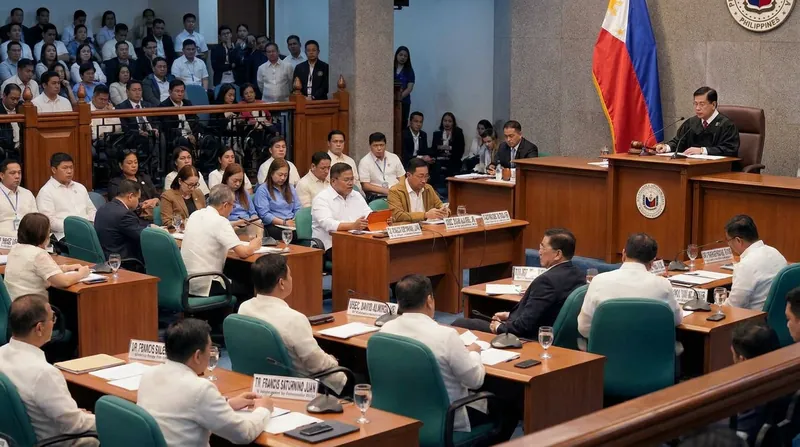
Philippine Senate Opens Historic Impeachment Trial of Vice President Sara Duterte
4 sources
Comments
Every angle. Every day.
Get News & Politics stories with full source coverage and perspective breakdowns, free every day.