
Evidence Pack: How Russia Trades Submarine Technology for Chinese Machine Tools
In exchange for the industrial equipment needed to sustain its defense manufacturing, Moscow is transferring highly sensitive acoustic dampening technology to Beijing, fundamentally altering the global undersea balance.

Share this story
In short
- Russia has become structurally dependent on Chinese industrial equipment, importing 70% of its machine tools and 90% of its microelectronics from China.
- In exchange for this manufacturing lifeline, Moscow is transferring highly sensitive military technology, including submarine acoustic dampening designs, to Beijing.
- The exchange addresses critical vulnerabilities for both nations: Russia gains the physical tools to sustain its defense base, while China accelerates its undersea warfare capabilities.
In the final quarter of 2023, nearly 70 percent of Russia's $900 million in machine tool imports originated from a single partner: China. This influx of computer numerical control (CNC) machines, microelectronics, and nitrocellulose filled a critical void left by Western sanctions, allowing Russian defense plants to sustain the production of ballistic missiles, armored vehicles, and aircraft.
Yet this supply chain is not a one-way transaction. In exchange for the industrial equipment required to maintain its immediate manufacturing base, Moscow is transferring some of its most closely guarded military secrets to Beijing.[1][2][3][4]
The most consequential of these transfers involves advanced submarine quieting technology. For decades, the People's Liberation Army Navy (PLAN) has rapidly expanded its surface fleet, but its submarines—many of which are diesel-electric models—have lagged behind the all-nuclear U.S. submarine force in acoustic stealth. Russian nuclear-powered attack submarines, by contrast, possess highly sophisticated acoustic dampening, hull designs, and propulsion mechanisms. By providing Beijing with the engineering blueprints and technical assistance to build quieter submarines, Moscow is directly addressing one of China's most significant naval vulnerabilities.[3][4][5]
The strategic logic driving this exchange represents a fundamental shift in Sino-Russian relations. Historically, Russia hesitated to share its apex military technology with China, wary of reverse-engineering and long-term border security. Moscow previously restricted the export of its most advanced jet engines and submarine designs, preferring to sell downgraded export variants. However, the protracted conflict in Ukraine has inverted the power dynamic, stripping Russia of its leverage and forcing a reevaluation of its technology sharing policies.[2][6]
Unable to source precision milling machines from Germany, Japan, or Taiwan, Russia's defense-industrial base has become structurally dependent on Chinese imports. Customs data reveals that China's share of Russian metalworking machine tool imports jumped from roughly 13 percent in 2017 to nearly 90 percent by late 2023, completely replacing former European and Asian suppliers. This dependency has forced Moscow to open its most sensitive technology portfolios, including aeronautical stealth design and missile defense architectures, to secure the physical tools needed for immediate survival.[2][4][6]
The evidence for this technological barter emerges from a combination of declassified intelligence, trade data, and public statements by military commanders. U.S. Indo-Pacific Command has explicitly warned that the transfer of Russian submarine technology has the potential to close the gap in undersea dominance. Meanwhile, Ukrainian intelligence has confirmed that at least 20 different Russian defense plants have received machine tools, chemical products, and components directly from Chinese suppliers, underscoring the scale of the industrial backfill.[2][3][4]
Despite the clear macro-trend, the precise mechanics of the technology transfer remain opaque. It is unclear whether Russia is providing complete technical data packages, dispatching engineering teams to Chinese shipyards, or jointly developing next-generation platforms. The timeline for integrating Russian acoustic technology into Chinese submarine production lines is similarly uncertain, as submarine construction requires years of lead time and exacting manufacturing tolerances.[2][3][5][6]
Furthermore, while Chinese CNC machines are sustaining Russian production lines, questions remain regarding their long-term reliability and precision compared to the Western equipment they replaced. The 3-to-4 micron precision required for advanced aerospace components pushes the limits of mid-tier industrial tools. If Chinese machines suffer higher breakdown rates or fail to meet the exacting tolerances required for advanced weaponry, Russia's production capacity could face future bottlenecks despite the current influx of equipment.[6][7]
The downstream consequences of this exchange extend far beyond the immediate European theater. By accelerating China's undersea warfare capabilities, the technology transfer alters the strategic calculus in the Indo-Pacific. Quieter Chinese nuclear submarines would complicate U.S. and allied anti-submarine warfare (ASW) operations, requiring exponentially more resources to track and monitor PLAN vessels. This dynamic effectively links the European and Pacific security environments into a single, interconnected strategic system, where industrial support in one theater directly subsidizes military modernization in another.[3][4][5]
Ultimately, the Sino-Russian defense technology trade illustrates how sanctions can inadvertently catalyze new technological alliances. By cutting Russia off from global industrial markets, Western policy forced Moscow to leverage its remaining asymmetric asset—advanced military engineering—to secure physical manufacturing capacity. The result is a symbiotic relationship where Chinese industrial scale meets Russian technical pedigree, fundamentally reshaping the defense capabilities of both nations and accelerating the deployment of advanced naval systems.[1][2][6]
Key terms
- Computer Numerical Control (CNC) Machine
- Automated milling and lathing equipment used to manufacture highly precise metal components for aerospace and defense applications.
- Acoustic Dampening
- Engineering techniques, including specialized hull coatings and isolated propulsion systems, used to reduce the noise a submarine makes underwater.
- Microelectronics
- Small-scale electronic components, such as semiconductors and legacy chips, essential for the guidance and control systems of modern weaponry.
Viewpoints in depth
U.S. Indo-Pacific Command
Views the technology transfer as a direct threat to American undersea dominance.
Military planners in the Indo-Pacific view the Sino-Russian exchange as a critical strategic risk. For decades, the U.S. Navy has relied on the acoustic superiority of its all-nuclear submarine fleet to track and deter rival vessels. By acquiring Russian quieting technology, China could rapidly close this capability gap, forcing the U.S. and its allies to expend significantly more resources on anti-submarine warfare (ASW) patrols and acoustic sensor networks across the Pacific.
Russian Defense Sector
Views the exchange as a necessary survival mechanism to maintain production.
For the Russian defense-industrial base, the transfer of sensitive technology is a calculated trade-off driven by immediate necessity. Cut off from Western precision milling machines and microelectronics, Russian factories cannot produce the ballistic missiles, drones, and armored vehicles required for the ongoing conflict. Trading future technological exclusivity for present-day manufacturing capacity ensures the survival of the state's military output, even if it empowers a neighboring power in the long term.
Strategic Analysts
Views the dynamic as an unintended consequence of Western sanctions.
Geopolitical and economic analysts point out that the current technology barter is a structural byproduct of the sanctions regime. By isolating Russia from global industrial markets, Western policy inadvertently forced Moscow to leverage its only remaining high-value currency—advanced military engineering. This dynamic has accelerated the integration of the European and Pacific security theaters, creating a symbiotic relationship where Chinese industrial scale directly subsidizes Russian military operations, and Russian technical pedigree accelerates Chinese naval modernization.
- U.S. Defense Officials
- Focuses on the strategic threat posed by a modernized Chinese submarine fleet.
- Industrial Supply Chain Analysts
- Focuses on the data and mechanics of the machine tool and microelectronics trade.
- Geopolitical Strategists
- Analyzes the broader implications of the Sino-Russian alignment and the unintended effects of sanctions.
Perspectives this story doesn't cover
- Chinese defense ministry officials detailing their domestic submarine development timeline.
- European machine tool manufacturers assessing the secondary market flow of their equipment.
Sources
Source coverage
8 outlets
3 viewpoints surfaced








- [1]AP NewsIndustrial Supply Chain Analysts
U.S. intelligence shows China is surging equipment sales to Russia to help war effort in Ukraine
Read on AP News → - [2]Foundation for Defense of DemocraciesGeopolitical Strategists
China-Russia Defense Cooperation Showcases Rising Axis of Aggressors
Read on Foundation for Defense of Democracies → - [3]Defense OneU.S. Defense Officials
Russian submarine tech could help China outpace US: INDOPACOM
Read on Defense One → - [4]South China Morning PostU.S. Defense Officials
China and North Korea's Ukraine war aid to Russia creates risk in Pacific: US admiral
Read on South China Morning Post → - [5]Australian Strategic Policy InstituteGeopolitical Strategists
Russia's Pacific submarine fleet: a potential asset for China
Read on Australian Strategic Policy Institute → - [6]Tufts UniversityIndustrial Supply Chain Analysts
Russia's industrial sector has become full dependent on China for machine tools
Read on Tufts University → - [7]NewsweekIndustrial Supply Chain Analysts
Russia denied key technology by China
Read on Newsweek → - [8]Factlen Editorial TeamGeopolitical Strategists
Synthesis by Factlen editorial team
Read on Factlen Editorial Team →
More in Defense & Security
See all →Acoustic Stealth
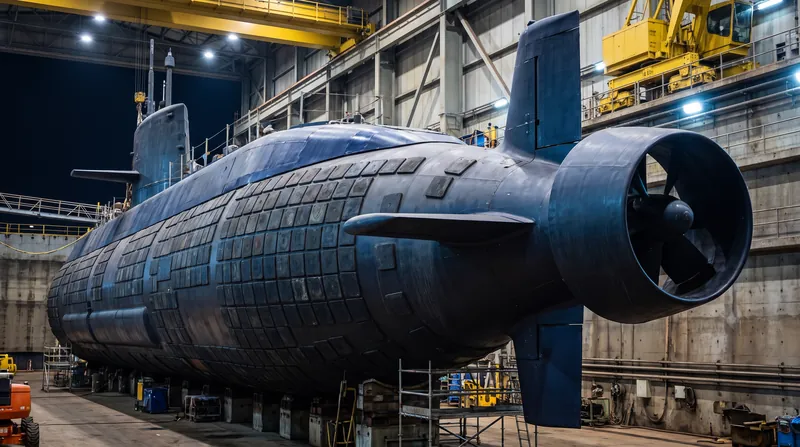
Silencing the Hull: How Anechoic Tiles, Isolation Mounts, and Pump-Jets Suppress Submarine Radiated Noise
9 sources
Directed Energy
Atmospheric Constraints on Directed Energy: How Thermal Blooming and Jitter Cap Laser Weapon Range
7 sources
Precision Strike
Evaluating the Accuracy and Vulnerability of Inertial, GPS-Aided, and Terminal Missile Guidance
5 sources
Electromagnetic Spectrum
How Electronic Warfare Cycles Through Support, Attack, and Protection
7 sources
Comments
Every angle. Every day.
Get Defense & Security stories with full source coverage and perspective breakdowns, free every day.