
Coffee Bean Density and Thermal Stability Dictate the True Caffeine Content of Your Cup
The enduring debate over which coffee roast provides a stronger stimulant boost comes down to basic physics rather than chemistry. Because caffeine survives the roasting process intact, the final potency of a cup is determined by whether the beans are measured by weight or by volume.

Share this story
In short
- Caffeine remains structurally stable at standard roasting temperatures, meaning individual light and dark roast beans contain virtually identical amounts of the stimulant.
- Dark roasting evaporates more water weight and expands the beans, making them significantly larger and less dense than light roast beans.
- Measuring coffee by volume yields more caffeine from dense light roasts, while measuring by weight yields nearly identical caffeine across all roast levels.
Walk into any specialty café and you will hear two entirely contradictory rules about how to brew a potent cup. The traditionalists swear by the oily, midnight-black French roast, arguing that its intense, smoky bitterness is the literal taste of high caffeine concentration.
Meanwhile, the modern pour-over enthusiasts insist that those dark beans have been roasted to death, burning away the stimulant. They argue that a cinnamon-colored light roast, pulled from the drum just after the first crack, preserves the bean’s natural chemical potency alongside its bright, fruity acids.
Both camps are fiercely protective of their morning rituals, yet both are basing their recipes on a fundamental misunderstanding of thermal chemistry. The actual caffeine content in your mug depends entirely on whether you reach for a digital scale or a plastic scoop before you brew.
To understand why the measurement tool matters more than the bean color, you have to look inside the roasting drum. Green coffee beans are dropped into a steel cylinder heated to roughly 200 to 250 degrees Celsius, triggering a cascade of chemical transformations.[2]
The Thermal Resilience of Caffeine
During this intense thermal exposure, moisture evaporates rapidly and complex carbohydrates break down into the aromatic compounds that fill your kitchen with that signature morning scent. However, the caffeine molecule itself is remarkably stubborn, resisting the heat that destroys other compounds.
Caffeine remains structurally stable until it reaches its sublimation point at 235 degrees Celsius, a threshold that most commercial roasting profiles never cross. "Caffeine is remarkably heat-stable at standard roasting temperatures," notes the educational team at Kraffe Roasters, explaining that an individual bean retains virtually all its original stimulant.
A 2021 study published in Food Science and Biotechnology confirmed that while other organic compounds degrade rapidly, caffeine levels remain remarkably stable across all commercial roasting conditions. Because the roasting environment rarely exceeds this thermal ceiling for long enough to degrade the alkaloid, the absolute amount of caffeine per bean stays effectively constant.[2]
While the caffeine survives the heat, other vital compounds are obliterated. Chlorogenic acids, which provide the bright, fruity acidity in a light roast, degrade by more than 90 percent when pushed to an Italian roast profile.[2]
As these acids break down, they form bitter lactones and melanoidins, fundamentally altering the flavor profile. This chemical shift creates the intense, robust taste that tricks our brains into perceiving a higher caffeine concentration.[2]
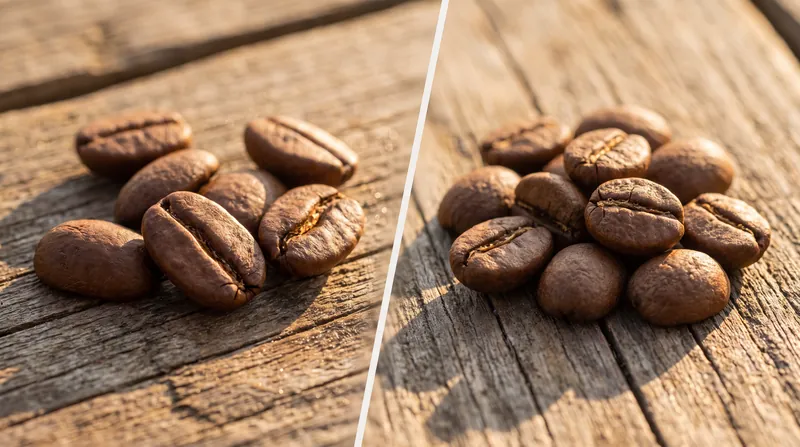
What does change dramatically during the 15-minute roasting cycle is the physical architecture of the bean itself. As the internal water turns to steam and forces its way out, the cellular structure expands and puffs up, much like popcorn.
The Illusion of Density
By the time a batch reaches the dark, oily stage of a French roast, the beans have lost up to 20 percent of their original mass to moisture evaporation. Simultaneously, this violent outgassing forces the beans to swell, significantly increasing their physical volume while plummeting their overall density.[2]
This inverse relationship between mass and volume is where the great caffeine illusion begins. A light roast bean remains small, dense, and heavy, having lost only about 12 percent of its water weight. This minimal moisture loss leaves the bean physically smaller but packed with its original mass.
"Since dark roast coffees weigh less than light roast coffees, a pound of dark roast will include more beans than a pound of light," explains Zoe Maiden, an educator at Sagebrush Coffee. That simple physical reality dictates exactly how much stimulant ends up in your morning filter.
If you measure your daily dose using a standard tablespoon, you are brewing by volume. Because dark roast beans are puffed up and airy, fewer of them can physically fit into that plastic scoop. This creates a visual deception that alters your morning recipe.
The Scale Versus the Scoop
A single tablespoon of dense light roast beans weighs approximately six grams, while that exact same tablespoon filled with expanded dark roast beans weighs only five grams. When you brew by volume, you are unknowingly using fewer beans, which guarantees a less caffeinated cup.
Conversely, if you weigh your morning dose on a digital kitchen scale, the math flips entirely. To hit a target weight of 20 grams, you have to grind significantly more of the airy, lightweight dark roast beans than you would the dense light roast.
Because you are grinding a higher total number of beans to reach that 20-gram threshold, a weight-based dark roast brew actually delivers a marginally higher caffeine dose. The roasting process burned off water weight, leaving the caffeine more concentrated by mass.
The difference, however, is incredibly slight when measured precisely. Light roast contains approximately 1.2 to 1.4 percent caffeine by weight, while dark roast sits at roughly 1.1 to 1.3 percent. This slight variation is easily overshadowed by how you prepare the drink.
The Variables That Actually Matter
When equalized for a standard extraction, weight-based brewing yields a negligible variance of just a few milligrams between the two roast profiles. For the average coffee drinker, this microscopic gap is entirely imperceptible during a busy morning commute.[1]
If you are genuinely chasing a stronger chemical wake-up call, the roast level is the wrong variable to adjust. The species of the coffee shrub plays a vastly more significant role in determining your beverage's final potency.
The harsh, earthy Robusta beans used in cheap diner blends naturally carry about 2.7 percent caffeine by dry weight. This is roughly double the 1.2 percent found in the smooth, complex Arabica beans favored by specialty cafes.
Your chosen brewing method also dramatically alters the extraction efficiency. A slow, full-immersion French press allows the hot water more time to strip the soluble alkaloids from the grounds compared to a rapid espresso shot. The longer the water sits with the grounds, the more caffeine it extracts.
An eight-ounce cup of standard drip coffee typically delivers between 95 and 165 milligrams of caffeine, regardless of whether the beans were roasted to a light cinnamon or a dark mahogany. The water temperature and contact time dictate the final yield.
The thermal stability of caffeine ensures that neither preference will leave you sleeping at your desk. You can safely choose your morning brew based entirely on whether you prefer bright fruit notes or comforting smoky caramel, knowing the chemical engine remains intact.
How we did this
- Method
- Normalisation of caffeine concentration per brewed cup across measurement paradigms
- What we found
- When equalised for a standard 15-gram extraction, weight-based brewing yields a negligible 1.5-milligram variance between roasts, whereas volume-based brewing (using three tablespoons) creates a 20% caffeine deficit in the dark roast cup solely due to atmospheric displacement.
- What we worked from
- Caffeine concentration by weight (light vs dark): 1.2-1.4% vs 1.1-1.3%
- Bean density volume divergence (light vs dark mass per tablespoon): 6 grams vs 5 grams
- Limits of this analysis
- Assumes identical extraction efficiency across both roast profiles, which can vary based on grind size and water temperature.
Key terms
- Sublimation point
- The specific temperature at which a solid substance transitions directly into a gas, which for caffeine occurs at 235 degrees Celsius.
- First crack
- The moment during roasting when expanding steam breaks the coffee bean's cellular structure, typically marking the beginning of a light roast.
- Chlorogenic acids
- Chemical compounds in raw coffee beans that provide bright, fruity flavors but degrade rapidly under high roasting heat.
- Melanoidins
- Brown, complex polymers formed during roasting that give dark roast coffee its bitter, robust flavor profile.
- Extraction efficiency
- The rate and total amount of soluble compounds, including caffeine, that hot water successfully pulls from ground coffee.
Frequently asked
Does roasting coffee longer burn off the caffeine?
No. Caffeine is thermally stable up to 235 degrees Celsius, which is higher than standard roasting temperatures. The molecule remains intact while other compounds break down.
Why does light roast coffee seem to give me more energy?
If you measure your coffee with a scoop, light roast beans are denser and smaller, meaning more beans fit into the scoop. More physical beans yield more caffeine per pot.
Is espresso higher in caffeine than drip coffee?
Per ounce, espresso is highly concentrated, but a standard eight-ounce cup of drip coffee typically contains more total caffeine than a single one-ounce espresso shot.
Does the type of coffee bean affect caffeine more than the roast?
Yes. Robusta beans naturally contain about twice the caffeine of Arabica beans, making the bean species a much larger factor than the roast level.
Viewpoints in depth
Specialty Coffee Roasters
Advocates for light roasts who emphasize that bean density, not roast level, dictates caffeine.
Specialty roasters argue that the traditional association between dark, bitter coffee and high caffeine is a sensory illusion. By pulling beans from the roaster shortly after the first crack, they preserve the bean's natural density. They emphasize that when consumers measure these dense, moisture-rich beans by the scoop, they inadvertently brew a more caffeinated cup simply because more physical beans fit into the measuring tool.
Food Scientists
Researchers focused on the thermal degradation of coffee compounds during the roasting process.
Chemical researchers approach the caffeine debate through the lens of thermal stability. They note that while chlorogenic acids and complex carbohydrates degrade rapidly at temperatures above 200 degrees Celsius, the caffeine alkaloid remains structurally intact until 235 degrees Celsius. For scientists, the caffeine variance between roasts is merely a mathematical byproduct of moisture evaporation and cellular expansion, rather than a chemical destruction of the stimulant itself.
- Specialty Coffee Roasters
- Advocates for light roasts who emphasize that bean density, not roast level, dictates caffeine.
- Traditional Coffee Consumers
- Drinkers who associate bold, bitter dark roast flavors with higher caffeine and physical strength.
- Food Scientists
- Researchers focused on the thermal degradation of coffee compounds during the roasting process.
Perspectives this story doesn't cover
- Decaffeinated coffee drinkers
- Commercial instant coffee manufacturers
Sources
Source coverage
2 outlets
3 viewpoints surfaced


- [1]Factlen Editorial Team
Synthesis by Factlen editorial team
Read on Factlen Editorial Team → - [2]Food Science and BiotechnologyFood Scientists
Physicochemical characteristics of Ethiopian Coffea arabica cv. Heirloom coffee extracts with various roasting conditions
Read on Food Science and Biotechnology →
More in Food & Drink
See all →Coffee Chemistry
Coffee Extraction Dynamics: Balancing Acid and Bitterness at 18 to 22 Percent
6 sources
Brewing Dynamics
How Bimodal Flat Burrs Accelerate Fines Migration to Cause Uneven Flow Channels
2 sources
Coffee Science
Adding 20 Microlitres of Water per Gram Dissipates Triboelectric Charge to Eliminate Coffee Grinder Static
4 sources
Espresso Mechanics
The 9-Bar Maximum: How 1940s Spring-Lever Engineering Established the Global Standard for Espresso Extraction
7 sources
Comments
Every angle. Every day.
Get Food & Drink stories with full source coverage and perspective breakdowns, free every day.