
GuideHall Effect Sensors for Stick DriftRevision 1Updated
Hall Effect and TMR Sensors: The Permanent Fix for Controller Stick Drift
The gaming hardware industry is rapidly abandoning traditional analog sticks in favor of frictionless magnetic sensors. By replacing physical contact with quantum tunneling, TMR and Hall Effect modules permanently eliminate the mechanical wear that ruins controllers.

Share this story
In short
- Standard controller thumbsticks use potentiometers that wear out from friction, causing stick drift in as little as 400 hours of heavy use.
- Hall Effect sensors eliminate friction by using magnets to measure movement, making them virtually immune to traditional stick drift.
- TMR (Tunnel Magnetoresistance) is the newest sensor generation, offering higher precision and drawing up to 1,000 times less power than Hall Effect modules.
For any dedicated player, the symptoms are instantly recognizable and entirely infuriating. You take your thumb off the right stick, but the game camera continues to pan slowly toward the sky. Your character wanders off a ledge while you are looking at your inventory. This is stick drift, the mechanical plague of modern gaming hardware.
It ruins competitive matches, destroys speedruns, and forces players to replace expensive gamepads long before the buttons or triggers fail. The issue has sparked class-action lawsuits against major console manufacturers and spawned a massive aftermarket repair industry. Yet, the root cause is not a software bug or a manufacturing defect, but a fundamental limitation of the underlying technology.
The vast majority of standard controllers rely on a decades-old component to translate physical movement into digital input. These components are cheap to produce, easy to program, and inherently doomed to fail. The friction required to make them work is exactly what eventually destroys them.
Now, the peripheral industry is undergoing a massive hardware shift to permanently solve the problem. By replacing physical contact with magnetic fields, hardware engineers are building thumbsticks that simply do not wear out from friction. The transition from traditional potentiometers to Hall Effect and Tunnel Magnetoresistance sensors represents the biggest leap in controller reliability in twenty years.
The Mechanics of Stick Drift
To understand why controllers fail, you have to look at the component inside the thumbstick module. Most first-party gamepads, including the PlayStation DualSense and Xbox Series X controllers, use joystick modules manufactured by ALPS Alpine. These modules rely on traditional potentiometers to measure where your thumb is pushing.[1]
A potentiometer works through direct physical contact. Inside the module, a small metal wiper is mechanically linked to the stick shaft. As you move the thumbstick, this wiper drags across a curved carbon resistive track. The position of the wiper changes the electrical resistance, which the controller translates into an X and Y coordinate.[4]
Because the wiper must physically scrape against the carbon track to read the resistance, every single movement grinds away a microscopic layer of material. Over months of gameplay, this friction wears the track down and creates carbon dust inside the housing. The electrical signal becomes noisy and inconsistent.[8]
That electrical noise is what the console interprets as stick drift. The controller reads a change in resistance caused by the damaged track and assumes you are pushing the stick, even when it is perfectly centered. Once the track is physically scarred, no amount of software recalibration or deadzone adjustment can permanently fix it.
The lifespan of these components is surprisingly short. According to an investigation by iFixit, the ALPS RKJXV potentiometers used in many modern controllers are rated for roughly 2,000,000 actuation cycles. While that sounds like a massive number, it translates to a remarkably brief window of heavy use.[1]
By measuring the stick inputs required for a standard first-person shooter, an iFixit teardown engineer calculated the grim reality. "No device rated for a finite number of actions, especially one that lives next to so much contamination and takes so much abuse, can maintain perfect performance forever," the engineer noted, estimating the sticks could exceed their operating life in just 417 hours of gameplay.[1]
How Hall Effect Sensors Work
The solution to friction-based wear is to remove the friction entirely. Hall Effect sensors achieve this by measuring magnetic fields instead of relying on physical contact. The technology is named after physicist Edwin Hall, who discovered the underlying electromagnetic phenomenon in 1879.[3]
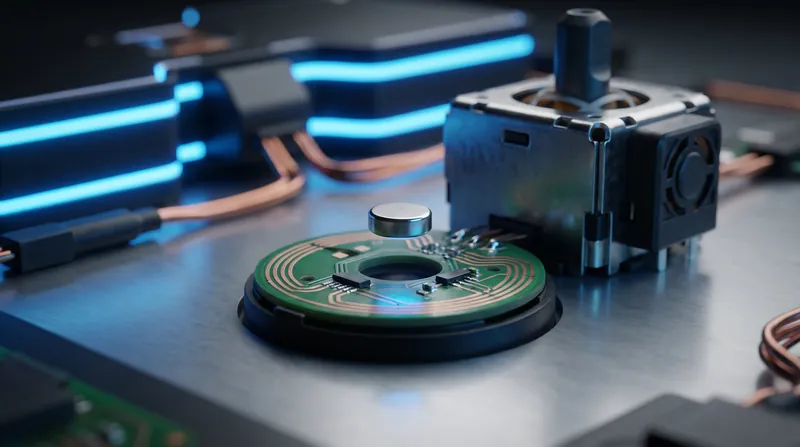
In a Hall Effect thumbstick, a small permanent magnet is attached to the base of the joystick shaft. A stationary semiconductor sensor sits nearby on the circuit board. As you move the stick, the magnet shifts, altering the magnetic field passing through the sensor.[3][4]
The sensor detects this change in the magnetic field and outputs a proportional voltage. Because the magnet and the sensor never physically touch, there is no wiper dragging across a carbon track. The primary mechanical wear mechanism that causes stick drift is completely eliminated from the equation.
This is not actually a new concept in gaming hardware. Sega pioneered the use of Hall Effect sensors in the Dreamcast and Saturn controllers in the late 1990s. Many of those original gamepads still function perfectly today, demonstrating the remarkable long-term durability of magnetic sensing.
However, the industry largely abandoned the technology in the 2000s in favor of cheaper ALPS potentiometers. It was only when the Nintendo Switch Joy-Con drift controversy reached a boiling point that third-party manufacturers began looking for a premium, drift-proof alternative to market to frustrated consumers.
The TMR Breakthrough
While Hall Effect sticks are a massive upgrade over potentiometers, hardware engineers have recently introduced an even more advanced magnetic technology. Tunnel Magnetoresistance, or TMR, is the third and newest generation of joystick sensing. It takes the contactless benefits of Hall Effect and applies quantum physics to improve it.[2][5]
Instead of measuring variations in a perpendicular magnetic field, a TMR sensor relies on a microscopic structure composed of two ferromagnetic layers separated by an incredibly thin insulating barrier. One magnetic layer is fixed, while the other responds to the moving magnet on the thumbstick.[10]
Electrons use quantum tunneling to pass through the insulating barrier. As the thumbstick moves, the changing magnetic field alters the probability of electrons tunneling through, which changes the electrical resistance of the component. This in-plane measurement is incredibly sensitive to microscopic movements.[10]
The same TMR technology is used in the read heads of modern hard drives, where detecting microscopic magnetic shifts is essential. By bringing this quantum sensing into game controllers, manufacturers can achieve a level of precision that traditional Hall Effect sensors struggle to match without heavy software filtering.[7]
Power Draw and Battery Life
The most significant practical difference between Hall Effect and TMR sensors is power consumption. Because the Hall effect produces a very subtle voltage change, the signal requires active amplification on the circuit board. This amplification process constantly draws power from the controller's battery.
A standard Hall Effect sensor typically draws between 5 and 10 milliamperes of current. While this is negligible for a wired gamepad plugged into a PC, it becomes a serious drain on a wireless controller. Replacing four potentiometers with four Hall Effect sensors noticeably reduces the overall battery life of a wireless pad.[6]
TMR sensors solve this efficiency problem entirely. Because they measure resistance shifts rather than relying on voltage amplification, their power requirements are drastically lower. Technical specifications show that a TMR sensor draws only 0.001 to 0.01 milliamperes, making it up to a thousand times more efficient than a Hall Effect module.[6]
This massive reduction in power consumption makes TMR the ideal choice for premium wireless controllers. Brands like GameSir and Razer are leveraging this efficiency to push polling rates higher without killing the battery. The Razer Wolverine V3 Pro, for instance, uses TMR to maintain a high-speed wireless connection while preserving hours of playtime.[6]
For competitive players, the combination of drift immunity and low latency is the holy grail. A wireless controller that can run at a 1000Hz polling rate without dying in the middle of a tournament bracket is a massive competitive advantage, and TMR makes that power budget possible.
Precision and Deadzones
Beyond battery life, TMR sensors offer a cleaner signal floor. Traditional potentiometers often suffer from jitter, requiring firmware engineers to implement deadzones—small areas in the center of the stick where movement is ignored. This prevents the camera from drifting, but it makes fine aiming feel sluggish.
Because TMR sensors are so sensitive, they can operate with true zero deadzones. The GameSir G7 Pro utilizes Mag-Res TMR sticks that boast a 4096-level resolution. This allows the controller to register the absolute slightest twitch of a thumb, translating into incredibly smooth and linear motion on screen.[9]
In a competitive first-person shooter, this micro-precision matters. When tracking a moving target at long range, a player needs the crosshair to respond instantly to a millimeter of pressure. TMR sensors provide that crisp, immediate input curve without the underlying noise that plagues worn carbon tracks.
The overall implementation still matters heavily. A premium sensor paired with bad firmware will still feel terrible. However, controllers like the Leadjoy Saber Plus have integrated raw-input RC filters natively into their TMR setups, yielding maximum stick smoothness without adding latency penalties.[11]
This level of hardware tuning is why professional players are starting to take notice. While many pros cling to the classic PlayStation 4 controller shape out of muscle memory, the internal hardware of those old pads cannot compete with the tracking fidelity of a modern TMR module.
Upgrading and Modding
For players who refuse to abandon their favorite first-party controllers, the aftermarket has stepped in. Modding communities and peripheral companies are now manufacturing drop-in magnetic replacement modules for standard gamepads.
GuliKit, a pioneer in the magnetic stick market, has released Hall Effect replacement modules for the Nintendo Switch Joy-Cons and the Valve Steam Deck. These kits allow users to open their devices, remove the failing ALPS sticks, and install drift-proof magnetic sensors in their place.[12]
Upgrading a standard PlayStation DualSense or Xbox Series controller is significantly more difficult. Sony and Microsoft solder the analog stick modules directly to the main circuit board. Replacing them requires a soldering iron, a desoldering pump, and a steady hand to remove the 14 pins holding the module in place.
To bypass this difficulty, GuliKit and other manufacturers are targeting modular controllers. The $200 PlayStation DualSense Edge features hot-swappable thumbstick modules that slide out of the chassis. Third-party companies are developing magnetic replacements that slot directly into the Edge, upgrading the pad without voiding the warranty.[12]
Repair shops are also offering mail-in TMR upgrade services. For a fee, technicians will desolder the factory ALPS sticks from an Xbox Elite Series 2 or a standard DualSense and solder in high-precision TMR modules, effectively future-proofing the controller against friction wear.[8]
The Reality of Drift Immunity
While magnetic sensors are marketed as a permanent cure for stick drift, it is important to understand their physical limitations. Hall Effect and TMR sensors eliminate the electrical wear that causes 90 percent of drift issues, but the thumbstick assembly is still a mechanical device.
The stick itself sits inside a plastic or metal gimbal, supported by a centering spring. Every time you push the stick and let it snap back to the middle, that spring absorbs the impact. Over millions of cycles, the metal spring will eventually lose its tension and become slightly loose.
When the spring weakens, the stick may fail to return perfectly to the physical center. Because a TMR sensor is so incredibly precise, it will accurately read that the stick is resting slightly off-center, and the game will register that as movement. This is mechanical drift, and no magnetic sensor can prevent it.[7]
Additionally, the plastic components of the gimbal can grind against each other, creating physical looseness or "slop" in the mechanism. While the sensor will never degrade, the physical housing around it eventually will. They are not immortal, but they will easily outlast a potentiometer by years.
There is also the issue of magnetic interference. Because these sensors read magnetic fields, placing a strong magnet near the controller can temporarily throw off the calibration. This is why Xbox Elite controllers, which use magnetic interchangeable thumbstick caps, require specialized shielding to use TMR upgrades.
The Future of First-Party Pads
The rapid adoption of magnetic sensors by third-party brands is putting immense pressure on the big three console manufacturers. As consumers become educated about the flaws of ALPS potentiometers, they are increasingly demanding Hall Effect or TMR sticks as standard equipment.
There are strong signs that the industry is finally pivoting. In September 2023, Nintendo filed a patent for a new joystick design that utilizes magnetic fields and a smart fluid to provide resistance. This strongly suggests that the successor to the Nintendo Switch will abandon potentiometers entirely.[13]
If Nintendo makes the jump to magnetic sensing, Sony and Microsoft will be forced to follow suit. The days of treating thumbsticks as consumable, degrading parts are coming to an end. The technology to build a permanent, drift-free controller is already here, and it is rapidly becoming the new baseline for competitive play.
Until the first-party manufacturers catch up, the third-party market will continue to dominate this space. Brands like 8BitDo, GameSir, and Flydigi are delivering premium TMR and Hall Effect controllers at prices that aggressively undercut standard first-party gamepads.[11]
The era of the disposable controller is closing. Whether through a Hall Effect upgrade or a cutting-edge TMR wireless pad, players now have the tools to permanently banish stick drift from their setups. The quantum leap in joystick technology has arrived, and it is changing how we interact with our games.
Comparison
| Sensor Type | Measurement Method | Physical Contact | Power Draw | Drift Resistance |
|---|---|---|---|---|
| ALPS Potentiometer | Resistive carbon track | Yes (Friction) | Low | Poor (Wears over time) |
| Hall Effect | Perpendicular magnetic field | No (Contactless) | High (5-10 mA) | Excellent |
| TMR (Tunnel Magnetoresistance) | In-plane quantum tunneling | No (Contactless) | Ultra-low (0.001-0.01 mA) | Excellent |
How we did this
- Method
- Compared the power draw specifications and actuation lifespans of traditional ALPS potentiometers, standard Hall Effect sensors, and emerging TMR modules across manufacturer datasheets and technical teardowns to determine the precise efficiency gains of the new generation.
- What we found
- While both Hall Effect and TMR sensors eliminate the friction-based wear that limits ALPS potentiometers to roughly 2 million cycles, TMR achieves this drift immunity while drawing up to 1,000 times less power than standard Hall Effect modules, fundamentally changing the battery life equation for high-polling wireless controllers.
- What we worked from
- Limits of this analysis
- Manufacturer cycle ratings are theoretical maximums measured in clean environments; real-world lifespan also depends on the mechanical gimbal and centering springs, which can still degrade over time.
Key terms
- Potentiometer
- A traditional analog sensor that measures joystick position by dragging a metal wiper across a carbon track, creating friction.
- Hall Effect Sensor
- A contactless sensor that measures the position of a joystick by detecting changes in a perpendicular magnetic field.
- TMR Sensor
- Tunnel Magnetoresistance; an advanced contactless sensor that uses quantum tunneling to measure magnetic fields with extreme precision and low power draw.
- Stick Drift
- A hardware failure where a controller registers joystick movement even when the stick is perfectly centered, usually caused by worn potentiometers.
- Deadzone
- A programmed area in the center of a joystick's range where small physical movements are ignored by the software to hide sensor jitter.
- Polling Rate
- How many times per second a controller sends its input data to the console or PC, measured in Hertz (Hz).
Reader questions
Can a Hall Effect or TMR joystick still get stick drift?
Yes, but not from sensor wear. While the magnetic sensor never degrades, the physical centering spring can lose tension over millions of uses, causing the stick to rest slightly off-center.
Can I install TMR sticks in my current Xbox or PlayStation controller?
Yes, but it requires advanced soldering skills to remove the factory ALPS modules from the main circuit board, unless you use a modular pad like the DualSense Edge.
Why do TMR sensors matter for wireless controllers?
TMR sensors draw up to 1,000 times less power than standard Hall Effect sensors, which dramatically extends battery life on wireless gamepads running at high polling rates.
Why didn't Sony and Microsoft use Hall Effect sticks from the start?
Standard ALPS potentiometers are significantly cheaper to manufacture at a massive scale, and the industry accepted their limited lifespan as a standard consumable cost until consumer backlash forced a change.
Where opinion splits
Hardware Modders & Repair Advocates
Pushing for an end to consumable, degrading controller parts.
This community views traditional ALPS potentiometers as a planned obsolescence failure. By reverse-engineering first-party controllers and manufacturing drop-in magnetic replacements, modders argue that consumers should not have to buy a new $70 gamepad every year just because a carbon track wore out. They advocate for modular designs and right-to-repair legislation to force manufacturers to adopt durable standards.
Competitive Esports Players
Focused entirely on raw tracking fidelity and input latency.
For professional players, the durability of a magnetic stick is secondary to its precision. Traditional potentiometers require software deadzones to hide their electrical noise, which makes fine aiming feel sluggish. Competitive players favor TMR sensors because they provide a perfectly clean signal floor, allowing for true zero-deadzone configurations and instant micro-corrections in fast-paced shooters.
What changed
- · Revision 1Published.
- Hardware Modders & Enthusiasts
- Advocate for right-to-repair and modular designs, pushing for magnetic sensors to become the industry standard.
- Competitive Esports Players
- Prioritize raw performance, zero deadzones, and high polling rates, favoring TMR for its precision and low latency.
- First-Party Manufacturers
- Balance production costs with reliability, historically relying on ALPS potentiometers but slowly exploring magnetic alternatives.
Perspectives this story doesn't cover
- ALPS Alpine component engineers
- Casual gamers unaware of the hardware differences
Sources
Source coverage
14 outlets
3 viewpoints surfaced













- [1]iFixitHardware Modders & Enthusiasts
Here's Why PS5 Joysticks Drift (and Why They'll Only Get Worse)
Read on iFixit → - [2]HLPlanet
Potentiometer vs hall effect joystick sensor
Read on HLPlanet → - [3]AimControllers
Hall Effect Sensor Technology to Boost the Performance of Your Controller
Read on AimControllers → - [4]PowerA
What are Hall Effect thumbsticks?
Read on PowerA → - [5]ModdedZone
DualSense Edge: Hall Effect vs. Going Further with TMR
Read on ModdedZone → - [6]The Neo
TMR vs Hall Effect: Which Magnetic Sensor Is Better for Joysticks and Keyboards?
Read on The Neo → - [7]AceGamerCompetitive Esports Players
What Is a TMR Joystick?
Read on AceGamer → - [8]OG RepairsHardware Modders & Enthusiasts
Standard vs Hall effect vs TMR controller sticks
Read on OG Repairs → - [9]Banggood
GameSir G7 Pro Review
Read on Banggood → - [10]Tech4Gamers
TMR Sensor Technology
Read on Tech4Gamers → - [11]GadgetHyperCompetitive Esports Players
LEADJOY Saber Plus vs GameSir Tarantula 8K vs GuliKit TT Max
Read on GadgetHyper → - [12]TheSixthAxisFirst-Party Manufacturers
GuliKit DualSense Edge Hall Effect stick modules
Read on TheSixthAxis → - [13]GameranxFirst-Party Manufacturers
Nintendo Allegedly Files Patent For Hall Effect Joysticks
Read on Gameranx → - [14]Factlen Editorial Team
Synthesis by Factlen editorial team
Read on Factlen Editorial Team →

More in Gaming & Esports
See all →Hearthstone Esports
Hearthstone World Championship Hits Highest Peak Viewership in Six Years, Signaling Franchise Revival
6 sources

Controller Tech
The Physics of Stick Drift: How Hall Effect Sensors Eliminated Controller Degradation
4 sources
Display Tech
Disabling TV Dynamic Tone Mapping for HGiG: How Hard Clipping Prevents Double Tone Mapping and Preserves HDR Game Highlights
4 sources
Game Publishing
Video Game Advance Recoupment: How Platform Cuts, Marketing Deductions, and Net Revenue Definitions Determine Studio Royalties
4 sources

Comments
Every angle. Every day.
Get Gaming & Esports stories with full source coverage and perspective breakdowns, free every day.