
AMD Reportedly Developing 'Neural Lighting' to Counter Nvidia's DLSS 5 on RDNA 5 GPUs
A prominent hardware leaker claims AMD is building a neural rendering feature called 'Neural Lighting' for its next-generation RDNA 5 graphics architecture. The technology would use AI to calculate real-time global illumination, serving as AMD's answer to Nvidia's DLSS 5.
By Omar Haddad

- Hardware Enthusiasts
- PC gamers focused on feature parity and performance metrics between AMD and Nvidia.
- Game Developers
- Studio engineers evaluating the integration cost of proprietary rendering technologies.
- Console Ecosystem
- Players and analysts focused on the hardware capabilities of the next PlayStation and Xbox.
Perspectives this story doesn't cover
- Nvidia Engineering Team
- Current RDNA 3 GPU Owners
Fast facts
- Hardware leaker Kepler_L2 claims AMD is developing 'Neural Lighting' to replace traditional shaders with AI models.
- The technology is expected to be exclusive to AMD's upcoming RDNA 5 graphics architecture due to high computational costs.
- Unlike Nvidia's DLSS 5, AMD's approach may integrate directly into game engines using geometry and depth buffer data.
- The feature is anticipated to serve as a foundational rendering technology for the PlayStation 6 and next-generation Xbox.
Why this matters
As neural rendering replaces traditional shaders, AMD's approach could dictate how lighting is handled in the next generation of PC games and consoles. If integrated at the hardware level for the PlayStation 6 and next Xbox, developers will build games around this technology from the ground up.
AMD is reportedly developing a neural rendering technology dubbed "Neural Lighting" to compete with Nvidia's DLSS 5, according to claims from prominent hardware leaker Kepler_L2. The feature is expected to replace traditional shaders with neural networks to calculate real-time global illumination, fundamentally altering how lighting is rendered on AMD hardware. "Neural rendering is anything that replaces traditional shaders with neural networks," Kepler_L2 stated on the AnandTech forums, directly addressing the community's questions about the company's roadmap. "AMD will have their own version of 'Neural Lighting' like DLSS5 next-gen."[3]
The shift toward neural rendering represents a fundamental change in how 3D graphics are generated across the industry. Instead of relying entirely on traditional rasterization or hardware-accelerated ray tracing to calculate how light bounces around a complex scene, neural rendering offloads those intensive calculations to a trained AI model. This allows the GPU to generate photorealistic lighting, shadows, and reflections without the massive performance penalty typically associated with full path tracing, giving developers more headroom to push geometric detail and texture resolution.[2]
According to the leak, AMD's implementation may differ significantly from Nvidia's approach by integrating much deeper into the game engine itself. While DLSS 5 operates primarily as a post-process screen-space model that alters a rendered frame just before it reaches the display, AMD's Neural Lighting could be embedded earlier in the graphics pipeline. Kepler_L2 suggested that the ideal implementation would give the neural model direct access to 3D game data, including raw geometry, bounding volume hierarchies (BVH), and depth buffers, allowing the AI to understand the physical makeup of the scene.[1][2][3]
By feeding raw engine data directly into the neural network, AMD's solution could theoretically reduce the visual artifacts, ghosting, and "AI slop" sometimes associated with screen-space upscaling techniques. However, this deeper integration means that developers would have to explicitly program support for Neural Lighting into their games, rather than simply toggling it on as a universal post-process effect applied over the final image. This requirement could slow initial adoption, as studios would need to allocate engineering resources specifically for AMD's rendering pipeline.[1][3]
This requirement could slow initial adoption, as studios would need to allocate engineering resources specifically for AMD's rendering pipeline.
The computational cost of running these advanced neural networks means the feature will likely be exclusive to AMD's upcoming RDNA 5 graphics architecture. When asked by another forum user if the technology would be limited strictly to RDNA 5 hardware, Kepler_L2 noted that it "probably" would be, as the workload is "pretty heavy" and requires specific silicon capabilities. This aligns with broader industry trends, where advanced AI rendering techniques increasingly rely on dedicated tensor cores or specialized matrix multiplication hardware to function in real time.[2][3]
This hardware lock suggests that AMD's current-generation RDNA 3 and RDNA 4 graphics cards lack the dedicated AI accelerators necessary to run the new lighting models efficiently. If Neural Lighting remains exclusive to RDNA 5, it could create a hard feature divide within AMD's own ecosystem, leaving older Radeon RX 7000 and 8000 series owners without access to the company's flagship rendering technology. For a company that has historically championed open standards and backward compatibility with its FidelityFX Super Resolution (FSR) suite, locking a major feature to new hardware would mark a significant strategic pivot.[1][2]
Beyond the PC market, Neural Lighting could become a foundational technology for the next console generation. Because AMD provides the custom silicon for both Sony and Microsoft, RDNA 5 is widely expected to power the PlayStation 6 and Microsoft's next-generation Xbox. Unlike DLSS 5, which is strictly restricted to Nvidia's PC hardware ecosystem, AMD has the unique opportunity to deploy its neural rendering tech with the explicit backing of the major console manufacturers, instantly establishing a massive install base.[1]
AMD has already laid the groundwork for this console integration in its public roadmaps. Earlier in the year, the company confirmed that its upcoming FSR Diamond technology is "built for next-gen neural rendering" and is "natively optimised" for Microsoft's Xbox Project Helix. If Neural Lighting is baked directly into the console development kits, studios could build their lighting engines around the technology from day one, ensuring widespread adoption across multi-platform releases and minimizing the friction of supporting a proprietary PC feature.[1][3]
Despite the detailed leak, AMD has not officially announced RDNA 5 or Neural Lighting, and the new architecture is not expected to reach consumers until late 2027 or early 2028. In the meantime, Nvidia continues to aggressively push DLSS 5 across its RTX 40 and 50 series lineup, securing partnerships with major game engines. This timeline leaves AMD with a shrinking window to achieve feature parity before the next generation of games solidifies its rendering pipelines around Nvidia's established standard.[1][2]
Viewpoints in depth
Hardware Enthusiasts
PC gamers focused on feature parity and performance metrics between AMD and Nvidia.
For the enthusiast market, AMD's rumored Neural Lighting is seen as a necessary, if delayed, response to Nvidia's DLSS 5. This camp argues that AMD cannot afford to cede the neural rendering space to Nvidia, especially as path tracing becomes the standard for AAA titles. However, there is frustration over the potential hardware lock; enthusiasts who recently invested in RDNA 3 or RDNA 4 GPUs are concerned that their hardware will be artificially aged out of next-generation lighting features due to a lack of dedicated AI silicon.
Game Developers
Studio engineers evaluating the integration cost of proprietary rendering technologies.
Developers view the shift toward neural rendering as both an opportunity and a workflow bottleneck. While direct engine integration—feeding BVH and geometry data straight to the neural model—promises cleaner results than screen-space upscaling, it requires explicit programming support. This camp values the fact that AMD's technology will likely be baked into the PlayStation 6 and next Xbox, meaning the optimization work required for Neural Lighting on PC will naturally overlap with console development pipelines.
Console Ecosystem
Players and analysts focused on the hardware capabilities of the next PlayStation and Xbox.
From the console perspective, AMD's neural rendering advancements are the key to achieving 4K resolution and 60 frames per second with full global illumination in the next generation. Because consoles operate on fixed hardware budgets, replacing expensive traditional shaders with AI-driven lighting models is the most viable path to a generational graphical leap. This camp views Neural Lighting not just as a PC feature, but as the foundational rendering architecture for the entire console market through 2035.
Sources
Source coverage
3 outlets
3 viewpoints surfaced



- [1]OC3DConsole Ecosystem
AMD has DLSS 5-like "Neural Lighting" tech in the works - Leaker claims
Read on OC3D → - [2]TweakTownGame Developers
AMD is reportedly prepping its own version of DLSS 5 for next-gen RDNA 5 and Radeon
Read on TweakTown → - [3]VideoCardzHardware Enthusiasts
AMD will have its own DLSS 5-like Neural Lighting on next-gen GPUs, leaker claims
Read on VideoCardz →
Comments
More in Gaming & Esports
See all →Tone Mapping
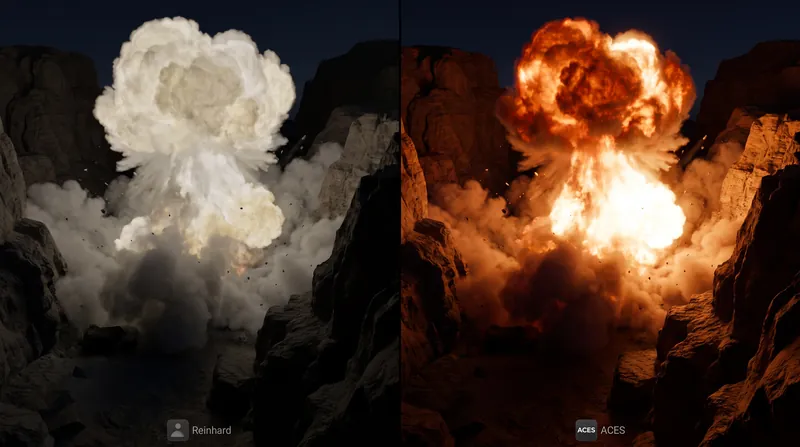
The Reinhard and ACES Formulas: How Tone Mapping Compresses a 32-Bit Render Target to a 10-Bit Display
8 sources
Graphics Architecture
The 24-Bit Depth Buffer: How Floating-Point Precision Dictates Maximum Draw Distance and Causes Z-Fighting
8 sources

Monetization Mechanics
The Mechanics of Mobile Game Monetization: Quantifying Conversion Rates and Lifetime Value
11 sources

Immigration Law
How the US P-1A Visa Dictates International Esports Rosters
7 sources
Every angle. Every day.
Get Gaming & Esports stories with full source coverage and perspective breakdowns delivered to your inbox.