
full timeline
Hakeem Jeffries House speaker bid
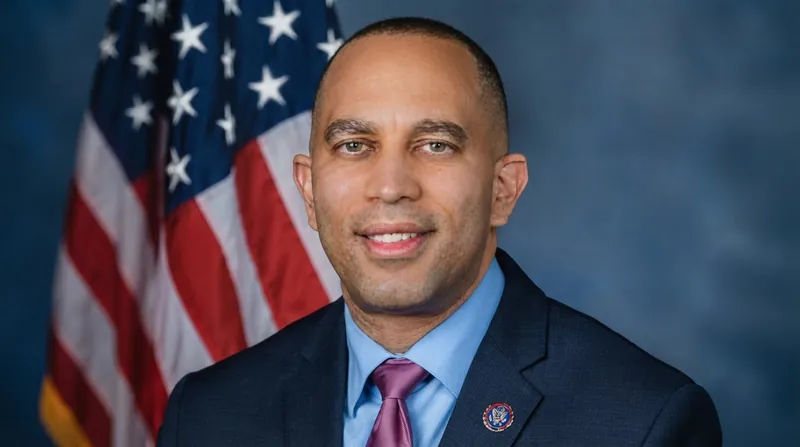
House Democrats have overwhelmingly selected Representative Hakeem Jeffries as their nominee for speaker, positioning him to become the first Black lawmaker to lead the chamber.
Follow Hakeem Jeffries House speaker bid in the Factlen app and get an alert when there is news. Get the app
Share this story
Latest report
House Democrats Nominate Hakeem Jeffries for Speaker in Historic Vote
House Democrats have overwhelmingly selected Representative Hakeem Jeffries as their nominee for speaker, positioning him to become the first Black lawmaker to lead the chamber. The New York congressman secured the nomination in a closed-door vote, though a small bloc of progressive members withheld their support as they seek policy commitments.
- Representative Hakeem Jeffries secured the Democratic nomination for House speaker in a 251-11 secret-ballot vote.
- If elected by the full chamber in January, Jeffries will become the first Black lawmaker to wield the speaker's gavel.
- Seven incoming progressive members voted against the nomination, citing ongoing negotiations over policy commitments including Medicare for All.
- The Democratic caucus also elevated Representatives Katherine Clark and Pete Aguilar to majority leader and whip, respectively.
House Democrats overwhelmingly nominated Representative Hakeem Jeffries to serve as speaker of the House during a closed-door meeting on Wednesday. The New York congressman secured the party's nod in a secret ballot, prevailing by a margin of 251 to 11.[1][2][4]
The nomination paves the way for Jeffries to make history when the new Congress convenes in January. If elected by the full chamber, he will become the first Black lawmaker to wield the speaker's gavel in United States history.[1][2]
Jeffries ran unopposed for the leadership post, capitalizing on a commanding Democratic majority secured during the recent midterm elections. The party is projected to control more than 250 seats, providing a substantial buffer for the incoming leadership team as they prepare to take power.[4]
Following the vote, Jeffries addressed reporters at the Capitol, reflecting on the historical weight of his nomination. He invoked the legacy of Shirley Chisholm, the trailblazing New York representative who was the first Black woman elected to Congress.[1]
"During the first 12 years of my life, my congresswoman, though I never met her, was Shirley Chisholm," Jeffries said. He added that he now has the opportunity to deliver for the children of America in a similar fashion.[1]
Progressive Bloc Demands Concessions
Despite the decisive victory, Jeffries faces resistance from a restive progressive faction within his caucus that is eager to flex its newfound leverage. Eleven Democrats cast their ballots against his nomination, signaling a desire for a definitive shift in the party's legislative priorities.[2][4]
Seven newly elected progressive members released a joint statement explaining their opposition. The group includes Representatives-elect Darializa Avila Chevalier and Claire Valdez of New York, Adam Hamawy of New Jersey, and Frederick Haynes of Texas.[4]
The incoming lawmakers stated that their constituents sent them to Washington with a clear mandate for bold policy changes. They are demanding commitments from leadership on issues such as Medicare for All and ending the transfer of offensive weapons to Israel.[4]
"While we have seen meaningful progress, there is still work to be done to ensure that the direction our party takes this coming Congress reflects what our constituents are demanding of leadership," the progressive bloc wrote. They noted that their internal negotiations are still active.[4]
The group emphasized that they have engaged in good-faith conversations with Jeffries over the past several weeks. Because those discussions remain ongoing, they chose to withhold their support during the internal caucus vote.[4]
When asked about the defectors, Jeffries downplayed the internal divisions and focused on the broader political landscape. "Our job is to fight MAGA extremism, not each other," he told reporters after clinching the nomination.[1][4]
A Historic Leadership Slate
The Democratic caucus also voted to elevate the rest of its leadership slate, solidifying a team that will make history across multiple fronts. Representative Katherine Clark of Massachusetts was elected as the next majority leader.[1][4]
Clark's elevation makes her the first woman to hold the position of House majority leader. Representative Pete Aguilar of California was chosen to serve as the majority whip, becoming the first Latino lawmaker to step into that role.[1][4]
The caucus additionally elected Representative Ted Lieu of California to serve as caucus chairman. Lieu's victory makes him the first Asian American to hold the position, further diversifying the highest ranks of congressional leadership.[4]
Jeffries, Clark, and Aguilar have risen through the ranks as a unified team, representing the first new generation of Democratic leaders in the post-Pelosi era. They previously served as the minority leadership trio during the 118th Congress.[1][3]
The transition marks a definitive shift from the long-standing leadership of Nancy Pelosi, Steny Hoyer, and James Clyburn. Clyburn, a mentor to Jeffries, delivered a powerful endorsement inside the caucus room ahead of Wednesday's vote.[1][3]
"Hakeem is interested in headways and not headlines," Clyburn told his colleagues, according to lawmakers present. He later described the moment as surreal, noting that the sacrifices of civil rights leaders like John Lewis were finally paying off.[1][4]
Navigating the New Majority
Jeffries' ascent to the speakership represents the culmination of a rapid political rise rooted in local New York politics. Born in Brooklyn and educated at New York University, he worked as a corporate lawyer before serving in the New York State Assembly from 2007 to 2012.[5]
Since entering Congress in 2013, Jeffries has cultivated a reputation as a pragmatic consensus-builder. He chaired the House Democratic Caucus from 2019 to 2023 before being unanimously elected to succeed Pelosi as minority leader.[5]
As speaker, Jeffries will be tasked with steering the Democratic legislative agenda while serving as a primary counterweight to the incoming Trump administration. Democrats are expected to launch aggressive oversight efforts and check executive power.[1][4]
The size of the incoming Democratic majority provides Jeffries with a significant tactical advantage. With a projected margin of nearly 40 seats, he can afford to lose a handful of votes on contentious legislation without derailing the party's agenda.[4]
This dynamic stands in stark contrast to the challenges faced by Republicans four years ago. During that transition, a narrow Republican majority struggled through 15 grueling ballots to elect Kevin McCarthy as speaker amid demands from far-right holdouts.[5]
Jeffries will face a formal roll call vote on the House floor when the new Congress convenes on January 3. While the 11 dissenting votes highlight internal friction, his path to securing the 218 votes required for the gavel appears secure.[3][4]
The coming weeks will test Jeffries' ability to bridge the ideological divides within his caucus before the new session begins. Progressive activists continue to flood congressional offices with calls and messages, demanding that the new leadership team adopt a more confrontational posture against conservative policies.[3]
For now, the Democratic leader is projecting confidence and unity. In a social media post following his nomination, Jeffries thanked his colleagues and promised to deliver bold change that makes a tangible difference for the American people.[4]
The Legislative Road Ahead
The pushback from the left flank underscores a broader debate over the party's mandate following their sweeping midterm victories. Progressive organizations argue that voters delivered a clear rejection of the status quo, necessitating a more ambitious legislative roadmap.[4]
Some newly elected members, including those backed by the Democratic Socialists of America, have refused to publicly commit to Jeffries without concrete policy guarantees. They are specifically seeking floor votes on universal healthcare and campaign finance reform.[4]
Sources
- [1]PBS NewsHour — Democrats nominate Hakeem Jeffries to become House speaker, a historic first Read on PBS NewsHour →
- [2]NBC News — Democrats formally nominate Rep. Hakeem Jeffries, paving way for him to be the first Black speaker Read on NBC News →
- [3]Associated Press — Democrats nominate Hakeem Jeffries on Wednesday to be speaker of the House Read on Associated Press →
- [4]CBS News — Jeffries wins Democratic nomination for House speaker, paving way for historic election Read on CBS News →
- [5]Wikipedia — Hakeem Jeffries Read on Wikipedia →
What to watch
- The full chamber will hold the final vote for Speaker of the House on January 3.
- Progressive members are seeking policy commitments, including Medicare for All, before the final vote.
Charts, maps and images
Timeline
November 2026
House Democrats Nominate Hakeem Jeffries for Speaker in Historic Vote
Hakeem Jeffries Launches Bid for US House Speaker Following Democratic Midterm Sweep
How the story developed
In the 2026 midterm elections, the Democratic party secured sweeping victories, resulting in a congressional majority. The incoming majority established plans to leverage its unified control of the House and Senate to prioritize voting rights and tax reform.
Following the midterm sweep, Representative Hakeem Jeffries formally announced his uncontested campaign for Speaker of the House. The New York lawmaker launched his bid on Wednesday, ahead of November 5.
The campaign positioned Jeffries to potentially make American history. If elected to the leadership role, he would become the first Black speaker of the United States Congress.
While Jeffries entered the race with broad support, his campaign faced immediate pressure from the left wing of the party. Progressive advocates urged left-leaning lawmakers to demand concessions on committee assignments before the final vote.