
full timeline
US Air Force F-15EX program
The U.S.
Follow US Air Force F-15EX program in the Factlen app and get an alert when there is news. Get the app
Share this story
Latest report
USAF Deploys First Permanently Assigned F-15EX Eagle II Fighters to Kadena Air Base in Japan
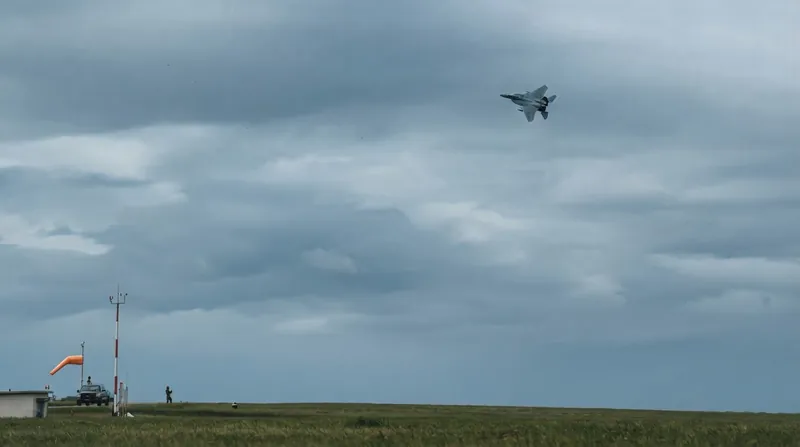
The U.S. Air Force has stationed its first two F-15EX Eagle II fighter jets in Okinawa, marking the platform's first permanent overseas deployment. The arrival initiates a long-anticipated modernization of American tactical airpower in the Indo-Pacific.
- The U.S. Air Force permanently deployed its first two F-15EX Eagle II fighters to Kadena Air Base in Japan on November 15, 2026.
- The arrival marks the first time the advanced fighter platform has been stationed outside the continental United States.
- Kadena's 18th Wing will eventually receive 36 of the aircraft to replace its retired fleet of legacy F-15C/D Eagles.
- The F-15EX brings advanced electronic warfare capabilities and a massive payload capacity to complement fifth-generation stealth fighters in the Indo-Pacific.
The U.S. Air Force has permanently deployed its first two F-15EX Eagle II fighter jets to Kadena Air Base in Okinawa, Japan. The aircraft touched down on November 15, 2026, marking the first time the service has stationed its newest fighter platform outside the continental United States. The arrival initiates a long-anticipated modernization of American airpower in the Indo-Pacific.[1][2][4]
Kadena’s 18th Wing is scheduled to receive 36 of the advanced fighters over the coming years, dividing them evenly between the 44th and 67th Fighter Squadrons. The deployment ends a transitional period that began in November 2022, when the base started withdrawing its aging fleet of 48 F-15C/D Eagles. Those legacy airframes had operated from the Japanese installation for four decades.[2][4]
"The arrival of the F-15EX at Kadena marks a significant milestone for American airpower in the Pacific," said Brig. Gen. John Gallemore, commander of the 18th Wing.[1]
"These aircraft strengthen our ability to deter aggression, respond to emerging threats and defend Japan alongside our allies and partners. Their permanent presence at Kadena reinforces our commitment to the U.S.-Japan alliance and ensures we continue to bring advanced combat capabilities to one of the most strategically important regions in the world."[1][7]
During the four-year gap between the legacy fleet's retirement and the Eagle II's arrival, the Air Force maintained its regional presence through rotational deployments. Squadrons flying F-35 Lightning IIs, F-22 Raptors, and F-16 Fighting Falcons temporarily operated from Okinawa to ensure continuous coverage. The permanent assignment of the F-15EX restores a dedicated, long-term tactical fighter force to the installation.[2][4]
Strategic Geography and the Indo-Pacific
Kadena Air Base occupies a critical geographic position in the Western Pacific, sitting roughly 450 miles from Taiwan. Military planners frequently refer to the installation as the "Keystone of the Pacific" due to its proximity to potential regional flashpoints. The base serves as a primary staging ground for U.S. and allied operations across the East China Sea.[4][5]
The introduction of the F-15EX directly addresses the evolving security environment in the Indo-Pacific. While the Eagle II lacks the stealth characteristics of fifth-generation fighters like the F-35, it compensates with an exceptionally large payload capacity. Defense analysts often describe the aircraft as a "missile truck" capable of carrying outsized munitions over extended ranges.[2][4]
The aircraft can carry up to 29,500 pounds of ordnance, significantly more than the legacy F-15C models it replaces. This expanded capacity allows the Eagle II to carry outsized hypersonic weapons that cannot fit inside the internal weapons bays of the F-22 or F-35.[2][4]
This payload capacity allows the F-15EX to operate in tandem with stealth platforms during complex combat scenarios. Fifth-generation fighters can penetrate contested airspace to identify targets, while the heavily armed Eagle IIs launch long-range munitions from safer distances. This networked approach maximizes the lethality of the combined fleet without exposing non-stealth aircraft to advanced air defense systems.[2][5]
The Eagle II also features an open mission systems architecture, allowing software and hardware upgrades to be integrated rapidly. This digital backbone ensures the aircraft can adapt to emerging electronic warfare threats and deploy future weapon systems without requiring extensive physical modifications. The platform's adaptability is considered essential for maintaining parity with rapid technological advancements in the region.[2][8]
Advanced Avionics and Electronic Warfare
A defining feature of the F-15EX is the Eagle Passive Active Warning Survivability System, or EPAWSS. This advanced electronic warfare suite provides pilots with a comprehensive digital shield, capable of jamming enemy radar and disrupting incoming missile guidance systems. The system represents a generational leap over the defensive countermeasures equipped on the retired F-15C models.[4][6]
The aircraft also incorporates a digital fly-by-wire flight control system, which enhances maneuverability and reduces pilot workload during high-stress engagements. Combined with state-of-the-art radar and targeting sensors, the F-15EX offers unprecedented situational awareness. These systems allow crews to track and engage multiple targets simultaneously across vast distances.[1][2]
Preparing Kadena for the new platform required extensive coordination across multiple Air Force installations. Operators from the 67th Fighter Squadron traveled to Eglin Air Force Base in Florida and the Portland Air National Guard Base in Oregon to complete their initial aircraft qualification training. Maintainers from the 18th Aircraft Maintenance Squadron underwent similar technical instruction.[1][7]
"The arrival of the F-15EX represents years of hard work and dedication from our maintainers," said Maj. Spencer A. Sherman, commander of the 18th Aircraft Maintenance Squadron. "These Airmen have spent countless hours preparing for this day, and I am incredibly proud of the team."[1]
"Getting the F-15EX to Kadena is just the beginning," said Lt. Col. Ajay Dua, commander of the 67th Fighter Squadron.[1]
"Now our focus shifts to integrating the aircraft into our flying operations, building experience as a squadron, and learning how to get the most out of its capabilities. It's an exciting time to be part of the 67th Fighter Squadron."[1][2]
Expanding the Eagle II Fleet
The arrival of the first two jets in Japan brings the total number of F-15EXs delivered to the Air Force to 25. The Oregon Air National Guard’s 142nd Wing was the first operational unit to receive the aircraft, paving the way for the overseas deployment. Boeing, the aircraft's manufacturer, recently commenced deliveries for the third production lot.[2][4]
The Air Force has significantly expanded its procurement plans for the Eagle II over the past two years. Initially, the service intended to purchase just 80 airframes, a number that was later revised to 129. In its fiscal year 2027 budget request, the Air Force announced a new acquisition goal of 267 aircraft, more than doubling the previous target.[2][4][7]
This expanded procurement strategy reflects a growing consensus within the Pentagon regarding the platform's long-term utility. Lawmakers have largely supported the increased acquisition, with Congress appropriating an estimated $12.48 billion for the program since fiscal year 2022. The Air Force recently awarded Boeing a $2.38 billion contract to produce an additional 22 airframes.[4][7]
The production schedule has faced some headwinds, including delays stemming from a 2025 labor strike at Boeing's manufacturing facility in St. Louis, Missouri. These disruptions pushed the initial Kadena delivery timeline from the spring of 2026 to mid-November. Despite these setbacks, the Air Force maintains that the full complement of 36 aircraft will be stationed in Japan by 2028.[4]
Regional Integration and Future Operations
The permanent stationing of the F-15EX at Kadena is expected to enhance bilateral training exercises with the Japan Air Self-Defense Force. Integrating the Eagle II into joint operations will allow both nations to refine their interoperability and develop new tactical doctrines. These collaborative efforts are designed to present a unified and credible deterrent to regional adversaries.[1][7]
Chinese defense analysts have closely monitored the deployment, frequently noting the aircraft's capabilities in state-affiliated media. While some regional commentators argue the non-stealth platform remains vulnerable to advanced air defense networks, U.S. planners emphasize its role within a broader, multi-domain force structure. The aircraft is not intended to operate in isolation during a high-end conflict.[5]
The deployment also coincides with broader infrastructure improvements across U.S. military installations in the Pacific. As the Air Force modernizes its aircraft fleet, it is simultaneously upgrading hardened shelters, runway facilities, and logistical networks to support sustained operations. These investments reflect a comprehensive approach to regional security and force projection.[2][8]
Recent military exercises, such as Valiant Shield, have demonstrated the F-15EX's potential to operate alongside uncrewed autonomous aircraft. The Air Force is actively exploring concepts where crewed fighters serve as command nodes for "loyal wingman" drones. Operating from Kadena, the Eagle II could eventually direct autonomous formations across the vast expanses of the Pacific.[2]
Preparing for the Next Century
The addition of conformal fuel tanks to operational Eagle IIs is another development being closely monitored. While initially omitted from the air-to-air focused variants, these external tanks significantly extend the aircraft's combat radius. In the geographically expansive Indo-Pacific theater, the ability to operate further forward without relying heavily on aerial refueling tankers provides a distinct tactical advantage.[2]
As the 18th Wing approaches its centennial anniversary in 2027, the integration of the F-15EX marks a new chapter in its operational history. The wing traces its lineage back to the 18th Pursuit Group, activated in Hawaii in 1927. A century later, the unit remains at the forefront of American airpower projection.[1]
The successful deployment of the first two airframes validates years of logistical planning and personnel training. As additional jets arrive over the next two years, Kadena will gradually transition back to a fully permanent fighter presence. The rotational deployments that bridged the gap will eventually phase out, stabilizing the base's operational tempo.[1][4]
The F-15EX provides military commanders with a versatile and highly capable platform tailored for the modern battlespace. By combining heavy payload capacity with advanced electronic warfare systems, the aircraft bridges the gap between legacy fighters and fifth-generation stealth platforms. Its permanent presence in Japan establishes a new baseline for tactical airpower in the Western Pacific.[1][2][4]
Sources
- [1]U.S. Air Force — Kadena welcomes first permanently assigned F-15EX Eagle II aircraft Read on U.S. Air Force →
- [2]The War Zone — First F-15EX Eagle IIs Arrive In Japan Read on The War Zone →
- [3]Task & Purpose — The first permanently stationed F-15EX Eagle II arrives in Japan Read on Task & Purpose →
- [4]Air & Space Forces Magazine — First Permanently Stationed F-15EX Lands at Kadena Read on Air & Space Forces Magazine →
- [5]South China Morning Post — US airbase Kadena gets F-15EX fighters but no upper hand against China, analysts say Read on South China Morning Post →
- [6]Airforce Technology — US Air Force permanently deploys F-15EX jets to Kadena Air Base in Japan Read on Airforce Technology →
- [7]Military Times — First permanently assigned F-15EXs touch down at Kadena Air Base Read on Military Times →
- [8]Janes — US Air Force deploys first F-15EX fighters to Kadena Read on Janes →
What to watch
- Full deployment of the F-15EX to Kadena Air Base is delayed to 2027.
- Kadena's 18th Wing will eventually receive 36 of the aircraft.
Timeline
November 2026
USAF Deploys First Permanently Assigned F-15EX Eagle II Fighters to Kadena Air Base in Japan
September 2026
Pentagon Report Details Cost and Schedule Risks in Expanded F-15EX Order
How the story developed
The U.S. Air Force expanded its F-15EX procurement from 129 to 267 aircraft, stretching production across 12 lots.
The longer timeline introduced obsolescence risks for key systems, including the aircraft's radar and electronic warfare suite.
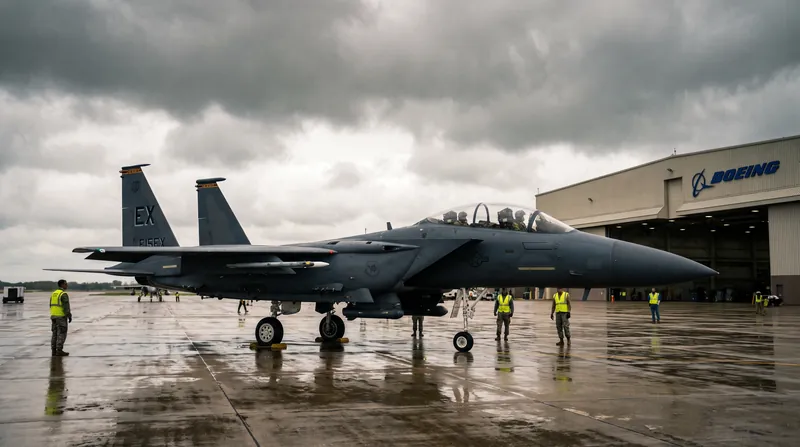
In 2025, a labor strike at Boeing's St. Louis plant caused unrecoverable delays. The work stoppage pushed Lot 3 and Lot 4 deliveries years behind schedule.
In August, the first F-15EX destined for Kadena Air Base departed St. Louis. Kadena's 18th Wing was designated to replace its retired fleet of legacy F-15C/D Eagles with the new aircraft.