
World Athletics Mandates Uniform 20mm Stack Height Cap for All Track Spikes
Starting this November, all track and field spikes must adhere to a strict 20-millimeter stack height limit, ending the era of thicker 'super spikes' in distance events. The sweeping regulation aims to preserve the integrity of historical records while pushing manufacturers to innovate within tighter constraints.

Share this story
Track and field is fundamentally a sport of human limits, but for the past half-decade, the conversation has been heavily dominated by foam and carbon fiber. Starting this November, the governing body of the sport is stepping in to draw a hard line in the sand regarding athletic footwear.[1]
World Athletics has announced a universal 20-millimeter maximum stack height for all track spikes, applying equally to every discipline from the 100-meter sprint to the 10,000-meter run. The sweeping regulation, which officially takes effect on November 1, marks the end of a tiered system that previously allowed thicker, 25-millimeter shoes for middle and long-distance track events.[4]
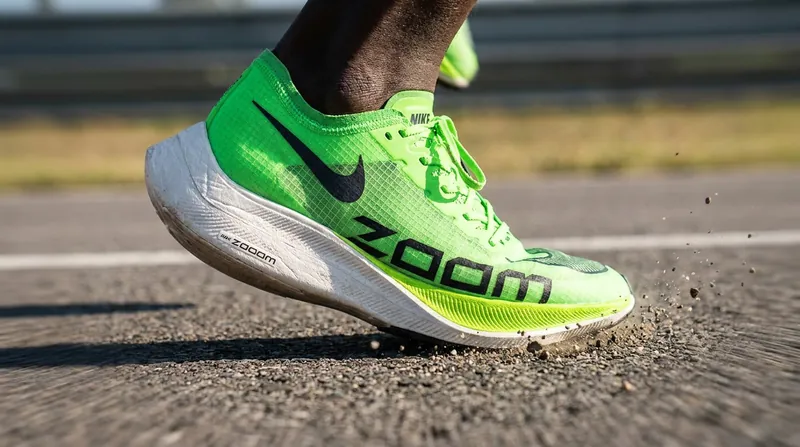
The move is a direct response to the 'super shoe' revolution that began upending the sport's record books in the late 2010s. Manufacturers discovered that embedding rigid carbon-fiber plates inside thick slabs of highly resilient, lightweight foam could dramatically improve a runner's running economy, allowing them to maintain faster paces with less oxygen consumption.
As brands developed 'super spikes' with up to 25 millimeters of energy-returning foam, distance runners began shattering long-standing world records and personal bests at an unprecedented rate. This rapid technological progression created an existential crisis for the sport, prompting debates over how fans could fairly compare the achievements of modern athletes to legends who raced in thin, minimalist spikes.[1][2]
Stack height refers to the amount of material between the bottom of the athlete's foot and the running surface. In traditional track spikes, this layer was practically non-existent, designed solely to hold metal pins for traction. Modern super spikes, however, use that vertical space to house compressible foam that acts like a microscopic trampoline, absorbing the impact of each footstrike and returning a significant percentage of that energy to the runner.
By capping the stack height at 20 millimeters across the board, World Athletics is severely limiting the volume of energy-returning foam that can be placed under the foot. Biomechanical researchers note that while 20 millimeters is still enough space to include a thin carbon or composite plate, it is not enough to achieve the massive trampoline effect seen in 25-millimeter track shoes or the 40-millimeter road racing shoes used in marathons.[4]
For sprinters running the 100-meter to 400-meter dashes, the new rule changes very little, as their footwear was already capped at 20 millimeters to prioritize ground feel and explosive power out of the starting blocks. The true impact will be felt by middle and long-distance runners competing in the 800-meter through 10,000-meter events, who must now transition away from the highly cushioned spikes they have trained and raced in for the past several years.[2]
The reduction in foam volume is not just a matter of top-end speed; it is fundamentally about physical preservation. The thicker 25-millimeter spikes significantly reduced the muscular damage and lower-leg fatigue athletes experienced during grueling 25-lap races. Without that extra cushioning, runners and their coaches will need to carefully manage training loads to prevent Achilles and calf injuries as lower limbs absorb more impact force.
Behind the scenes, the November deadline has triggered a frantic race among major footwear manufacturers. Brands are currently overhauling their elite track spike lineups to ensure compliance before the upcoming indoor season. Millions of dollars in research and development are being redirected toward maximizing the efficiency of next-generation foams within the strict 20-millimeter constraint.[3]
Rather than relying on sheer volume, engineers are now focusing on the geometry of the spike plates, the exact chemical composition of the foams, and the precise placement of the traction pins. Industry analysts suggest this constraint might actually spur more creative engineering, forcing brands to look beyond simply adding more foam to achieve performance gains.[3]
Proponents of the universal cap argue it restores a crucial element of fairness to the sport. A single, easy-to-measure standard eliminates the confusion of the previous tiered system and ensures that athletes competing in multi-event disciplines, like the decathlon, do not have to navigate a complex web of shoe regulations. It also helps level the playing field between athletes sponsored by industry giants and those running for smaller brands.[1][2]
As the November implementation date approaches, the track and field community is bracing for a potential slowing of record-breaking performances in the distance events. However, many purists welcome this stabilization. By drawing a definitive line on footwear geometry, World Athletics is ensuring that the focus of the sport returns to where it belongs: the physiological limits, tactical brilliance, and sheer willpower of the human athlete.[2][4]
Perspectives explored
Sport Purists & Historians
Advocates for strict equipment regulations to preserve the integrity of historical records.
This camp views the 20-millimeter cap as a necessary intervention to save the sport's history. They argue that the unchecked proliferation of 25-millimeter super spikes created a 'technological doping' scenario, rendering comparisons between modern athletes and legends of the 1990s and 2000s meaningless. By strictly limiting the energy return provided by the shoe, they believe the sport can return to measuring human physiological limits rather than footwear engineering.
Footwear Manufacturers
Brands focused on pushing the boundaries of athletic performance through technology.
Industry engineers and brand representatives often view stack height limits as arbitrary constraints on human potential. While they are complying with the new regulations, many argue that thicker foams primarily protect athletes from injury and allow for faster recovery between grueling races. They point out that technological evolution—from cinder tracks to synthetic surfaces, and heavy leather shoes to lightweight synthetics—has always been a natural part of track and field.
Elite Distance Runners
The athletes who must adapt their training and racing to the new physical constraints.
The athletes themselves are caught in the middle. While many welcome a level playing field where talent dictates the winner, distance runners are acutely aware of the physical toll the rule change will bring. Transitioning from 25-millimeter to 20-millimeter spikes means less impact absorption over 10,000 meters, forcing athletes to adapt their biomechanics and carefully manage their lower-leg health to avoid Achilles and calf injuries during the competitive season.
Key points
- World Athletics is enforcing a strict 20mm stack height limit for all track spikes starting November 1.
- The rule eliminates the previous 25mm allowance for middle and long-distance track events.
- The cap aims to preserve the integrity of historical records and ensure fairness across all disciplines.
- Footwear brands are actively redesigning their elite spike lineups to comply with the new volume constraints.
Open questions
- How significantly the 20mm cap will slow down record-breaking trends in the 5,000m and 10,000m events.
- Whether manufacturers will discover new plate geometries that replicate the 'trampoline effect' within the 20mm limit.
- If the reduction in foam will lead to a measurable increase in Achilles or calf injuries among elite distance runners.
Timeline
2016
The first carbon-plated 'super shoes' debut in road marathoning, fundamentally changing distance running.
2019
Super shoe technology migrates to the track, with athletes debuting highly cushioned, plated spikes.
2020
World Athletics introduces initial stack height rules, capping road shoes at 40mm and distance track spikes at 25mm.
Dec 2021
World Athletics announces a future universal 20mm cap for all track events to allow manufacturers time to adapt.
Nov 2026
The universal 20mm stack height cap officially takes effect for all track and field disciplines.
- Sport Purists & Regulators
- Prioritize the integrity of historical records and a level playing field over unchecked technological advancement.
- Footwear Industry
- Focus on maximizing athlete performance, speed, and injury prevention through continuous material innovation.
- Distance Athletes & Coaches
- Concerned with the practical realities of adapting to less cushioning and managing increased injury risks.
Perspectives this story doesn't cover
- Amateur and high school track athletes who must purchase new compliant footwear.
- Sports biomechanists studying the long-term joint health of athletes using thinner spikes.
Sources
Source coverage
4 outlets
3 viewpoints surfaced




- [1]ReutersSport Purists & Regulators
World Athletics standardizes 20mm shoe stack height for all track events
Read on Reuters → - [2]LetsRunDistance Athletes & Coaches
World Athletics Ends the 25mm Super Spike Era Ahead of 2027 Worlds
Read on LetsRun → - [3]The AthleticFootwear Industry
Shoe wars: How brands are scrambling to redesign track spikes ahead of November deadline
Read on The Athletic → - [4]World AthleticsSport Purists & Regulators
Athletic Shoe Regulations: Technical Update July 2026
Read on World Athletics →

More in Fitness
See all →Marathon Milestone
The Sub-Two-Hour Marathon Barrier Falls: How Human Physiology and 'Super Shoes' Finally Converged
4 sources

Carb Loading
New Research Establishes Higher Optimal Carbohydrate Loading Dose for Endurance Athletes
5 sources

Marathon Expansion
London Marathon to Expand to Two-Day Event in 2027, Doubling Field to 100,000 Runners
2 sources

Running Tech
PEBA Foam and Carbon Plates: How Super Shoes Boost Running Economy by 4 Percent
5 sources
Comments
Every angle. Every day.
Get Fitness stories with full source coverage and perspective breakdowns, free every day.