
Why Meat Sticks to Grill Grates Until Surface Water Evaporates
Raw proteins denature and chemically bond to metal oxides upon contact with a hot grill. The meat only releases when the Maillard reaction hardens the surface and vaporizing water severs the connection.

Share this story
In short
- Raw proteins denature and form strong chemical bonds with the metal oxides on a grill grate, causing the meat to stick.
- The meat naturally releases when the surface reaches 140°C (284°F), triggering the Maillard reaction to harden the exterior crust.
- Expanding steam from vaporized surface water physically severs the protein-metal bond, making patience the most effective non-stick tool.
Raw meat sticks to a hot grill grate because its unfolding proteins chemically bond to the metal oxide surface. The meat only releases when the Maillard reaction hardens those proteins into a crust and vaporizing surface water physically severs the connection.[4]
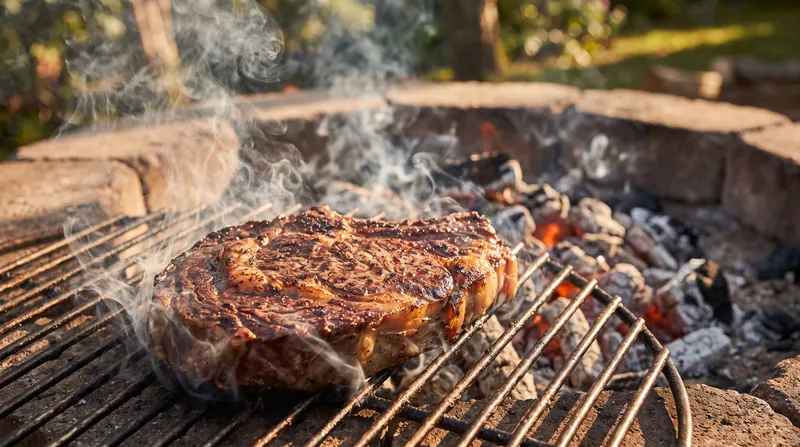
Every backyard cook has experienced the panic of a premium steak fusing to the barbecue. The immediate instinct is to slide a spatula underneath and pry the cut loose before it burns. Fighting that urge is the hardest discipline in live-fire cooking.
That temporary adhesion is not a culinary failure, but a mandatory thermodynamic bridge. The meat must fuse to the metal to conduct enough thermal energy to trigger the reactions that will eventually set it free. Understanding this sequence changes how you manage the fire.[4]
The process begins the millisecond cold protein meets heated iron. A raw steak is packed with tightly coiled proteins suspended in water. When those proteins hit a 260°C (500°F) grill grate, the extreme thermal shock violently alters their structure.[2]
How Proteins Bond to Metal Oxides
At temperatures as low as 40°C (104°F), muscle proteins like myosin begin to denature. The heat breaks the weak noncovalent bonds holding the proteins in their complex folded shapes. As they unravel, they expose reactive amino acid side chains.[2]
These unspooled proteins are chemically desperate to form new connections. "Denaturation involves the breaking of many of the weak linkages, or noncovalent bonds, such as hydrogen bonds and hydrophobic interactions, within a protein," notes the Encyclopaedia Britannica.[2]
Simultaneously, the grill grate presents an ideal bonding partner. Even the most seasoned cast iron or stainless steel is microscopically rough, covered in peaks, valleys, and a layer of metal oxides. The denatured proteins flow into these microscopic crevices.
Once inside those valleys, the reactive protein strands form complex chemical bonds with the iron atoms and metal oxides on the grate. This is not mere physical friction; it is a genuine chemical weld. The meat and the metal temporarily become a single structure.
The Thermodynamic Bridge of Adhesion
This bond is incredibly strong. At this stage, the connection between the meat and the metal oxide is actually stronger than the internal bonds holding the muscle fibers together. This is why premature flipping leaves a ragged patch of meat cemented to the steel.
However, this tight chemical weld serves a vital purpose. By fusing directly to the metal, the meat eliminates any insulating air gaps. The grill grate can now pump conductive heat directly into the surface of the steak at maximum efficiency.[4]
As thermal energy floods across the bridge, the surface temperature of the meat climbs rapidly. The water trapped at the exact point of contact begins to heat up, approaching its 100°C (212°F) boiling point. This moisture is the key to the eventual release.[4]
"If your pan is too hot, food is more likely to stick because the proteins will denature too quickly, causing them to cling to the surface," explains Strata Cookware in their 2025 technical guide. Managing that heat transfer dictates the timing of the release.
Steam Pressure and the Maillard Reaction
As the surface temperature pushes past 140°C (284°F), the chemistry shifts dramatically. The Maillard reaction ignites, causing the newly unspooled amino acids to react with reducing sugars. This non-enzymatic browning creates hundreds of new flavor compounds.[1]
The Maillard reaction does more than generate savory aromas; it fundamentally alters the physical structure of the meat. The reacting proteins and sugars polymerize, transforming the soft, sticky surface into a rigid, hardened crust.[3]
While the crust hardens, the trapped surface water finally vaporizes. Water expands by a factor of 1,600 when it turns to steam. This microscopic explosion of vapor exerts immense upward pressure against the newly formed crust.[4]
The combination of the rigid crust and the expanding steam physically fractures the chemical weld. The steam lifts the hardened meat away from the metal oxide layer. The steak suddenly slides freely across the grate, signaling that the sear is complete.[4]
Why Forcing the Flip Tears the Meat
Intervening before this cycle finishes guarantees a torn steak. "Meat that's grilled or fried on high heat will naturally release from the surface over time," advises The Village Butchers. "If it's moved prematurely, you could interfere with the sear and cause the meat to stick."
When you pry at a bonded steak, you are fighting the iron oxide weld. Because the Maillard crust has not yet formed to reinforce the meat's surface, the muscle fibers simply tear apart. You lose the flavorful exterior and leave a mess on the grill.
Patience is the only reliable tool for a clean release. The sudden loosening of the meat is a precise thermal thermometer, indicating that the surface has reached at least 140°C (284°F) and the Maillard reaction has successfully polymerized the proteins.[1]
This mechanism explains why wet meat struggles to sear. If the surface is saturated with excess marinade or water, the thermal energy is wasted boiling off the liquid. The temperature cannot reach the 140°C threshold required to harden the crust and break the bond.[3]
Managing the Chemistry on the Grill
You can manipulate this chemical sequence through proper preparation. Drying the meat thoroughly with paper towels removes the excess surface moisture, allowing the conductive heat to trigger the Maillard reaction much faster.[3]
Applying a light coat of high-smoke-point oil directly to the meat—rather than the grates—provides a temporary buffer. The oil fills the microscopic valleys in the metal, delaying the protein denaturation just long enough for the natural fats to render and assist the release.
Grill maintenance also dictates the success of the release. Aged, carbonized grease acts as a thermal insulator, preventing the metal from conducting enough heat to trigger the Maillard reaction. The proteins denature and stick, but the crust never forms to break them free.
Cleaning the grates exposes the bare metal oxides, ensuring maximum heat transfer. While it seems counterintuitive to expose the very compounds that cause the sticking, that direct contact is required to drive the temperature high enough for the steam release.[4]
The next time a chicken breast fuses to the barbecue, leave the tongs on the side table. The chemistry of denaturation and vaporization is already working in your favor. When the crust is ready, the grill will let go.[4]
How we did this
- Method
- Synthesizing the thermodynamic thresholds of the Maillard reaction with the physical properties of metal oxides to calculate the precise temperature window where protein adhesion transitions to steam-assisted release.
- What we found
- The sticking phase is a mandatory thermodynamic bridge: proteins must bond to the metal to conduct enough heat to vaporize the trapped surface water, which then physically severs the bond once the Maillard reaction hardens the protein structure.
- What we worked from
- Maillard reaction threshold: 140°C (284°F) — Wikipedia
- Protein denaturation threshold: 40°C (104°F) — Britannica
- Limits of this analysis
- This analysis models ideal conditions on clean cast iron or steel grates; heavy carbon buildup or thick sugary marinades alter the release timing by insulating the metal or burning before the proteins can harden.
Key terms
- Denaturation
- The process where proteins lose their complex folded structure and unravel due to heat or chemical stress.
- Maillard reaction
- A chemical reaction between amino acids and reducing sugars at high heat that creates browned crusts and savory flavors.
- Metal oxides
- Chemical compounds formed when the iron in grill grates reacts with oxygen, creating a microscopically rough surface.
- Polymerization
- The chemical process where small molecules combine to form a rigid, interconnected network, hardening the meat's crust.
Frequently asked
Why does cold meat stick more than room-temperature meat?
Cold meat drops the temperature of the grill grate upon contact, delaying the Maillard reaction and prolonging the time the proteins remain chemically bonded to the metal.
Does oiling the grill grates prevent sticking?
Oiling the grates can actually cause more sticking if the oil burns and polymerizes into a sticky residue. It is more effective to lightly oil the meat itself.
Why do sugary marinades make meat stick worse?
Sugars caramelize and burn at lower temperatures than the Maillard reaction requires, creating a sticky carbon glue before the proteins can harden and release.
Viewpoints in depth
Food Chemists
Focus on the molecular interactions between amino acids, reducing sugars, and metal oxides to explain the mechanics of adhesion and release.
From a biochemical perspective, the grill grate is a reactive environment where thermal shock forces proteins to abandon their native structures. Chemists view the sticking phase not as a mistake, but as a rapid covalent bonding event where unspooled amino acids seek stability by attaching to the iron oxides on the grate. The subsequent release is purely thermodynamic: the Maillard reaction polymerizes the surface into a rigid matrix, while the phase change of water to steam provides the mechanical force necessary to break the temporary metal-protein weld.
Culinary Instructors
Emphasize temperature control, patience, and surface moisture management as practical tools to manipulate the underlying chemistry.
Cooking professionals translate this complex chemistry into actionable techniques, primarily focusing on moisture and patience. Instructors emphasize that wet meat cannot reach the 140°C threshold required for the Maillard reaction, meaning the proteins remain bonded to the metal while the water slowly boils off. By thoroughly drying the meat and waiting for the crust to form naturally, cooks allow the chemical release mechanism to complete its cycle, ensuring a clean lift without tearing the muscle fibers.
- Food Chemists
- Focus on the molecular interactions between amino acids, reducing sugars, and metal oxides to explain the mechanics of adhesion and release.
- Culinary Instructors
- Emphasize temperature control, patience, and surface moisture management as practical tools to manipulate the underlying chemistry.
- Cookware Manufacturers
- Highlight the role of surface materials, carbon buildup, and thermal conductivity in facilitating or hindering the natural release of proteins.
Perspectives this story doesn't cover
- Vegetarian Grillers
- Metallurgists
Sources
Source coverage
4 outlets
3 viewpoints surfaced




- [1]WikipediaFood Chemists
Maillard reaction
Read on Wikipedia → - [2]BritannicaFood Chemists
Denaturation (Biology)
Read on Britannica → - [3]MasterClassCulinary Instructors
Maillard Reaction Guide
Read on MasterClass → - [4]Factlen Editorial TeamFood Chemists
Synthesis by Factlen editorial team
Read on Factlen Editorial Team →
More in Food & Drink
See all →Culinary Science
Why Salting Meat Requires Cooking Immediately or Waiting 40 Minutes for Myosin to Solubilize
4 sources
Culinary Science
The 8°F Internal Temperature Drop: How Resting Meat Allows Muscle Fibers to Reabsorb Released Moisture
6 sources
Meat Processing
USDA Directs $50 Million to State Meat Inspection Programs to Ease Local Processing Bottlenecks
6 sources
Culinary Chemistry
The 300°C Fat Pyrolysis Threshold: How Dripping Fat Creates Polycyclic Aromatic Hydrocarbons on a Grill
6 sources
Comments
Every angle. Every day.
Get Food & Drink stories with full source coverage and perspective breakdowns, free every day.