
USDA Proposes Lifting Line Speed Limits for Pork and Poultry Plants: How the Policy Works
The USDA has proposed increasing processing speeds for chicken and turkey and removing the cap entirely for pork, aiming to lower grocery costs and boost efficiency. The move has sparked a complex debate over supply chain economics, food safety, and the physical toll on plant workers.
By Irina Belova

Share this story
The U.S. Department of Agriculture is advancing a major regulatory shift that could fundamentally alter how fast meat moves from the farm to the grocery store. Under a sweeping new proposal, the agency aims to significantly increase processing line speeds for poultry and remove the maximum speed cap entirely for pork facilities. The move represents one of the most substantial changes to meatpacking oversight in recent years, touching every node of the supply chain from livestock producers to retail consumers.[1]
The initiative, spearheaded by Agriculture Secretary Brooke Rollins, is framed as a necessary modernization effort designed to lower production costs and stabilize the American food supply chain. By updating regulations that the agency describes as outdated bottlenecks, the USDA hopes to align federal oversight with the real-world capabilities of modern processing equipment. The administration argues that these changes will provide long-term regulatory certainty for meatpackers who have operated under a patchwork of temporary waivers and pilot programs for years, ultimately creating a more resilient food system.[1]
For consumers heading into the summer grilling season, the regulatory changes are being pitched as a direct mechanism to ease retail meat prices. Industry advocacy groups argue that artificial limits on processing speeds constrain the overall supply of meat, creating inefficiencies that drive up costs at the supermarket checkout. By allowing processing plants to operate at their maximum safe capacity, proponents believe the increased volume will naturally translate to more affordable protein options for American households that have been grappling with persistent grocery inflation over the past several years.[1]
However, the proposal has ignited a fierce and highly public debate over the hidden costs of supply chain efficiency. The planned speed increases have drawn intense opposition from labor unions, food safety advocates, environmental organizations, and a coalition of Democratic lawmakers. These critics warn that the regulatory changes prioritize corporate production volumes over human well-being, arguing that faster lines will inevitably endanger plant workers, compromise the thoroughness of federal food inspections, and negatively impact animal welfare standards across the industry.[2]
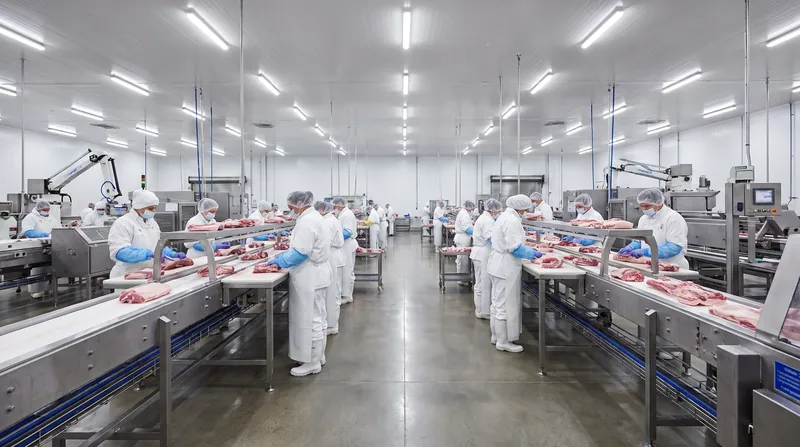
To understand the stakes of this regulatory battle, it is necessary to look closely at the mechanics of modern meatpacking. In facilities operating under the New Swine Inspection System (NSIS) and the New Poultry Inspection System (NPIS), the workflow is highly regimented and heavily reliant on continuous, uninterrupted motion. Animals move along a mechanized conveyor belt where individual workers perform highly specific, repetitive tasks—such as cutting, deboning, shaving, and packaging—at a relentless pace dictated entirely by the central line speed of the facility.[1]
Currently, poultry plants operating under standard federal oversight are capped at processing 140 chickens or 55 turkeys per minute. The USDA's new proposal would raise those limits substantially, allowing participating facilities to process up to 175 chickens and 60 turkeys every sixty seconds. This translates to nearly three chickens per second moving past a single point on the processing line, a velocity that fundamentally changes the physical demands placed on the workers stationed alongside the conveyor belts and the inspectors tasked with monitoring them.
For pork processing, the proposed regulatory changes are even more sweeping and controversial. The USDA is proposing to eliminate the existing maximum line speed of 1,106 hogs per hour entirely for facilities enrolled in the New Swine Inspection System. Instead of adhering to a hard federal cap, these plants would be permitted to set their own operating speeds based on their specific equipment capabilities, staffing levels, and their demonstrated ability to maintain strict process control while complying with overarching food safety requirements.[1]
The meat industry has lobbied for these speed increases for over two decades, arguing that modern processing technology can safely handle significantly higher volumes than legacy regulations currently permit. The Meat Institute, a major industry trade group representing processors, asserts that faster lines will allow companies to invest in sector growth, facility upgrades, and innovation. They argue that the current federal caps are arbitrary and fail to account for recent technological advancements in automated sorting, cutting machinery, and overall plant ergonomics.
Under the modernized inspection systems championed by the USDA, the division of labor between plant employees and federal regulators shifts significantly. Plant employees take over the initial manual sorting duties—identifying and removing visible defects, bruises, and abnormalities from carcasses and parts—before the meat ever reaches the federal inspectors. This structural change allows the processing line to move much faster, as company employees handle the bulk of the preliminary quality control work that was historically performed by government personnel.
The USDA maintains that this modernized system actually improves overall safety and regulatory efficiency. By delegating routine sorting tasks to plant employees, the agency argues that its Food Safety and Inspection Service (FSIS) personnel are freed up to focus more effectively on critical food safety verifications, facility sanitation checks, and animal welfare monitoring. Furthermore, the agency insists that federal inspectors retain the absolute authority to slow or stop the processing line at any time if they observe a loss of process control or a threat to food safety.[1]
But for the workers stationed along the conveyor belts, faster lines mean an immediate acceleration of already grueling physical labor. Meatpacking inherently involves highly repetitive, forceful motions with sharp knives and heavy saws, often performed in environments that are cold, wet, excessively noisy, and densely crowded. Workers must repeat the exact same physical cutting or pulling motion thousands of times per shift to keep up with the flow of carcasses, leaving little room for error, rest, or physical recovery during their hours on the floor.[2]
Labor advocates point out that meatpacking workers already experience occupational illness and injury rates that are up to six times higher than the national average across all other private industries. Increasing the speed of the line, they argue, directly elevates the risk of severe musculoskeletal disorders of the hand, wrist, and shoulder due to the sheer volume of repetitive strain. Furthermore, faster processing speeds increase the likelihood of acute traumatic injuries, including severe lacerations, accidental amputations, and devastating slips or falls on wet plant floors.
The USDA has countered these widespread safety concerns by pointing to recent empirical data, specifically citing a January 2025 study conducted by researchers at the University of California, San Francisco. According to the agency's interpretation of the research, the data indicates that overall line speed itself is not the leading factor in worker injury risk within modern processing facilities.
The USDA uses this specific finding to justify the removal of hard federal speed caps, suggesting that regulatory focus should be shifted toward other operational metrics rather than a universal speed limit.[1][2]
Instead of overall line speed, the USDA points to "piece rate"—the specific number of animals or cuts of meat a single worker handles per minute—as the primary driver of musculoskeletal strain and injury. The agency argues that plants can run faster lines safely if they adjust their staffing levels accordingly, ensuring that individual workers are not forced to process more meat than is ergonomically safe, even as the total volume of the plant increases. In theory, a faster line with more workers should not increase the individual burden.[1]
In theory, a faster line with more workers should not increase the individual burden.
Critics, however, accuse the USDA of fundamentally mischaracterizing the data to push through a deregulatory agenda favored by the meat industry. Worker organizations and some researchers argue that in practice, faster overall line speeds inevitably force individual employees to work faster. They contend that meatpacking plants rarely hire enough additional staff to perfectly offset the increased volume, meaning the piece rate naturally rises in tandem with the line speed, directly increasing the physical toll and injury risk for the existing workforce stationed on the floor.
Beyond the immediate concerns regarding worker safety, the proposed speed increases raise significant questions about food quality and public health. Former federal inspectors and food safety organizations have warned that at a rate of 175 birds per minute, government personnel have only a fraction of a second to examine each individual carcass as it flies by. In that incredibly brief window, they must accurately identify signs of disease, fecal contamination, or other subtle defects that, if missed, could trigger a widespread foodborne illness outbreak affecting thousands of consumers.[2]
The proposed rule also includes a major administrative change that has deeply alarmed labor advocates: it would eliminate the requirement for NSIS-enrolled pork plants to submit annual worker safety attestations to the USDA. Previously, participating plants were required to document that they maintained an active program to monitor and address work-related conditions and injuries. The new rule would scrap this paperwork entirely, framing it as an unnecessary bureaucratic hurdle that does not directly impact meat quality or fall under the USDA's core mission.[1]
The agency argues that worker safety falls strictly under the statutory authority of the Occupational Safety and Health Administration (OSHA), making the USDA's data collection redundant and outside its legal purview. Opponents, however, view this as a dangerous abdication of federal oversight in an inherently hazardous industry. They argue that the USDA should not authorize production speed increases that directly alter the physical environment of the plant without simultaneously monitoring the human cost of those changes, rather than passing the buck entirely to an already stretched OSHA.
The public response to the proposed regulatory changes has been overwhelming and highly organized. During the 60-day public comment period, the USDA received more than 42,000 comments from concerned citizens, plant workers, and various advocacy groups. The United Food and Commercial Workers (UFCW) union mobilized massive grassroots opposition, generating tens of thousands of comments specifically targeting both the poultry and pork rules, while dozens of federal lawmakers sent formal letters urging the administration to abandon the effort entirely in the name of worker protection.[3]
As the USDA reviews the mountain of public feedback and prepares to finalize the rule, the ultimate outcome will likely shape the economics and daily operations of the American meat industry for years to come. The impending decision represents a critical test of how the federal government balances the relentless drive for supply chain efficiency, corporate profitability, and lower consumer grocery prices against the physical toll of mass production on the essential workers who labor behind the scenes to feed the nation.[1]
Key points
- The USDA has proposed raising maximum processing line speeds for chicken and turkey, and eliminating the speed cap entirely for pork.
- The agency argues the changes will modernize outdated regulations, lower production costs, and help stabilize retail grocery prices.
- Labor unions and Democratic lawmakers strongly oppose the move, warning that faster lines will increase severe repetitive motion injuries among workers.
- The proposal would also eliminate the requirement for pork plants to submit annual worker safety data to the USDA, shifting oversight entirely to OSHA.
Open questions
- Whether meatpacking plants will actually hire enough additional staff to maintain safe 'piece rates' if overall line speeds increase.
- How the Occupational Safety and Health Administration (OSHA) will handle the increased oversight burden once the USDA stops collecting worker safety data.
- Whether the proposed speed increases will face new legal challenges from labor unions, similar to the lawsuit that blocked the 2019 rules.
Timeline
Mid-1990s
The USDA begins developing and piloting new pork and poultry slaughter inspection systems designed to shift sorting duties to plant employees.
September 2019
The USDA issues the final New Swine Inspection System (NSIS) rule, which eliminates the 1,106 hogs per hour speed cap.
March 2021
A federal court vacates the NSIS line speed increases, ruling that the USDA failed to properly consider worker safety impacts.
November 2021
The USDA launches a time-limited trial allowing select plants to operate at faster speeds to gather safety data.
January 2025
Researchers at UCSF release a USDA-commissioned study on line speeds and worker safety, which the agency uses to justify new rules.
February 2026
The USDA officially proposes new rules to permanently raise poultry speeds and eliminate the pork speed cap.
- Meat Industry & Regulators
- Argues that modern equipment can safely handle higher volumes, lowering costs and easing supply chain bottlenecks.
- Labor & Worker Advocates
- Warns that faster lines force employees to perform repetitive motions at dangerous speeds, increasing severe injury risks.
- Food Safety & Environmental Groups
- Cautions that increased speeds give federal inspectors only fractions of a second to spot contamination or disease.
Perspectives this story doesn't cover
- OSHA Regulators
- Grocery Retail Buyers
- Livestock Farmers
Sources
Source coverage
3 outlets
3 viewpoints surfaced



- [1]USDAMeat Industry & Regulators
USDA Announces Proposed Updates to Federal Line Speed Regulations
Read on USDA → - [2]Safety+Health MagazineLabor & Worker Advocates
Democrats push USDA to maintain meat-processing line speed limits
Read on Safety+Health Magazine → - [3]OHS OnlineLabor & Worker Advocates
Public Floods USDA With Comments Against Faster Line Speeds
Read on OHS Online →
More in Food & Drink
See all →Air Quality
How the EPA's Proposed Air Quality Rules Could Change Wood and Charcoal Grilling
6 sources

Grilling Science
Why Reverse Searing Meat at Low Heat Eliminates Gray Bands and Retains Moisture
2 sources
Grilling Thermodynamics
Why Charcoal's Radiant Infrared Heat Sears Meat Faster Than a Gas Grill's Convection Currents
7 sources
Grilling Chemistry
Why Meat Sticks to Grill Grates Until Surface Water Evaporates
4 sources
Comments
Every angle. Every day.
Get Food & Drink stories with full source coverage and perspective breakdowns, free every day.