
Why Powdered Infant Formula Carries Botulism Risks That Ready-to-Feed Liquids Avoid
Following the 2025 ByHeart and 2026 Nara Organics outbreaks, the safety of powdered infant formula is under renewed scrutiny. We compare the biological risks and economic trade-offs of powdered versus commercially sterile liquid formula.
By Hui Lin

Share this story
In short
- Powdered infant formula is not a sterile product and cannot be subjected to the pressurized heat required to kill Clostridium botulinum spores.
- The 2025 ByHeart and 2026 Nara Organics outbreaks hospitalized 51 infants, concentrating the recent botulism risk in specific organic whole-milk brands.
- Standard home preparation advice—mixing powder with 160°F water—kills Cronobacter but leaves botulism spores completely intact.
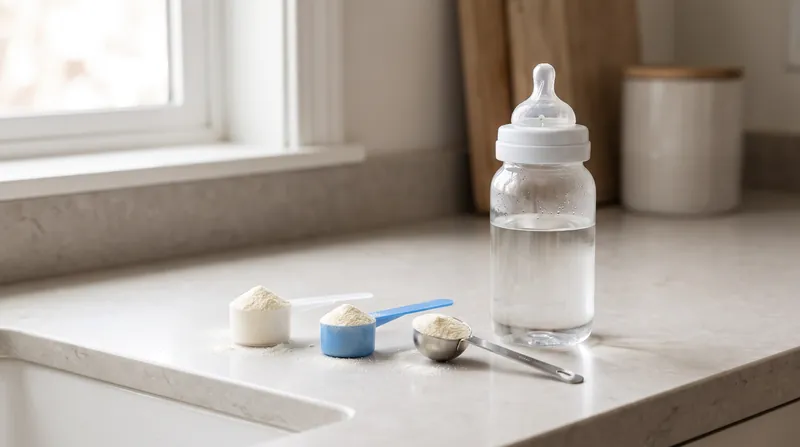
For decades, parents have prepared baby bottles under a fundamental misunderstanding: they believe powdered infant formula is a sterile product. It is not. While the manufacturing process is highly regulated, the physical reality of spray-drying milk into powder means that complete sterilization is impossible without destroying the nutritional value of the food.
This biological vulnerability has been thrust into the spotlight following two major multistate outbreaks of infant botulism in the United States, prompting a renewed evaluation of how families feed their most vulnerable members. The choice between powdered formula and liquid ready-to-feed options is no longer just a matter of convenience; it is a calculated trade-off between cost, logistics, and absolute microbiological safety.[6]
The specific threat in these recent outbreaks is Clostridium botulinum, a spore-forming bacterium naturally found in soil and dust. Unlike ordinary bacteria, which are relatively fragile, botulism spores are heavily armored survival mechanisms designed to withstand extreme environmental stress. They can easily enter a dairy manufacturing facility on the shoes of workers, through ventilation systems, or directly from the farm environment via raw milk.
Once ingested by an infant, these spores can colonize the immature intestinal tract and produce a potent neurotoxin that causes descending paralysis. Because a baby's gut microbiome is not fully developed in the first few months of life, they lack the competitive bacteria that protect older children and adults from these ubiquitous spores.[2]
The consequences of this vulnerability materialized sharply between late 2025 and the summer of 2026. In November 2025, federal health officials linked a massive outbreak of infant botulism to ByHeart, a premium organic powdered formula, resulting in 48 hospitalizations across 17 states.
Just seven months later, in June 2026, the FDA and CDC announced a new investigation into Nara Organics, another organic whole-milk powdered formula, after three infants in California, Washington, and Pennsylvania contracted the illness. Both companies initiated voluntary recalls of all their products currently on the market, pulling millions of cans from retail shelves and forcing parents to scramble for safe alternatives.[1][2][3][4][5]
When analyzing the data from these two events, a striking statistical concentration emerges. Despite accounting for less than two percent of the total infant formula supply in the United States, ByHeart and Nara Organics were collectively responsible for 51 confirmed infant botulism hospitalizations within a seven-month window.
This disproportionate impact demonstrates that the recent botulism risk has been highly concentrated in specific organic whole-milk supply chains, rather than representing an evenly distributed baseline risk across the entire powdered formula industry. However, this concentration does not negate the underlying biological reality that all powdered formulas share the same inherent vulnerability to spore survival.[1][2][6]
The core engineering problem is the failure of heat. In standard dairy processing, pasteurization is used to kill dangerous pathogens like Salmonella and E. coli. However, pasteurization temperatures are entirely insufficient to destroy Clostridium botulinum spores. Even the subsequent spray-drying process, which blasts the milk with hot air to evaporate the water, leaves the spores completely intact.
To reliably destroy botulism spores, a manufacturer must apply intense, pressurized heat—similar to the conditions inside a commercial pressure canner. If this level of heat were applied to milk powder, it would scorch the product, ruin the taste, and degrade the essential vitamins and proteins that infants require for healthy growth.[6]
This physical limitation extends into the family kitchen, rendering standard safety advice ineffective against botulism. Public health agencies routinely advise parents to mix powdered formula with water heated to 160 degrees Fahrenheit. This specific temperature threshold was established to kill Cronobacter sakazakii, another deadly bacterium that occasionally contaminates powdered formula.
But 160 degrees does absolutely nothing to Clostridium botulinum spores, which can easily survive boiling water. Parents who meticulously followed the preparation instructions for their organic formula were unknowingly providing zero protection against the very spores that ultimately hospitalized their infants.[6]
Complicating the safety landscape is a significant regulatory gap in global food standards. The Codex Alimentarius Commission, which sets international food safety guidelines, does not currently classify Clostridium botulinum as a hazard requiring routine testing in powdered infant formula. Instead, regulators and manufacturers rely on testing for indicator bacteria, assuming that a clean facility will naturally exclude botulism spores.
However, recent genomic analyses of the recalled formula lots revealed that botulism spores were present even when standard indicator tests came back completely negative. This scientific revelation suggests that the current testing framework is fundamentally unequipped to detect sporadic spore contamination before the product reaches the consumer.[6]
The only mathematically secure alternative on the retail shelf is liquid ready-to-feed formula. Unlike powder, liquid formula is commercially sterile. Because it is already hydrated, manufacturers can seal the liquid inside its final packaging and subject the entire container to the intense, pressurized heat required to achieve absolute sterility.
The only mathematically secure alternative on the retail shelf is liquid ready-to-feed formula.
This process physically destroys any botulism spores that may have entered the raw ingredients. Federal health guidance explicitly identifies ready-to-feed liquid as the safest option for higher-risk infants, including those born prematurely or those under two months of age whose immune systems and gut microbiomes are still developing.[1][3]
Despite the clear safety advantages of liquid formula, the industry remains overwhelmingly dominated by powder due to inescapable economic realities. Shipping heavy, water-filled bottles across the country requires significantly more fuel and logistical overhead than transporting lightweight powder. These costs are passed directly to the consumer, making ready-to-feed formula a premium product that many families simply cannot afford for an entire year of feeding.
Furthermore, liquid formula has a shorter shelf life once opened and generates vastly more plastic waste. Until new sterilization technologies are developed for dry powders, parents and pediatricians must continue to navigate this complex trade-off between absolute microbiological safety and practical financial sustainability.[6]
How we did this
- Method
- Aggregation of 2025–2026 infant botulism outbreak data and correlation with the stated market shares of the recalled brands to determine risk concentration.
- What we found
- Despite accounting for less than 2% of the U.S. infant formula supply, these two brands were responsible for 51 infant botulism hospitalizations in a seven-month period, demonstrating that the recent botulism risk is highly concentrated in specific organic whole-milk supply chains rather than distributed evenly across the powdered formula industry.
- What we worked from
- Limits of this analysis
- This analysis relies on epidemiological linkages and market share estimates provided during the recalls; it cannot definitively prove that other brands are entirely free of spores, only that they have not triggered recognized outbreaks.
Different angles
Powdered Infant Formula
The industry standard for cost and shelf life, but inherently non-sterile.
The primary argument for powdered formula is its cost-effectiveness and logistical efficiency. Because the water weight is removed, it is cheaper to ship, easier to store, and significantly more affordable for families over a year of feeding. Against this is the biological reality that powdered formula is not a sterile product. The spray-drying process cannot utilize the pressurized heat required to destroy Clostridium botulinum spores without scorching the milk and destroying its nutritional profile. The evidence from the 2025 ByHeart and 2026 Nara Organics outbreaks demonstrates that when spores enter the supply chain—often through raw milk or environmental dust—they can survive all the way to the infant's bottle. This option fits well when infants are healthy, full-term, and over two months of age, at which point their gut microbiome is generally mature enough to prevent spores from colonizing. It does not fit when feeding premature or immunocompromised infants who lack those internal defenses.
Liquid Ready-to-Feed Formula
Commercially sterile and heat-treated to destroy spores, offering maximum safety at a premium price.
The case for liquid ready-to-feed formula centers entirely on guaranteed sterility. Because it is sealed in its final container and subjected to intense, pressurized heat, any potential Clostridium botulinum spores are physically destroyed before the product reaches the shelf. Against this safety profile is the significant cost premium and environmental footprint; shipping heavy liquid across the country is expensive, and those costs are passed directly to parents. The evidence supporting its use comes directly from federal health guidance, which explicitly identifies ready-to-feed liquid as the safest option for higher-risk infants precisely because it is commercially sterile. This format fits well when feeding newborns under two months of age, premature infants, or any baby with a compromised immune system where the risk of spore colonization is highest. It does not fit when strict budget constraints make the ongoing purchase of premium liquid formula financially unsustainable for a family.
- Public Health Officials
- Focus on absolute safety and recommend sterile liquid formula for vulnerable infants.
- Formula Manufacturers
- Balance nutritional integrity with supply chain logistics and recall protocols.
- Independent Analysts
- Evaluate the statistical risk concentration and the physical limits of home preparation.
Perspectives this story doesn't cover
- Dairy Farmers / Milk Suppliers
- Low-Income Parents
Sources
Source coverage
6 outlets
3 viewpoints surfaced





- [1]FDAPublic Health Officials
Outbreak Investigation of Infant Botulism: Powdered Infant Formula (June 2026) — Nara Organics
Read on FDA → - [2]FDAPublic Health Officials
Post-Outbreak Response Activities: Clostridium botulinum Illnesses Associated with Consumption of Powdered Infant Formula
Read on FDA → - [3]CDCPublic Health Officials
Investigation Update: Infant Botulism Outbreak Linked to Nara Organics Infant Formula
Read on CDC → - [4]American Academy of PediatricsPublic Health Officials
Baby formula recalled after three infant botulism cases reported
Read on American Academy of Pediatrics → - [5]Nara OrganicsFormula Manufacturers
Nara Organics Refund Request Form
Read on Nara Organics → - [6]Factlen Editorial TeamIndependent Analysts
Synthesis by Factlen editorial team
Read on Factlen Editorial Team →

More in Shopping & Reviews
See all →Product Safety
Colerinsec Recalls 38,500 Jerify Magnetic Toys Following Child Hospitalizations
5 sources

Mattress Safety
The 6-Inch Maximum: How the CPSC Standard Dictates Crib Mattress Thickness and Firmness to Prevent Suffocation
6 sources

Car Seat Safety
How Rigid LATCH Cuts Car Seat Installation Errors by 25 Percentage Points
2 sources

Infant Nutrition
How Soy and Hydrolyzed Formulas Raise Osmotic Load Compared to Standard Cow's Milk
5 sources
Comments
Every angle. Every day.
Get Shopping & Reviews stories with full source coverage and perspective breakdowns, free every day.