
Cocktail Thermodynamics: Why Chilling Drinks Inevitably Requires Ice Dilution
The mechanics of mixing a drink rely on the thermodynamics of ice, where chilling and dilution are inextricably linked. Understanding how surface area and kinetic energy interact allows for precise control over a cocktail's final texture and taste.

Share this story
In short
- A cocktail cannot be chilled with ice without melting the ice, making dilution an unavoidable and essential ingredient.
- The chilling power of ice comes from the latent heat of fusion during the melting phase, not just the cold surface.
- Shaking introduces kinetic energy and air bubbles for a lighter texture, while stirring creates a dense, silky mouthfeel.
Open on the sound of ice rattling in a Boston shaker—a rhythmic, percussive crackle that lasts exactly twelve seconds before the metal tins frost over. That frost is not just a sign of a cold drink; it is the visual receipt of a rapid thermodynamic exchange. The bartender is not merely mixing ingredients; they are executing a precise physical reaction that fundamentally alters the structure of the liquid.[5]
At the heart of every well-crafted cocktail is a fundamental rule of physics: you cannot chill a drink with ice without melting that ice, and you cannot melt that ice without diluting the drink. Dilution is often treated by novices as a mistake, a watering-down of the good stuff. In reality, it is the invisible ingredient that binds spirits, citrus, and sugar together, opening up aromatic compounds and softening the harsh burn of ethanol.[1]
The mechanism driving this transformation is the latent heat of fusion. When ice melts, it absorbs a massive amount of energy from its surroundings—in this case, room-temperature gin, vermouth, or whiskey. It takes roughly eighty times more energy to turn zero-degree ice into zero-degree water than it does to raise the temperature of that water by a single degree.[1][5]
This means the chilling power of ice comes almost entirely from its melting phase, not just its cold surface. As culinary physicists have demonstrated, the temperature of a mixed drink is inextricably linked to its dilution. If a drink reaches a specific sub-zero temperature, a mathematically predictable amount of water has been added to the glass, regardless of the technique used to get there.[1]
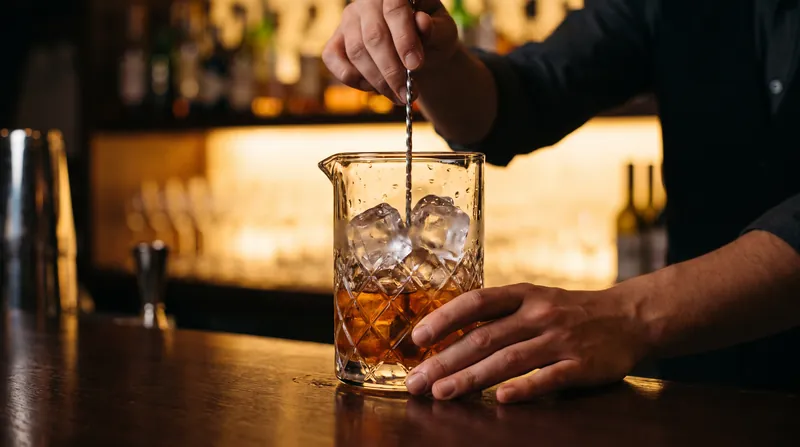
The choice between shaking and stirring is not about aesthetics or theatrical flair; it is about kinetic energy and texture. Stirring a Negroni or a Martini is a gentle, deliberate process. The spoon glides around the edge of the mixing glass, creating a smooth, laminar flow of liquid over the ice cubes.[3]
This gentle agitation cools the drink slowly, often taking up to forty-five seconds to reach thermal equilibrium. Because no air is folded into the liquid during this smooth rotation, the resulting cocktail is silky, dense, and crystal clear. The dilution happens steadily, allowing the maker to taste the progression and stop at the exact moment of perfect balance.[3][5]
Shaking, by contrast, is a violent collision. When a Daiquiri or Margarita is thrown back and forth inside a shaker, the liquid and ice smash against the walls and each other. This extreme kinetic energy shatters the edges of the ice cubes and rapidly accelerates the melting process, forcing the thermal exchange into overdrive.[3]
A shaken drink reaches its minimum temperature—often dipping well below the freezing point of water due to the antifreeze properties of the alcohol—in just twelve to fifteen seconds. Beyond the rapid chill and dilution, shaking forces tiny air bubbles into the liquid, creating a cloudy, aerated texture that feels lighter and more effervescent on the palate.[3][4]
Then comes the question of ice format, which is where intuition often clashes with physics. A persistent myth in mixology is that crushed ice dilutes a drink significantly more than large, solid cubes during the shaking or stirring process. The reality, tested extensively in cocktail science, is far more nuanced.[2]
Crushed ice has a vastly larger surface area than a single large cube. When room-temperature liquid is poured over it, that massive surface area causes an immediate, rapid melt. The drink chills almost instantly, but it also dilutes heavily in those first few crucial seconds of contact.[2][4]
However, once the liquid reaches thermal equilibrium—the point where the drink is as cold as the ice can make it—the melting dramatically slows down. If you strain a drink immediately after shaking or stirring, the total dilution is dictated by the final temperature, meaning crushed ice and large cubes will yield nearly identical water content if the drink is strained at the same temperature.[1][2]
Where ice size truly matters is in the glass, after the drink is poured and served. A large, clear cube in an Old Fashioned has minimal surface area relative to its volume. It melts slowly, keeping the drink cold without rapidly turning it into a watery mess as you sip it over twenty minutes.[4]
Conversely, a Mint Julep or a Tiki drink relies on crushed ice precisely because those drinks are strong, intensely flavored, and heavily sweetened. The continuous, slow melt of the crushed ice in the glass evolves the drink, mellowing the high-proof spirits and heavy syrups as you drink it, turning a potent mixture into a refreshing cooler.[4][5]
The structural quality of the ice also plays a crucial role in the final execution. Cloudy ice, often produced by standard home freezers, contains trapped air and dissolved minerals. These imperfections make the ice brittle, causing it to shatter easily when shaken, which can lead to over-dilution and unwanted ice shards floating in the final glass.[4]
Clear ice, frozen directionally to push out air and impurities, is denser and structurally sound. It melts more predictably, giving the bartender tighter control over the final wash line and the evolving flavor profile of the cocktail as it sits on the bar top.[4][5]
Clear ice, frozen directionally to push out air and impurities, is denser and structurally sound.
Ultimately, understanding cocktail dilution is about recognizing ice as an active, dynamic ingredient rather than a passive chilling tool. By manipulating time, agitation, and surface area, you are tuning the thermodynamic engine of the drink to achieve a specific sensory outcome.[1][5]
The next time you order a Martini or shake a Daiquiri at home, pay attention to the condensation forming on the outside of the glass. It is a quiet testament to the precise, calculated exchange of heat and water that transforms harsh spirits into a cohesive, elegant experience.[5]
How we did this
- Method
- Comparing the thermal exchange rates and dilution percentages of different ice formats (crushed vs. cubed) during both shaking and stirring, normalising the data to derive a unified thermodynamic rule for cocktail preparation.
- What we found
- The total dilution of a strained cocktail is dictated almost entirely by the final temperature reached—meaning that if a drink is strained immediately upon reaching thermal equilibrium, crushed ice and large cubes produce the exact same amount of dilution, debunking the myth that ice size inherently dictates water content.
- What we worked from
- Shaken cocktail temperature and aeration rate: Sub-zero temperatures reached in 12-15 seconds — Difford's Guide
- Crushed ice surface area dilution curve: Rapid initial melt stabilizing at thermal equilibrium — Cooking Issues
- Limits of this analysis
- This model assumes the drink is strained immediately; ice left in the glass for consumption will dilute at vastly different rates based on surface area.
Terms to know
- Latent heat of fusion
- The massive amount of energy required to change ice into water at the same temperature, which is the primary mechanism that chills a cocktail.
- Thermal equilibrium
- The point at which the liquid in a shaker or mixing glass becomes as cold as the ice can possibly make it, slowing further melting.
- Directional freezing
- A method of making ice where water freezes from one direction only, pushing trapped air and impurities to the bottom to create perfectly clear, dense ice.
- Wash line
- The level at which the finished liquid sits inside the cocktail glass, which is heavily influenced by the amount of water added through dilution.
Questions readers ask
Does shaking a drink 'bruise' the alcohol?
No. 'Bruising' gin or vodka is a myth. Shaking simply chills the drink faster, dilutes it more rapidly, and introduces air bubbles, which changes the texture but does not damage the spirit's molecular structure.
Why do some drinks use crushed ice while others use large cubes?
Large cubes have less surface area, melting slowly to keep a drink cold without watering it down quickly. Crushed ice melts continuously, which is intentionally used to mellow out strong, highly sweetened drinks like Tiki cocktails over time.
Does crushed ice dilute a drink more than cubed ice in a shaker?
If strained immediately upon reaching thermal equilibrium, both ice types produce nearly identical dilution. The difference is that crushed ice reaches that temperature almost instantly, while larger cubes take slightly longer.
Different angles
Culinary Physicists
Focuses on the thermodynamics, latent heat of fusion, and precise temperature control to achieve perfect dilution.
For culinary physicists and science-minded mixologists, the cocktail shaker is a closed thermodynamic system. They view ice not as a garnish, but as a precise tool for energy transfer. By measuring the exact temperature drop of a liquid, they can calculate the precise percentage of water added to the drink, proving that dilution is a mathematical certainty rather than a bartender's variable. This camp advocates for weighing ingredients and using standardized ice to ensure that every drink reaches the exact same thermal equilibrium, removing human error from the equation.
Traditional Bartenders
Values technique, the sensory feel of the shaker, the visual clarity of the ice, and the evolving experience of the drink.
Traditional and craft bartenders approach dilution through a sensory and experiential lens. While they intuitively understand the physics, their focus is on the tactile feedback of the shaker frosting over or the sound of the ice changing pitch as it rounds a mixing glass. For this camp, the visual appeal of a perfectly clear, hand-carved block of ice in an Old Fashioned is just as important as its slow-melting properties. They view dilution as an evolving journey, particularly in drinks served over crushed ice, where the first sip is intentionally potent and the last sip is a refreshing, mellowed cooler.
Home Enthusiasts
Prioritizes practical application, making do with standard freezer ice, and accessible techniques for better drinks.
The home cocktail enthusiast is often caught between high-end bar theory and the reality of a standard kitchen freezer. This perspective is highly pragmatic, focusing on how to adapt professional science to cloudy, brittle crescent ice. Home makers are primarily concerned with avoiding over-dilution, learning to shake for shorter durations to compensate for the rapid shattering of standard freezer ice. They rely on accessible workarounds, like directional freezing in small coolers, to replicate the structural integrity and predictable melting rates of professional bar ice without expensive equipment.
- Culinary Physicists
- Focuses on the thermodynamics, latent heat of fusion, and precise temperature control to achieve perfect dilution.
- Traditional Bartenders
- Values technique, the sensory feel of the shaker, the visual clarity of the ice, and the evolving experience of the drink.
- Home Enthusiasts
- Prioritizes practical application, making do with standard freezer ice, and accessible techniques for better drinks.
Perspectives this story doesn't cover
- Commercial Ice Manufacturers
- Spirits Distillers
Sources
Source coverage
5 outlets
3 viewpoints surfaced




- [1]Cooking IssuesCulinary Physicists
Cocktail Science in General: Part 1 of 2
Read on Cooking Issues → - [2]Cooking IssuesCulinary Physicists
Cocktail Science: Does Crushed Ice Dilute More?
Read on Cooking Issues → - [3]Difford's GuideTraditional Bartenders
Stirring vs Shaking Cocktails: Key Differences
Read on Difford's Guide → - [4]BolsTraditional Bartenders
The masterclass guide to cocktail ice: Science, application, and execu
Read on Bols → - [5]Factlen Editorial Team
Synthesis by Factlen editorial team
Read on Factlen Editorial Team →
More in Food & Drink
See all →Spirits Science
The Ouzo Effect: How Spontaneous Emulsification Creates the Milky Cloud in Anise Spirits
7 sources
Cocktail Science
The 66° to 68° Brix Window: How Sugar Concentration Dictates the Microbial Stability and Crystallization of Simple Syrup
6 sources
Cocktail Science
The 10% to 20% Air Incorporation: How Shaking Creates Opacity and Texture in Cocktails
6 sources
Cocktail Science
The 25% to 35% Dilution Window: How Ice Melt Dictates a Cocktail's Final Texture and Flavor Balance
11 sources
Comments
Every angle. Every day.
Get Food & Drink stories with full source coverage and perspective breakdowns, free every day.