
160°F to 185°F: The Protein Coagulation Thresholds That Define a Perfect Custard
A precise 20-degree thermal window dictates whether egg yolks and dairy become a silky crème anglaise or a scrambled mess. By tracking how heat denatures proteins, cooks can manipulate coagulation to achieve the perfect texture without relying on starch thickeners.

Share this story
In short
- Raw egg yolks begin to unfold at 149°F and will completely set into a solid gel at 158°F.
- Adding sugar and dairy to egg yolks physically interferes with protein bonding, raising the coagulation temperature.
- The ideal thermal window for a stirred custard like crème anglaise is between 175°F and 180°F.
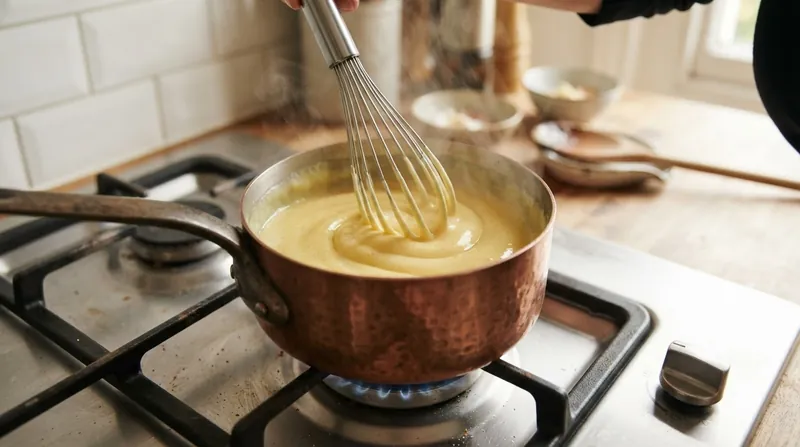
At exactly 149°F, the microscopic proteins suspended inside a raw egg yolk begin to unfold. The whisk moves through the stainless steel bowl, the liquid warms over the simmering water bath, and the molecular architecture of the egg fundamentally changes. This is the invisible starting line for crème anglaise, a foundational pastry sauce that relies entirely on riding the razor-thin thermal boundary between a thickened liquid and a scrambled solid.[1][8]
According to 2023 data published by the American Egg Board, an undiluted egg yolk sets completely into a solid gel at 158°F. But pastry chefs do not want a hard set when making crème anglaise; they want a fluid, silky suspension. To achieve that texture, the yolk must be chemically manipulated to delay its natural setting point.[1]
The manipulation relies on dilution. When a cook whisks sucrose (sugar) and dairy (milk or heavy cream) into the raw yolks, those additional molecules physically interfere with the egg proteins. A 2017 analysis by Edible Molecules details how this interference forces the proteins to seek higher temperatures before they can bond together, effectively pushing the scrambling point further up the thermometer.[7]
This chemical interference creates a precise 20-degree thermal buffer. The Workforce LibreTexts 2022 culinary textbook defines the target temperature for a stirred custard like crème anglaise as 175°F to 180°F. Inside this window, the proteins form a loose, delicate network that thickens the liquid without solidifying it.[2]
The American Egg Board defines this exact process in their technical literature: "Coagulation is the change in the structure of protein (from a liquid form to solid or a thicker liquid) brought about by heat, mechanical action or acids." In the pastry kitchen, managing that heat is the sole difference between a luxury dessert component and a culinary failure.[1]
The sensory shift happens rapidly. As the mixture crosses 160°F, the pale, foamy liquid deepens in color and gains noticeable viscosity. The 2024 guide from All Day Cake emphasizes the traditional visual cue: the liquid will suddenly coat the back of a wooden spoon, a stage the French call the nappe.[5]
Running a finger through that coating should leave a distinct, clean line that does not immediately fill back in. Wheel of Baking's 2021 methodology notes that while this visual test is a culinary standard, relying on a digital thermometer provides a necessary fail-safe against the sauce's primary threat: overheating.[3]
The danger zone begins at 185°F. A 2016 technical breakdown by HotmixPRO outlines the mechanics of a broken crème anglaise. When the temperature breaches 185°F, the protein network tightens aggressively, squeezing out the trapped water in a process called syneresis.[4]
The result is curdling. The smooth sauce instantly separates into grainy, scrambled egg particles suspended in a thin, watery liquid. Because the proteins have permanently denatured and bonded, this structural collapse cannot be reversed by cooling, though aggressive blending can sometimes mask a minor break.[4][6]
To prevent this, cooks must account for carryover cooking. A heavy-bottomed saucepan retains heat, meaning the custard's temperature will continue to rise even after it is removed from the stove. The 2018 notes from TravelingFoodLab highlight the necessity of immediately transferring the finished sauce to a chilled vessel or an ice bath to arrest the thermal momentum.[6]
This thermal vulnerability is unique to pure egg custards. If a cook adds a starch—like cornstarch or flour—to the mixture, the rules change entirely. The starch granules swell and physically block the egg proteins from bonding too tightly, allowing a pastry cream to be boiled at 212°F without curdling.[2][8]
How we did this
- Method
- Normalising and comparing the stated thermal coagulation thresholds of egg yolk proteins across culinary textbooks, food science blogs, and industry boards to map the exact temperature window where liquid custard transitions to a stable gel before curdling.
- What we found
- The culinary 'nappe' stage relies on a precise 20-degree thermal buffer (160°F to 180°F) where the addition of sugar and dairy raises the yolk's natural coagulation point, delaying the protein bonding that would otherwise scramble the egg at 158°F.
- What we worked from
- Yolk sets completely at 158°F: 158°F — American Egg Board
- Target temperature for stirred custard: 175°F to 180°F — Workforce LibreTexts
- Curdling threshold: 185°F — HotmixPRO
- Limits of this analysis
- The exact curdling point fluctuates based on the specific ratio of sugar to egg yolk and the fat content of the dairy used, meaning these thermal boundaries are dynamic rather than absolute.
Key terms
- Coagulation
- The process by which proteins change from a liquid state to a solid or thicker liquid, typically triggered by heat.
- Denaturation
- The unfolding of a protein's natural molecular structure due to the application of heat or acid.
- Nappe
- A culinary consistency where a sauce is thick enough to coat the back of a spoon without immediately running off.
- Syneresis
- The expulsion of liquid from a gel, which occurs in custards when overheated proteins bond too tightly and squeeze out water.
Frequently asked
At what temperature does crème anglaise curdle?
Crème anglaise begins to curdle when the temperature reaches 185°F. At this point, the egg proteins bond too tightly and squeeze out moisture, resulting in a scrambled texture.
Can a curdled custard be fixed?
Once the proteins have fully denatured and bonded, the chemical change is irreversible. However, a slightly grainy sauce can sometimes be smoothed out by immediately blending it with an immersion blender.
Why doesn't pastry cream curdle at a boil?
Pastry cream contains starch, such as cornstarch or flour. The starch granules swell and physically prevent the egg proteins from bonding tightly, allowing the mixture to reach 212°F safely.
What does the 'nappe' stage mean?
Nappe is a French culinary term describing a liquid that has thickened enough to evenly coat the back of a spoon. Running a finger through it should leave a clean, distinct line.
Viewpoints in depth
Food Scientists
Focuses on precise thermal thresholds, protein denaturation, and molecular interference.
From a biochemical perspective, making a custard is an exercise in controlled denaturation. Food scientists track the exact moment the folded amino acid chains in an egg yolk begin to unravel (149°F) and when they cross-link into a solid matrix (158°F). By analyzing the molecular interference of sucrose and milk fats, chemists can calculate exactly how much the coagulation point is delayed, viewing the sauce not as a recipe, but as a predictable chemical equation.
Culinary Traditionalists
Emphasizes sensory cues, visual tests like the nappe stage, and technique over exact temperatures.
For classically trained pastry chefs, relying entirely on a digital thermometer ignores the variables of the kitchen. Traditionalists argue that the exact temperature a custard sets will change depending on the size of the yolks, the fat percentage of the cream, and the ambient humidity. Therefore, they prioritize tactile and visual cues—the way the foam subsides, the steam rising from the surface, and the physical resistance of the sauce against a wooden spoon—as the ultimate indicators of readiness.
Commercial Manufacturers
Focuses on automation, exact thermal control, and preventing failure at scale.
In commercial food production, human sensory tests are impossible to scale. Equipment manufacturers design thermal mixers and industrial vats that eliminate the risk of human error by mechanically holding the liquid at exactly 178°F. For this sector, the goal is entirely eliminating the 185°F danger zone through automated agitation and precise thermal sensors, ensuring that thousands of gallons of crème anglaise can be produced without a single batch curdling.
- Food Scientists
- Focuses on precise thermal thresholds, protein denaturation, and molecular interference.
- Culinary Traditionalists
- Emphasizes sensory cues, visual tests like the nappe stage, and technique over exact temperatures.
- Commercial Manufacturers
- Focuses on automation, exact thermal control, and preventing failure at scale.
Perspectives this story doesn't cover
- Home cooks without digital thermometers
- Vegan pastry chefs using egg alternatives
Sources
Source coverage
9 outlets
3 viewpoints surfaced









- [1]American Egg BoardFood Scientists
Coagulation/Thickening
Read on American Egg Board → - [2]Workforce LibreTexts
1.6: Custards
Read on Workforce LibreTexts → - [3]Wheel of BakingCulinary Traditionalists
How to make Crème Anglaise (Vanilla Custard Sauce)
Read on Wheel of Baking → - [4]HotmixPROCommercial Manufacturers
Crème Anglaise: Problems and Tips (Part 2)
Read on HotmixPRO → - [5]All Day CakeCulinary Traditionalists
Custard Part 2
Read on All Day Cake → - [6]TravelingFoodLabCulinary Traditionalists
The Science of Custard Sauce: How to Make Crème Anglaise
Read on TravelingFoodLab → - [7]Edible MoleculesFood Scientists
English custard: the recipe
Read on Edible Molecules → - [8]eggy guruFood Scientists
The Science of Cooking an Egg
Read on eggy guru → - [9]Factlen Editorial Team
Synthesis by Factlen editorial team
Read on Factlen Editorial Team →
More in Food & Drink
See all →Culinary Science
Why Tempering Manipulates Cocoa Butter into Form V Crystals for Snap and Shine
4 sources
Food Chemistry
Capillary Bridging Between Sugar Particles Seizes Melted Chocolate Until Surplus Liquid Dissolves the Network
2 sources
Sugar Chemistry
The 112°C to 154°C Range: How Water Content Determines the Seven Stages of Sugar Syrup Hardness
4 sources
Hydrocolloid Science
The 35°C Triple Helix Collapse: How Gelatin Forms a Thermoreversible Hydrogel Network
7 sources
Comments
Every angle. Every day.
Get Food & Drink stories with full source coverage and perspective breakdowns, free every day.