
The Physics of Induction Cooking: Why It Is Replacing Gas and How It Actually Works
While gas burners lose nearly 70 percent of their heat to the ambient kitchen air, induction cooktops use electromagnetism to turn the cookware itself into the heat source, delivering 85 percent thermal efficiency while eliminating indoor combustion pollutants.
By Adrien Caron

Share this story
In short
- Induction cooktops use electromagnetism to heat the cookware directly, rather than heating the glass surface.
- Gas cooktops lose approximately 68 percent of their heat to the surrounding air, while induction transfers 85 percent of its energy directly to the food.
- The combustion of natural gas indoors releases nitrogen dioxide and benzene, pollutants linked to respiratory irritation and childhood asthma.
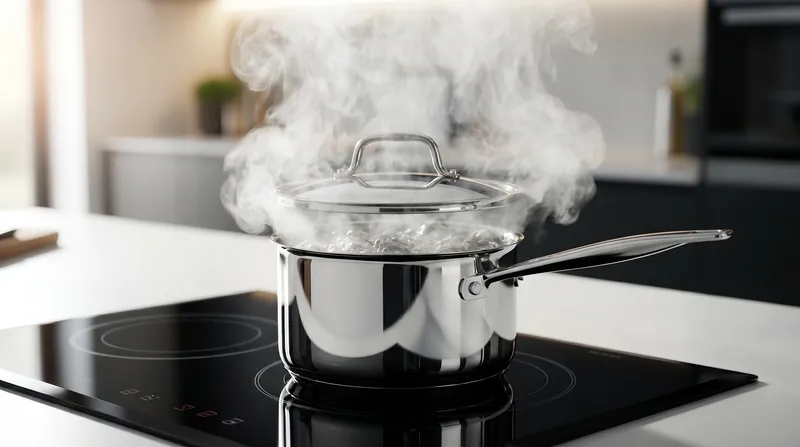
Most people think an induction cooktop is just a modern version of the electric glass-top stoves that have been around since the 1970s. The assumption is that the glass gets hot, and the glass heats the pan. In reality, the surface of an induction stove never generates its own heat. Instead, it uses electromagnetism to turn the cookware itself into the burner.[2]
This fundamental shift in physics is quietly rewriting the rules of the American kitchen. For decades, the culinary gold standard was the gas flame, prized for its immediate visual feedback and rapid temperature adjustments. But as the science of thermal dynamics and indoor air quality becomes clearer, induction is rapidly replacing gas in both high-end renovations and commercial kitchens.
To understand why, you have to look under the glass. Beneath an induction cooktop lies a tightly wound coil of copper wire. When you turn the stove on, an alternating electric current flows through this coil, creating a rapidly fluctuating magnetic field.[2]
This magnetic field penetrates the glass without heating it and enters the bottom of the cookware. If the pan is made of a magnetic material—like cast iron or magnetic stainless steel—the fluctuating magnetic field induces smaller electric currents, known as eddy currents, inside the metal of the pan. The electrical resistance of the iron against these eddy currents generates intense, immediate heat. The pan gets hot, while the glass below it only warms up slightly from the residual heat of the pan resting on it.[2]
The most significant consequence of this mechanism is thermal efficiency. When you cook with a traditional gas stove, the flame must heat the air around the burner, the grates, and the bottom of the pan. According to ENERGY STAR data, conventional gas cooktops operate at approximately 32 percent efficiency.
This means that for every dollar you spend on the gas to boil a pot of water, 68 cents worth of heat escapes around the sides of the pot and dissipates into your kitchen. Conventional electric resistance cooktops—the ones with glowing red coils under the glass—are better, transferring about 75 to 80 percent of their energy to the food.
Induction, however, operates at roughly 85 percent efficiency. Because the heat is generated directly inside the metal of the pan, there is virtually no ambient heat loss. The energy goes exactly where it is needed, which is why induction can boil a pot of water in less than half the time of a high-output gas burner.
This efficiency creates a cascading effect on a home's overall energy consumption. The wasted heat from a gas stove does not just vanish; it raises the ambient temperature of the kitchen. During the summer months, a homeowner is essentially paying twice for that wasted energy: once to burn the gas, and a second time for the air conditioning system to remove that excess heat from the house.[2]
Beyond energy efficiency, the shift toward induction is being heavily driven by new research into indoor air quality. For years, the focus on gas appliances was primarily on carbon monoxide, which is why building codes require ventilation. But recent studies have highlighted a broader spectrum of pollutants.[1]
The combustion of natural gas indoors creates a range of byproducts, most notably nitrogen dioxide (NO2). The American Public Health Association has noted that cooking with gas stoves without adequate ventilation can result in indoor NO2 concentrations that exceed the Environmental Protection Agency's ambient air quality standards for outdoor air.[1]
Nitrogen dioxide is a known respiratory irritant. Epidemiological studies have consistently shown that children living in homes with gas stoves have a higher risk of developing asthma and experiencing more severe asthma symptoms.[1]
Furthermore, research from PSE Healthy Energy has demonstrated that burning natural gas also generates benzene, a known human carcinogen. Their studies indicate that a single gas cooktop burner on high can raise indoor levels of benzene above those found in secondhand tobacco smoke.
Because induction cooktops use electromagnetism rather than combustion, they produce zero indoor emissions. The only byproducts are the steam and odors from the food itself, which can be easily managed by a standard range hood.
The transition is not without its hurdles. The most immediate barrier for homeowners is cookware compatibility. Because induction relies on magnetic fields, pots and pans made of aluminum, copper, or glass will not work. A simple test—seeing if a refrigerator magnet sticks firmly to the bottom of a pan—is the standard way to determine if existing cookware is induction-ready.[2]
There is also a learning curve. The immediate heat generation of induction means that pans heat up much faster than cooks might expect, requiring a shift in timing and prep work. You can no longer turn on the burner and then start chopping an onion; the oil in the pan will be smoking before you finish.[2]
Despite these adjustments, the momentum is clearly shifting. The U.S. Department of Energy notes that in recent nationally representative surveys, nearly 70 percent of consumers indicated they would consider induction for their next range or cooktop.
Despite these adjustments, the momentum is clearly shifting.
As federal rebates and local electrification incentives continue to lower the upfront cost of the appliances, induction is moving from a niche luxury item to the standard for modern, healthy, and efficient home design.
How we did this
- Method
- Normalizing the thermal transfer efficiency and ambient heat loss across gas, radiant electric, and induction cooktops to calculate the true energy delivered to the cookware versus energy lost to the kitchen environment.
- What we found
- While gas burners consume more raw energy (BTUs), nearly 70% of that energy is spent heating the ambient kitchen air rather than the food, meaning a standard 15,000 BTU gas burner delivers less actual cooking heat to a pan than a 1,800-watt induction element, while forcing the home's HVAC system to work harder to remove the wasted heat.
- What we worked from
- Gas cooktop thermal efficiency: 32%
- Induction cooktop thermal efficiency: 85%
- Limits of this analysis
- This analysis focuses purely on thermal energy transfer at the point of use and does not account for the upstream energy losses associated with generating and transmitting the electricity that powers the induction cooktop.
Terms to know
- Electromagnetic field
- A physical field produced by electrically charged objects, used in induction to transfer energy directly to the pan.
- Eddy currents
- Loops of electrical current induced within the metal of the cookware by the alternating magnetic field, creating heat through resistance.
- Thermal efficiency
- The percentage of energy consumed by an appliance that is actually transferred into the food being cooked, rather than lost to the surrounding air.
- Nitrogen dioxide (NO2)
- A toxic gas produced by the combustion of natural gas, known to act as a respiratory irritant and linked to asthma.
Questions readers ask
Do I have to buy all new pots and pans for an induction stove?
Not necessarily. Any cookware that a magnet sticks to, such as cast iron or magnetic stainless steel, will work perfectly on an induction cooktop.
Does the glass surface of an induction cooktop get hot?
The glass itself does not generate heat, but it will become warm from the residual heat of the hot pan resting on top of it.
Is induction cooking actually faster than gas?
Yes. Because the energy is transferred directly into the metal of the pan without ambient heat loss, induction can boil water in less than half the time of a standard gas burner.
Can induction cooktops interfere with pacemakers?
While the magnetic field is highly localized, manufacturers and cardiologists generally recommend that individuals with pacemakers consult their doctor and maintain a distance of about two feet from the active cooktop.
Different angles
Building Electrification Advocates
This group views the transition away from gas appliances as a critical step in reducing residential carbon footprints.
Advocates argue that as the electrical grid becomes increasingly powered by renewable energy sources, shifting homes to electric appliances like induction cooktops and heat pumps is the only viable path to decarbonizing the residential sector. They emphasize that gas stoves lock homes into fossil fuel infrastructure for decades, whereas electric appliances become greener as the grid improves.
Public Health Researchers
Medical and environmental health professionals focus on the immediate indoor air quality benefits of eliminating combustion.
This camp points to decades of epidemiological data linking gas stove emissions—specifically nitrogen dioxide and benzene—to elevated rates of childhood asthma and respiratory illness. They argue that the kitchen should be treated with the same indoor air quality standards as the rest of the home, making zero-emission induction technology a public health imperative rather than just a culinary choice.
Traditional Culinary Professionals
Chefs and experienced home cooks who prioritize the tactile feedback and established techniques of cooking over an open flame.
While acknowledging the efficiency of induction, traditionalists argue that gas provides crucial visual cues through the size of the flame and allows for techniques like charring peppers directly on the grate or aggressively tossing a wok without losing the heat connection. They often view the mandatory phase-out of gas in new construction as an overreach that limits culinary expression and forces expensive retrofits on the restaurant industry.
- Building Electrification Advocates
- This group views the transition away from gas appliances as a critical step in reducing residential carbon footprints and improving energy efficiency.
- Public Health Researchers
- Medical and environmental health professionals focus on the immediate indoor air quality benefits of eliminating combustion.
- Independent Analysts
- Observers who focus on the practical mechanics, market adoption, and consumer trade-offs of the technology.
Perspectives this story doesn't cover
- Natural Gas Industry Representatives
- Restaurant Owners Facing Retrofit Costs
Sources
Source coverage
2 outlets
3 viewpoints surfaced


- [1]American Public Health AssociationPublic Health Researchers
Gas Stove Emissions Are a Public Health Concern
Read on American Public Health Association → - [2]Factlen Editorial TeamIndependent Analysts
Synthesis by Factlen editorial team
Read on Factlen Editorial Team →
More in Home
See all →Food Standards
How International Standards Divide Food Date Labels Between Quality and Safety
6 sources

Water Chemistry
The 17.86 Milligrams per Litre Threshold: How International Water Hardness Scales Dictate Appliance Lifespans
6 sources
Cleaning Physics
The Sinner Circle: How Heat, Time, Chemistry, and Friction Actually Govern Kitchen Cleaning
6 sources
Fire Safety Tech
Particle Size vs. Sensor Type: Why Your Smoke Detector Might Ignore a Smoldering Couch Fire
6 sources
Comments
Every angle. Every day.
Get Home stories with full source coverage and perspective breakdowns, free every day.