
The Physics of Camera Sensors: Comparing Full-Frame, APS-C, and Micro Four Thirds
Understanding the physics of light gathering reveals why larger camera sensors cost exponentially more, and why smaller formats often provide a better balance of price and performance.

Share this story
In short
- The physical size of a camera's sensor is the primary factor determining its low-light performance, depth of field, and overall cost.
- Full-frame sensors gather significantly more total light, providing cleaner images in dark environments and shallower background blur.
- Smaller APS-C and Micro Four Thirds sensors apply a crop factor that effectively increases the reach of telephoto lenses.
The most consequential decision when buying an interchangeable-lens camera is not the brand name stamped on the prism, nor the megapixel count printed on the box. The defining characteristic that dictates a system's size, weight, cost, and optical capabilities is the physical dimensions of the silicon sensor inside.
In the digital photography era, the market has coalesced around three primary sensor sizes: Full-Frame, APS-C, and Micro Four Thirds. Understanding the physics of how these silicon rectangles gather light is the key to decoding why certain lenses cost thousands of dollars more than others, and why bigger is not universally better.
At the foundation of camera physics is a simple truth: photography is the act of collecting photons. Think of light as rain, and the camera sensor as a bucket. A larger bucket catches more total raindrops in the same amount of time, providing a stronger, clearer signal to measure.
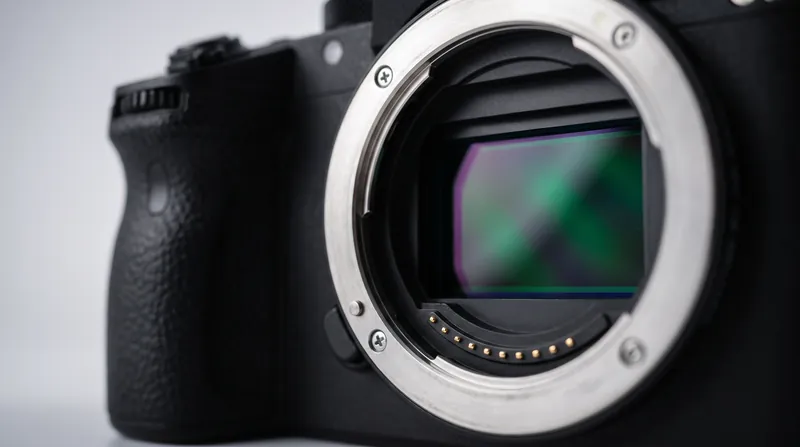
The baseline standard for modern professional cameras is the "full-frame" sensor. Measuring roughly 36 by 24 millimeters, it shares the exact dimensions of classic 35mm film. Because of its expansive 864-square-millimeter surface area, a full-frame sensor can accommodate millions of microscopic light-gathering cavities—called photosites—while keeping each individual cavity relatively large.[1]
These large photosites are highly efficient at capturing photons. When shooting in dimly lit environments, a full-frame sensor requires less electronic amplification to produce a usable image. This superior signal-to-noise ratio is why full-frame cameras excel at night photography, delivering clean files with rich dynamic range where smaller sensors might produce muddy, grain-filled shadows.
However, that light-gathering supremacy comes with severe physical and economic penalties. Silicon chips are manufactured on circular wafers. Because full-frame sensors are massive, very few can be cut from a single wafer. Furthermore, a single microscopic defect on the silicon ruins the entire sensor, driving down manufacturing yields.
As the surface area of a sensor increases, the probability of a defect ruining the chip rises exponentially. This geometric reality means that while a full-frame sensor is roughly 2.4 times larger than an APS-C sensor, it costs significantly more than 2.4 times as much to manufacture.[2]
The costs do not stop at the camera body. To project an image circle large enough to cover a 36x24mm sensor, full-frame lenses require massive glass elements. A full-frame 70-200mm f/2.8 zoom lens is a heavy, expensive cylinder of precision optics that demands a dedicated camera bag and a strong back.
Enter the "crop sensors"—APS-C and Micro Four Thirds. An APS-C sensor measures roughly 23.6 by 15.6 millimeters, while Micro Four Thirds is smaller still at 17.3 by 13 millimeters, offering just 224 square millimeters of surface area. Because they are smaller, they are dramatically cheaper to produce, and they require much smaller, lighter lenses to cover their surface area.[1][2]
The defining characteristic of these smaller formats is the "crop factor." Because an APS-C sensor only captures the center portion of the image circle that a full-frame sensor would see, it effectively crops the field of view. On a standard APS-C camera, this crop factor is 1.5x. On a Micro Four Thirds camera, it is 2.0x.[1]
This crop factor fundamentally alters the geometry of photography. A standard 50mm lens mounted on an APS-C camera delivers the field of view of a 75mm lens. Mounted on a Micro Four Thirds camera, it acts like a 100mm telephoto lens.[1]
For wildlife, sports, and aviation photographers, this crop factor is a massive advantage. A photographer shooting a bird with a 300mm lens on a Micro Four Thirds body gets the equivalent reach of a 600mm lens on a full-frame body—achieving professional-level magnification with a setup that weighs a quarter as much and costs thousands of dollars less.
But the physics of equivalence also apply to depth of field, which is where the smaller sensors face their primary compromise. Depth of field—the aesthetic background blur that isolates a subject—is tied to the physical aperture diameter of the lens relative to the field of view.
Because a crop-sensor photographer must stand further away or use a wider lens to match the framing of a full-frame camera, the resulting depth of field increases. An f/1.8 lens on an APS-C camera produces the light intensity of f/1.8 for exposure, but the depth of field looks closer to f/2.7 on a full-frame system.
This is why portrait photographers who crave ultra-shallow, creamy backgrounds overwhelmingly prefer full-frame systems. To achieve the exact same background blur as an 85mm f/1.4 lens on full-frame, an APS-C shooter would need a 56mm f/0.95 lens—an optical extreme that is incredibly difficult and expensive to manufacture.
Despite the marketing dominance of full-frame cameras, consumer purchasing data tells a different story. In 2025, APS-C and Micro Four Thirds bodies shipped roughly 4.45 million units globally, compared to just 2.54 million full-frame and larger formats. Smaller sensors are quietly outselling the giants by nearly 75 percent.
This sales volume is driven by the narrowing performance gap. Modern APS-C and Micro Four Thirds sensors feature advanced backside-illumination and AI-driven autofocus processors that were once exclusive to flagship models. For day-to-day photography, the image quality difference in good lighting is virtually indistinguishable to the human eye.
Ultimately, choosing a sensor size is an exercise in balancing physics against practical utility. Full-frame systems offer the absolute ceiling for low-light performance and subject isolation, but demand a premium in both budget and physical endurance.
Crop-sensor systems accept a mathematical compromise in total light gathering in exchange for unparalleled portability, telephoto reach, and economic accessibility. For the vast majority of visual creators, the best sensor is not the largest piece of silicon, but the one housed in the camera they are actually willing to carry.[3]
How we did this
- Method
- Calculated the physical light-gathering surface area ratio between the three major sensor formats and compared it against the silicon wafer manufacturing yield constraints to determine the true cost-per-photon premium.
- What we found
- While a full-frame sensor gathers roughly 2.4 to 3.8 times more total light than its smaller counterparts, the cost to manufacture it scales at a much steeper exponential rate due to the geometric decrease in viable chips per silicon wafer, meaning buyers pay a disproportionate premium for the final margins of low-light performance.
- What we worked from
- Limits of this analysis
- This analysis isolates sensor manufacturing costs and light-gathering physics, but does not account for the additional R&D, weather sealing, and processor upgrades manufacturers often bundle exclusively into their full-frame camera bodies.
Key terms
- Photosites
- The microscopic light-gathering cavities on a camera sensor that capture photons and convert them into electrical signals.
- Crop Factor
- A multiplier used to calculate the equivalent field of view of a lens when mounted on a sensor smaller than the 35mm full-frame standard.
- Depth of Field
- The distance between the nearest and farthest objects in a scene that appear acceptably sharp in an image.
- Signal-to-Noise Ratio
- The ratio of actual image data (light) to unwanted electronic interference (grain or noise), which improves as sensors gather more total light.
Frequently asked
Does a smaller sensor change the actual focal length of my lens?
No. A 50mm lens is always a 50mm lens. However, because a smaller sensor only captures the center portion of the light coming through the lens, it crops the field of view, making the image look as though it was taken with a longer lens.
Is an f/2.8 lens on a smaller sensor just as bright as on full-frame?
Yes and no. The light intensity (exposure) remains identical, meaning your shutter speed and ISO settings will match. However, the total amount of light gathered is less, which affects the signal-to-noise ratio and increases the depth of field.
Why are full-frame cameras so much more expensive?
Silicon sensors are cut from circular wafers. A larger sensor means fewer chips fit on a single wafer, and any microscopic defect ruins a much larger portion of the batch, causing manufacturing costs to scale exponentially rather than linearly.
Viewpoints in depth
The Full-Frame Purist View
Prioritizing absolute image quality, dynamic range, and subject isolation.
For commercial, wedding, and architectural photographers, the full-frame sensor remains the gold standard. By offering 864 square millimeters of light-gathering surface, these sensors allow for larger individual pixels (photosites) even at high resolutions. This translates directly to cleaner files in low light and a wider dynamic range—meaning details can be recovered from deep shadows without introducing destructive color noise. Furthermore, the geometry of a larger sensor requires lenses to be closer to their subjects for the same framing, naturally producing the ultra-shallow depth of field and creamy background blur that clients associate with premium professional photography.
The Crop-Sensor Pragmatist View
Valuing portability, telephoto reach, and exponential cost savings.
Wildlife, travel, and street photographers often view full-frame systems as an unnecessary burden. Because APS-C and Micro Four Thirds sensors only capture the center of the image circle, they apply a 'crop factor' that effectively multiplies a lens's focal length. A relatively compact 300mm lens on a Micro Four Thirds body delivers the same field of view as a massive, heavy, and prohibitively expensive 600mm lens on a full-frame camera. Combined with the fact that these smaller bodies and lenses cost a fraction of the price to manufacture, pragmatists argue that the minor trade-off in extreme low-light performance is more than justified by the ability to actually carry the gear into the field.
- Crop-Sensor Pragmatists
- Emphasize that APS-C and Micro Four Thirds offer a superior balance of cost, portability, and telephoto reach for most shooters.
- Full-Frame Purists
- Argue that the maximum light-gathering area is essential for professional dynamic range and shallow depth of field.
- Optical Physicists
- Focus strictly on the mathematical equivalence of light intensity, total light gathered, and signal-to-noise ratios.
Perspectives this story doesn't cover
- Smartphone Computational Photography Advocates
- Medium Format Commercial Shooters
Sources
Source coverage
3 outlets
3 viewpoints surfaced



- [1]DPReviewOptical Physicists
What is equivalence and why should I care?
Read on DPReview → - [2]PhotoSeekOptical Physicists
Compare digital camera sensor sizes
Read on PhotoSeek → - [3]Factlen Editorial TeamCrop-Sensor Pragmatists
Synthesis by Factlen editorial team
Read on Factlen Editorial Team →
More in Shopping & Reviews
See all →Creative Software
Adobe Completes Acquisition of Topaz Labs, Integrating AI Enhancement Tech into Creative Cloud
5 sources
Chroma Subsampling
4:2:2 vs. 4:2:0 Chroma Subsampling: How Two Numbers Dictate Video Color Grading Flexibility
6 sources
Camera Tech
Phase Detection vs. Contrast Detection Autofocus: How On-Sensor Microlenses Dictate Speed and Accuracy
8 sources
Image Stabilization
Optical Lens Stabilization and Sensor-Shift Systems: How Camera Shake Correction Dictates Low-Light Performance
7 sources
Comments
Every angle. Every day.
Get Shopping & Reviews stories with full source coverage and perspective breakdowns, free every day.