
UK's £20 ETA Mandate Requires Visa-Exempt Passengers to Hold Permits for Heathrow Layovers
The UK's fully enforced Electronic Travel Authorisation now requires visa-exempt travelers to secure a £20 digital permit before boarding, fundamentally changing how international layovers work at major British hubs.

Share this story
For decades, international travelers have treated London's Heathrow Airport as a frictionless gateway to the rest of the world. Passengers flying from New York to Rome or Sydney to Paris could seamlessly connect through the British hub without ever worrying about UK immigration paperwork. That era is officially over. As of 2026, the United Kingdom has fully implemented its Electronic Travel Authorisation (ETA) system, fundamentally altering the calculus for millions of transit passengers.
The new digital permit, which recently saw its fee increased to £20, is now a mandatory pre-travel requirement for citizens of 84 visa-exempt nations, including the United States, Canada, Australia, and the European Union. The shift marks the end of the spontaneous European layover, replacing it with a strict digital checkpoint that begins thousands of miles before a traveler ever reaches British airspace.[2][3]
The ETA is not a traditional visa, but rather a digital security screening tool designed to digitize the UK border and provide the Home Office with advance knowledge of everyone entering the country. Similar in concept to the American ESTA or the upcoming European ETIAS, the system cross-references applicant data against international security and criminal databases.
Once approved, the authorization is electronically linked to the traveler's passport chip. It remains valid for two years—or until the passport expires, whichever comes first—and permits multiple entries into the UK for stays of up to six months. While the system was designed to streamline entry for frequent visitors, its rigid application to transit passengers has caught thousands of travelers off guard.[2][6]
While the requirement for tourists actually visiting London is straightforward, the ETA has created a massive blind spot for travelers who merely intend to layover. The confusion stems from the UK's complex transit rules. If a passenger's itinerary requires them to pass through UK border control—a process known as "landside transit"—an ETA is absolutely mandatory.
This applies to travelers who need to collect and recheck their luggage, those changing airports (such as transferring from Heathrow to Gatwick), or those flying on separate tickets booked across different airlines. In these scenarios, the traveler is legally entering the United Kingdom, even if only for two hours to reach a different departure terminal.[4][6]
The more contentious issue involves "airside transit," where passengers remain in the secure terminal area and never officially enter the UK. While the Home Office maintains a temporary exemption for airside transit at Heathrow and Manchester airports, the reality on the ground is vastly different.
Because the exemption is officially listed as "under review," and because determining whether a specific itinerary requires border clearance is highly complex, many international airlines have adopted a blanket policy. To avoid severe penalties, carriers are increasingly requiring all UK-bound passengers to present a valid ETA at their departure gate, regardless of their final destination or the nature of their layover.[4][5]
This strict enforcement is driven by the Home Office's "no permission, no travel" mandate, which went into full effect in February 2026. Under the Authority to Carry Scheme, the burden of verifying immigration status has been entirely shifted to airlines, ferry operators, and rail providers like Eurostar.
When a traveler scans their passport at a departure gate in New York or Paris, the airline's system pings the UK border database. If no valid ETA or visa is found, the system automatically generates a "do not board" directive. Carriers that override this system and fly undocumented passengers to the UK face massive fines, incentivizing gate agents to enforce the ETA requirement with zero exceptions.[1][5]
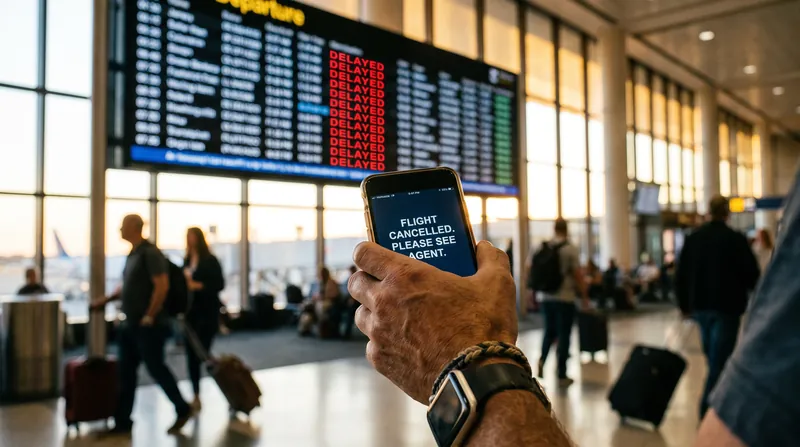
Consequently, the departure gate has become the new border. Travelers who arrive at the airport unaware of the ETA requirement are finding themselves stranded. While the application process is fully digital and can be completed via the official UK ETA smartphone app, relying on a last-minute application is a dangerous gamble.
The app requires users to scan their passport's biometric chip, take a live facial photograph, and answer a series of suitability questions regarding criminal history and past immigration violations. The interface is designed for speed, but the underlying security checks are rigorous and unforgiving of data entry errors.[5][6]
The Home Office states that most applications receive an automated decision within minutes, but any application flagged by the system's algorithms is diverted for manual review. These manual checks can take up to three working days. If a traveler is standing at the check-in counter two hours before their flight and their ETA application goes into a "pending" state, the airline will deny them boarding.
Furthermore, travelers denied boarding due to missing documentation have no legal right to a refund, and standard travel insurance policies explicitly exclude coverage for improper visa or ETA compliance, leaving passengers to absorb the cost of rebooking.[1][2]
The financial mechanics of the system have also evolved rapidly since its inception. When the ETA was first introduced in late 2023 for a handful of Gulf nations, the fee was set at £10. As the rollout expanded to include the European Union and the Americas, the price was hiked to £16.
In April 2026, the Home Office implemented another increase, bringing the cost to £20 (approximately $25 USD). Officials justify the fee hikes as necessary to fund the technological infrastructure of the digitized border, noting that the cost remains competitive with similar international schemes like the American ESTA.[3][6]
For families, the costs and administrative burdens multiply quickly. Unlike some international travel authorizations that offer group applications or exemptions for minors, the UK ETA requires a separate £20 application for every single traveler, including infants and children.
A family of four flying from Chicago to Athens with a layover in London must now budget an additional £80 and ensure four separate digital permits are approved well before their departure date. This added friction is prompting some travel agents to route clients through alternative European hubs like Amsterdam or Frankfurt to avoid the UK entirely, shifting transit revenue away from British airports.[2][4]
If an ETA application is outright refused—often due to a past criminal conviction or a previous UK visa denial—the traveler cannot appeal the decision. Instead, they must apply for a Standard Visitor visa, a process that costs significantly more (£135), requires extensive documentation, and can take weeks to process.
This strict binary outcome underscores the importance of answering the application questions truthfully; attempting to conceal a past infraction to secure a quick ETA approval can result in a multi-year ban from entering the UK under the suitability criteria of the Immigration Rules.[3][6]
Another significant point of friction involves dual nationals. British and Irish citizens are exempt from the ETA requirement, but they must travel on their British or Irish passports to prove it. During the system's rollout, a temporary tolerance period allowed dual nationals to enter the UK using their non-British passports.
That grace period ended in early 2026. Now, a dual US-UK citizen attempting to board a flight to London using only their American passport will be blocked by the airline's system unless they have paid for an ETA or secured a costly Certificate of Entitlement for their foreign passport.[1][5]
Ultimately, the UK's ETA rollout represents the new normal for global travel. As nations increasingly prioritize digital borders and pre-arrival threat assessments, the days of booking a flight and simply showing up with a passport are fading.
Ultimately, the UK's ETA rollout represents the new normal for global travel.
For the modern traveler, understanding the specific transit rules of connecting airports is now just as critical as securing lodging at the final destination. The £20 UK ETA is no longer just a requirement for visiting London; it is a mandatory toll for navigating one of the world's busiest aviation crossroads, requiring foresight, preparation, and an acceptance of the digitized border.[1][5]
Key points
- The UK ETA is now mandatory for 84 visa-exempt nationalities, costing £20 and remaining valid for two years.
- Airlines enforce a strict 'no permission, no travel' policy, denying boarding to passengers without an approved ETA.
- Landside transit, which involves passing through UK border control to recheck bags, explicitly requires the digital permit.
- While a temporary airside transit exemption exists, many airlines require the ETA regardless to avoid regulatory fines.
Unanswered questions
- Exactly when the Home Office will officially revoke the temporary airside transit exemption for Heathrow and Manchester.
- Whether the £20 fee will deter enough transit passengers to significantly impact revenue at major UK airport hubs.
- How seamlessly the UK ETA will integrate with the European Union's upcoming ETIAS for travelers crossing multiple borders.
How we got here
October 2023
The UK ETA system launches initially for citizens of select Gulf nations with a £10 fee.
April 2025
The system expands to include European Union citizens, and the fee is increased to £16.
February 2026
The Home Office implements strict 'no permission, no travel' enforcement, shifting liability to airlines.
April 2026
The ETA application fee officially increases to £20 for all 84 eligible visa-exempt nationalities.
- Border Security Officials
- Focuses on digitizing the border and pre-screening threats before they reach the UK.
- Travel Industry & Carriers
- Focuses on regulatory compliance, avoiding fines, and passenger education.
- Consumer Travel Advocates
- Focuses on the added cost, confusion over transit rules, and application friction.
Perspectives this story doesn't cover
- Airport Retailers
- European Hub Competitors
Sources
Source coverage
6 outlets
3 viewpoints surfaced






- [1]UK Visa BlogConsumer Travel Advocates
UK ETA: 2026 Updates and Enforcement
- [2]Schengen TravelerConsumer Travel Advocates
UK ETA for Americans: Cost, Requirements & How to Apply (2026)
- [3]VisasNewsConsumer Travel Advocates
UK: ETA fee to increase to £20 on April 8, 2026
- [4]Gherson ImmigrationTravel Industry & Carriers
New UK visa rule from February: ETA required for connecting US passengers
- [5]Newland ChaseTravel Industry & Carriers
UK to Enforce ETA Requirement from February 2026
- [6]UK Home Office BlogBorder Security Officials
Electronic Travel Authorisation (ETA) factsheet
More in Travel
See all →Airport Security
TSA Gold+ Transfers Airport Security Tech and Staffing to Private Contractors
11 sources

Travel Myths
The Truth About Travel Hacks: Do VPNs, Incognito Mode, and Skiplagging Actually Work?
2 sources

Award Travel
How to Fly Business Class for Less: The Science of Positioning Flights and Airline Alliances
2 sources

Flight Pricing
The Truth About Airline Pricing: How to Actually Hack Flights in 2026
3 sources
Comments
Every angle. Every day.
Get Travel stories with full source coverage and perspective breakdowns, free every day.