
Why the Panama Canal Drains 52 Million Gallons of Freshwater per Transit
Unlike sea-level passages, the Panama Canal operates as a massive water elevator that drains 52 million gallons of freshwater per transit. This unique architecture makes global supply chains structurally vulnerable to El Niño droughts.
By Hunter Cole

Share this story
In short
- The Panama Canal operates as a gravity-fed water elevator, lifting ships 85 feet above sea level to Gatun Lake.
- A single vessel transit drains approximately 52 million gallons of freshwater from the lake into the ocean.
- The canal's capacity is fundamentally constrained by rainfall, making it highly vulnerable to El Niño-driven droughts.
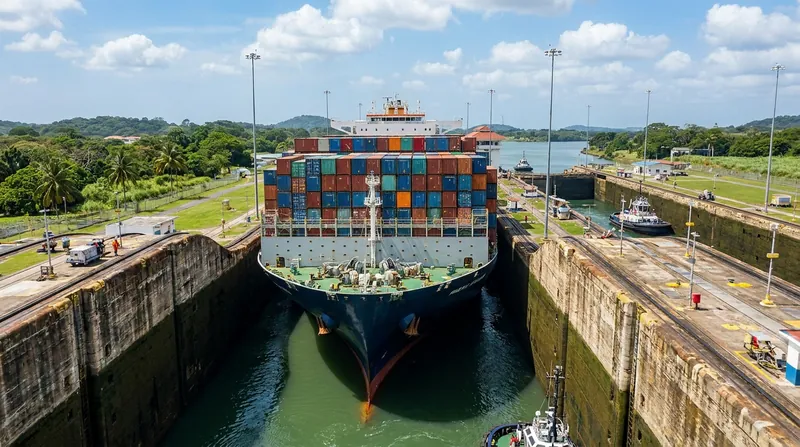
The global supply chain relies on predictable maritime routes, but one of its most critical arteries is fundamentally constrained by the weather. While passages like the Suez Canal are sea-level trenches that allow ocean water to flow freely, the Panama Canal operates on a completely different engineering principle. It is a massive, gravity-fed water elevator that lifts ships over the continental divide. This unique architecture makes the canal an engineering marvel, but it also creates a structural vulnerability: the entire system is dependent on continuous rainfall.[1]
The centerpiece of this system is Gatun Lake, an artificial freshwater reservoir located 85 feet above sea level. Created in 1913 by damming the Chagres River, the lake spans 166 square miles and holds approximately 5.48 cubic kilometers of water. When a ship enters the canal, it does not sail through a continuous channel; instead, it is sealed inside a lock chamber. Valves are opened, and gravity pulls water down from Gatun Lake into the chamber, raising the vessel to the lake's elevation.[1][2]
This process requires a staggering volume of water. An average of 52 million gallons of freshwater is used in a single passing of a ship through the original lock chambers. Once the vessel completes its transit and is lowered back down on the opposite coast, that massive volume of water is flushed out into the Atlantic or Pacific Ocean and permanently lost from the system. Under standard operating conditions, the canal's daily traffic drains nearly two billion gallons of freshwater from the reservoir every single day.[1]
Because the canal relies entirely on Gatun Lake, its capacity is strictly dictated by the region's hydrology. During the wet season, the Chagres River easily replenishes the lake. However, when climate patterns like El Niño warm the Pacific Ocean, they disrupt the trade winds and trigger severe droughts across the Panamanian isthmus. When rainfall drops, Gatun Lake's water level steadily declines, forcing the canal authority into a difficult balancing act to preserve the waterway's operational depth.[2]
The first lever the authority pulls during a drought is implementing draft restrictions. A ship's draft is the vertical distance between the waterline and the bottom of its hull. As the lake grows shallower, vessels are required to sit higher in the water to avoid scraping the bottom. For ocean carriers, this means they must load fewer cargo containers per voyage, effectively light-loading the ship. This drives up the per-unit cost of freight, as the same voyage expenses are spread across less cargo.[3]
If the drought persists and lake levels continue to fall, the canal authority must pull its second, more disruptive lever: slashing the number of daily transit slots. By reducing the number of ships allowed through each day, the canal conserves the 52 million gallons of water that would have been lost with each cancelled transit. This creates a severe bottleneck, forcing shipping companies into multi-million-dollar bidding wars for the remaining slots or pushing them to reroute around the Cape of Good Hope, adding weeks to their journeys.[4]
Engineers attempted to mitigate this freshwater dependency during the canal's 2016 expansion, which added a third lane of wider locks to accommodate massive Neopanamax vessels. These new locks were designed with lateral water-saving basins that capture and recycle a portion of the water used during each lockage. While this improves efficiency, it does not eliminate the fundamental drain on the lake, nor does it solve the compounding issue that Gatun Lake also serves as the primary drinking water supply for major Panamanian cities.[1][3]
As global trade volumes continue to grow and climate cycles like El Niño become more pronounced, the Panama Canal's freshwater dependency remains a critical vulnerability for the international supply chain. The waterway's capacity is no longer just a question of mechanical throughput, lock availability, or engineering ingenuity; it is inextricably linked to the unpredictable rainfall of the Central American rainforest. Until alternative water management solutions are developed, the rhythm of global shipping will continue to be dictated by the weather over Gatun Lake.[4]
How we did this
- Method
- Volumetric depletion calculation
- What we found
- A single vessel transit consumes approximately 0.0036 percent of Gatun Lake's total capacity, demonstrating that without continuous rainfall replenishment, the reservoir's operational depth would be rapidly exhausted by standard daily maritime traffic.
- What we worked from
- Limits of this analysis
- This calculation assumes a static reservoir and does not account for the partial water recycling achieved by the newer Neopanamax lock basins.
Jargon, explained
- Lock
- An enclosed chamber with gates at each end used to raise or lower ships between different water levels by filling or draining water.
- Draft
- The vertical distance between the waterline and the bottom of a ship's hull, which determines how much cargo it can safely carry.
- Panamax
- The size limit for ships that can fit through the original locks of the Panama Canal.
- Neopanamax
- A larger classification of ships designed to fit through the canal's expanded locks, which opened in 2016.
- El Niño
- A climate pattern characterized by the warming of surface waters in the eastern Pacific Ocean, which alters global weather and reduces rainfall in Panama.
Common questions
Why does the Panama Canal need freshwater?
Unlike sea-level canals, the Panama Canal uses a lock system that lifts ships 85 feet above sea level to Gatun Lake. Each transit drains millions of gallons of freshwater from the lake into the ocean.
How much water does one ship use?
An average of 52 million gallons of freshwater is used in a single passing of a ship through the original locks.
Why can't the canal just pump seawater?
Gatun Lake is the primary source of drinking water for major Panamanian cities. Pumping seawater into the locks would increase the lake's salinity and ruin the municipal water supply.
What is a draft restriction?
When lake levels drop, the canal authority limits how deep a ship's hull can sit in the water, forcing carriers to load less cargo so the vessel rides higher and avoids scraping the bottom.
Competing readings
The Engineering Perspective
Focuses on the mechanical design of the gravity-fed lock system.
From an engineering standpoint, the Panama Canal is a masterpiece of passive energy. By utilizing the natural topography and the abundant rainfall of the Chagres River basin, the original designers created a system that moves massive vessels over a mountain range without massive industrial pumps. Engineers view the 2016 addition of water-saving basins as the next logical evolution, attempting to stretch the finite freshwater supply to accommodate the massive Neopanamax ships.
The Supply Chain Perspective
Focuses on the economic friction caused by unpredictable water levels.
For logistics planners and ocean carriers, the canal's reliance on rainfall is a severe structural liability. When droughts force the canal authority to implement draft restrictions, ships must carry less cargo, destroying the economies of scale that make global shipping profitable. Supply chain analysts argue that the resulting auction bidding wars for limited transit slots create unpredictable cost spikes that ultimately trickle down to consumer goods and energy prices.
The Hydrological Perspective
Focuses on the ecological balance of the Gatun Lake watershed.
Hydrologists and climate scientists emphasize that Gatun Lake is not just a commercial transit corridor; it is a vital ecosystem and the primary drinking water reservoir for millions of Panamanians. They warn that as El Niño cycles become more intense, the tension between flushing billions of gallons of freshwater out to sea for commercial shipping and preserving it for human consumption will become increasingly untenable.
- Maritime Engineers
- Focus on the mechanical efficiency of the canal, emphasizing the ingenuity of the gravity-fed locks and the recent addition of water-saving basins.
- Global Supply Chain Analysts
- View the canal's freshwater dependency as a structural liability that forces costly draft restrictions and unpredictable transit delays during dry seasons.
- Hydrology Experts
- Highlight the ecological tension between operating a massive commercial waterway and preserving Gatun Lake as a municipal drinking water source.
Perspectives this story doesn't cover
- Local Panamanian residents relying on Gatun Lake for drinking water
- Retailers facing delayed inventory due to rerouted cargo
Sources
Source coverage
4 outlets
3 viewpoints surfaced


- [1]WikipediaHydrology Experts
Panama Canal
Read on Wikipedia → - [2]WikipediaHydrology Experts
Gatun Lake
Read on Wikipedia → - [3]WikipediaHydrology Experts
Panamax
Read on Wikipedia → - [4]Factlen Editorial TeamGlobal Supply Chain Analysts
Synthesis by Factlen editorial team
Read on Factlen Editorial Team →
More in Transportation
See all →Maritime Trade
Maersk Reverses Strategy With $5 Billion Order for 26 New Container Ships
7 sources
Aviation Safety
The V1, VR, and V2 Speeds: How Three Critical Velocities Define a Commercial Aircraft's Takeoff Decision
10 sources

Power Systems
Why Heavy Transport Relies on 120-Degree Three-Phase AC for Continuous Torque
6 sources
Maritime Law
SOLAS, MARPOL, and STCW: The Treaties Port Inspectors Use to Regulate Global Shipping
5 sources
Comments
Every angle. Every day.
Get Transportation stories with full source coverage and perspective breakdowns, free every day.