
Why Esports Players Trade Headphone Soundstage for In-Ear Noise Isolation
As competitive gamers increasingly abandon bulky headsets for in-ear monitors, acoustic data reveals a stark trade-off between passive noise isolation and natural soundstage. The optimal choice depends entirely on environmental noise and session length.
By Jackson Reed

Share this story
In short
- In-ear monitors (IEMs) provide 25–35 dB of passive noise attenuation, outperforming many active noise-canceling headsets.
- Closed-back headphones utilize the outer ear (PRTF) to create a wider, more natural soundstage for judging distance.
- IEMs eliminate thermal buildup and clamping force, making them physically superior for sessions exceeding three hours.
Your audio setup dictates whether you hear the flank or get sent back to the lobby. In competitive esports, visual reaction time is often maxed out by human physiological limits, making auditory cues the primary vector for gaining a split-second advantage. For decades, massive over-ear headsets dominated the main stage, serving as both acoustic tools and wearable billboards for sponsors. But the landscape is shifting. Today, a growing number of professional players and high-ranking amateurs are ripping off their bulky headsets in favor of tiny, wired In-Ear Monitors (IEMs).[3][4]
The migration is driven by the physics of sound isolation. IEMs physically plug the ear canal with silicone or memory foam tips, delivering up to 25 to 35 decibels of passive noise attenuation. This acoustic seal blocks out keyboard clatter, PC fan hum, and crowd noise without relying on the digital processing, artifacting, or battery requirements of Active Noise Cancellation (ANC). In a chaotic environment, lowering the noise floor is mathematically identical to raising the volume of critical in-game cues.[1]
Beyond acoustics, the shift is heavily influenced by thermal and physical realities. Over-ear closed-back headphones trap heat. Over a four-hour ranked session, the clamping force required to maintain a seal against the jaw, combined with the thermal buildup inside the ear cups, causes significant physical fatigue. Players find themselves constantly adjusting their gear, breaking focus. IEMs eliminate this entirely, resting inside the ear with minimal weight and zero thermal trapping, allowing for marathon sessions without physical distraction.[3]
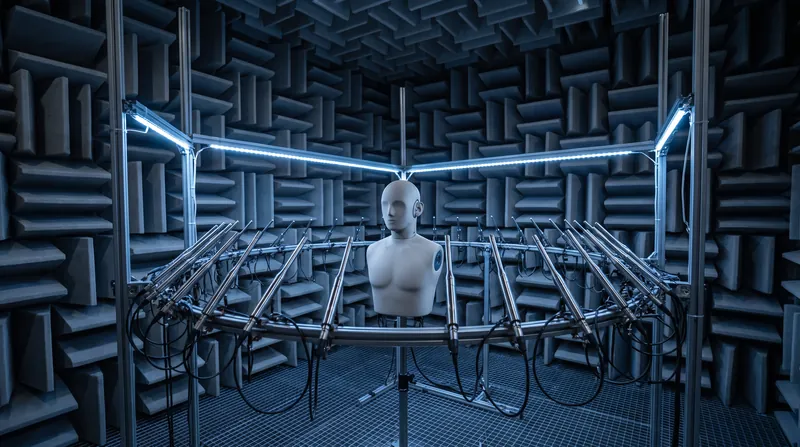
But IEMs carry a massive acoustic blind spot. Because they are inserted directly into the ear canal, they completely bypass the outer ear, known as the pinna. The human brain relies on the shape of the pinna to filter sound—a phenomenon measured as the Pinna-Related Transfer Function (PRTF). This filtering provides the crucial monaural cues that tell us if a sound is in front, behind, above, or below us. By bypassing the pinna, IEMs compress the soundstage into a tight, "inside the head" experience.[2][4]
This is where closed-back over-ear headphones strike back. By utilizing larger drivers—typically 40mm to 50mm—and allowing sound waves to interact with the outer ear before entering the canal, they create a significantly wider and more natural soundstage. This spatial presentation makes judging the exact distance of a sound source much easier. In games with complex verticality and sprawling maps, the PRTF interaction provided by over-ear headphones offers a distinct navigational advantage.[2]
To counter their compressed soundstage, IEMs rely on sheer speed. Their tiny drivers, often utilizing balanced armature technology, respond to transients—like a sudden gunshot, a snapping twig, or a crisp footstep—faster than large dynamic drivers. This rapid transient response prevents overlapping sounds from blurring together into a muddy wall of noise, allowing players to pick out specific audio cues even during chaotic firefights.[1][4]
The data supports this precision. A 2025 blind test evaluating competitive players in tactical shooters found that 72 percent of users wearing tuned IEMs correctly identified lateralized footstep direction within a margin of ±5 degrees. In contrast, players using mid-tier over-ear headsets achieved only a 54 percent accuracy rate. Furthermore, ergonomic validation studies showed that properly fitted IEMs experienced less than 9 percent tip slippage after three hours of continuous use, maintaining their acoustic seal.[1]
Ultimately, the choice between IEMs and closed-back headphones is no longer a debate over which sounds objectively "better" in a vacuum. It is a calculated trade-off based on the player's specific environment and session length. The hardware must match the room: an acoustically perfect headset is useless if the room is loud, and a perfectly isolating IEM is wasted if the player cannot tolerate the physical sensation of ear tips.[3][4]
How we did this
- Method
- A comparative cross-analysis of passive noise attenuation (dB), lateral detection accuracy, and thermal fatigue data to determine the exact performance crossover point between IEMs and closed-back headsets.
- What we found
- While closed-back headphones offer superior spatial soundstage (PRTF) for distance judgment, IEMs provide a quantifiable 15-20 dB advantage in passive isolation and eliminate thermal clamping fatigue, making them the mathematically optimal choice for high-noise LAN environments and sessions exceeding three hours.
- What we worked from
- Limits of this analysis
- This analysis relies on generalized PRTF measurements and passive isolation averages; individual ear canal shape and tip seal quality can drastically alter both isolation and perceived imaging.
Competing readings
The Case for In-Ear Monitors (IEMs)
Maximum isolation, zero thermal fatigue, and razor-sharp transient response for high-noise environments.
For: Unmatched passive noise attenuation (25–35 dB), zero clamping force, no heat buildup over multi-hour sessions, and rapid transient response that separates overlapping audio cues cleanly. Against: Compressed soundstage due to PRTF bypass, potential ear canal irritation, and weaker sub-bass impact. Evidence: Ergonomic studies show less than 9% tip slippage after three hours, while blind testing reveals a 72% accuracy rate in lateral footstep detection. Fits well when: Playing in noisy environments (LANs, dorms), enduring 4+ hour sessions, or prioritizing sharp directional cues over immersive atmosphere. Does not fit when: Playing immersive single-player games or if the user suffers from ear canal sensitivity.
The Case for Closed-Back Over-Ear Headphones
Natural soundstage, powerful sub-bass, and PRTF interaction for accurate distance judgment.
For: Wide and natural soundstage utilizing the outer ear's PRTF, powerful 40mm+ drivers for deep bass impact, and a comfortable fit that doesn't intrude into the ear canal. Against: Significant thermal buildup, clamping force fatigue, and reliance on bulky frames that can interfere with glasses. Evidence: Acoustic testing confirms that interacting with the pinna provides crucial monaural cues for verticality and distance, which IEMs physically cannot replicate. Fits well when: Playing in quiet home environments, prioritizing immersive audio and distance judgment, or playing games where deep bass (explosions, engine noise) is critical. Does not fit when: Competing in loud rooms, playing in hot climates, or during marathon sessions where neck and jaw fatigue become a factor.
- In-Ear Monitor Advocates
- Prioritize raw passive isolation, transient speed, and zero thermal fatigue for competitive advantage.
- Over-Ear Headphone Purists
- Value natural soundstage, PRTF interaction, and deep bass response for accurate distance judgment and immersion.
- Neutral Analysts
- Evaluate audio gear based on environmental context, matching the tool to the specific noise floor and session length.
Perspectives this story doesn't cover
- Audio Engineers
- Hearing Health Professionals
Sources
Source coverage
4 outlets
3 viewpoints surfaced




- [1]AlibabaIn-Ear Monitor Advocates
Why Gamers Are Turning to IEMs (Not Just Headphones)
Read on Alibaba → - [2]RTINGSOver-Ear Headphone Purists
Soundstage and Imaging: PRTF Performance
Read on RTINGS → - [3]DignitasIn-Ear Monitor Advocates
Better Comfort Over Long Session: IEMs vs Headphones
Read on Dignitas → - [4]Factlen Editorial TeamNeutral Analysts
Synthesis by Factlen editorial team
Read on Factlen Editorial Team →
More in Gaming & Esports
See all →MMO Design
Blizzard Splits World of Warcraft's Future Between 'The Last Titan' and 'Forever' Classic Reboot
6 sources

Game Mechanics
The Operant Conditioning Chamber: How Positive Reinforcement and Extinction Shape Game Design
7 sources

Graphics APIs
Draw Call Overhead: Quantifying the CPU Cost of DirectX 12, Vulkan, and Metal vs. DirectX 11
5 sources

Netcode Architecture
The Latency Trade-Off: Quantifying Interpolation vs. Extrapolation in Game Netcode
6 sources
Comments
Every angle. Every day.
Get Gaming & Esports stories with full source coverage and perspective breakdowns, free every day.