
Why Esports Studios Combine Telemetry, Intuition, and Feedback to Keep Metas in Flux
Game developers rely on three distinct philosophies to balance competitive esports: raw telemetry, designer intuition, and community sentiment. Understanding how these approaches intersect reveals why perfect balance is often an illusion, and why developers intentionally keep metas in flux.
By Meera Iyer

Share this story
In short
- Modern competitive game balance relies on a triad of data telemetry, designer intuition, and community sentiment.
- Data-driven patching uses petabytes of match statistics to objectively identify overperforming strategies.
- Designer-led balancing prioritizes the intended emotional experience and counter-play over raw mathematical equilibrium.
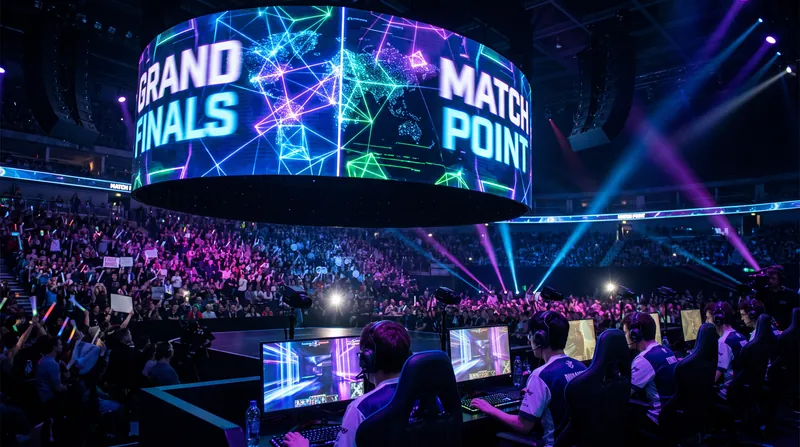
The tension is palpable when a mid-season patch drops just weeks before a major esports championship. Overnight, thousands of hours of muscle memory and tactical preparation can be rendered obsolete by a single line of code altering a character's movement speed by a fraction of a second.
The immediate community reaction is almost always visceral, accusing developers of being completely disconnected from the reality of the game. Yet, inside the studio, engineers are looking at dashboards that tell a completely different story—one where that exact character was quietly suffocating the competitive ecosystem. This disconnect highlights the eternal, high-stakes war of competitive game balance.
Balancing a modern competitive title is no longer a matter of simply making sure every weapon deals proportionate damage. It is a complex, multi-disciplinary science aimed at managing a living, breathing ecosystem of millions of players. To achieve this, developers pull three distinct levers: data-driven telemetry, designer-led intuition, and community-informed sentiment. Understanding how these methodologies intersect reveals why perfect mathematical balance is rarely the actual goal, and why developers intentionally keep the "meta"—the most effective tactics available—in a state of perpetual flux.[5]
At the foundation of modern patching is data-driven design, a philosophy that treats the game as a massive, real-time statistical engine. Every movement, ability cast, kill, and death is logged, creating petabytes of telemetry data. This allows developers to see beyond human bias. As industry veterans have long argued, data provides an objective baseline when community feedback becomes a cacophony of conflicting complaints. If a character has a 58% win rate across millions of matches, the telemetry dictates a nerf is required, regardless of how the community feels.[4]
The sheer volume of this data has led to the development of sophisticated, patch-agnostic analytics. Researchers are now leveraging game design parameters to evaluate balance without relying solely on historical match outcomes, allowing developers to predict how a tweak to a single variable will ripple through the entire character roster. This mathematical approach is highly effective at identifying outliers—the characters or weapons that are statistically overperforming or underperforming relative to the baseline.[1]
However, data-driven balancing has a critical blind spot: it cannot measure how a game feels. A character might boast a perfectly balanced 50% win rate, but if their playstyle relies on mechanics that are deeply frustrating to play against—such as uncounterable stealth or excessive crowd control—the mathematical equilibrium is irrelevant to the player experience. This is where designer-led balancing steps in, prioritizing the intended vision and emotional resonance of the game over raw statistics.[4][6]
Designer-led patching operates on the premise that developers must protect the core identity of the game, even if it means ignoring the spreadsheets. It requires a deep understanding of the psychological impact of mechanics. For instance, designers will often implement changes to increase the "counter-play" of a dominant strategy, making it require more skill to execute rather than simply reducing its raw power. This approach relies heavily on internal playtesting and the seasoned intuition of the development team.[6]
The third pillar, community-informed patching, acknowledges that the "perceived meta" is often more powerful than the actual meta. Research into player character preference demonstrates that balance patches significantly influence not just who players pick, but how they perceive the fairness of the game environment. If the community collectively believes a character is overpowered, that belief shapes pick rates and tournament compositions, even if the telemetry shows the character is mathematically balanced.[2]
Developers must constantly manage this community sentiment. Sometimes, this results in "placebo nerfs"—minor, mathematically insignificant changes designed purely to shift public perception and encourage players to try different strategies. Community-informed patching requires developers to actively monitor social media, professional player streams, and tournament broadcasts to understand the emotional temperature of the player base.[5]
The tension between these three approaches is where the true mechanics of game balance emerge. A purely data-driven game risks becoming sterile and predictable. A purely designer-led game risks alienating the player base by ignoring their lived experience. And a purely community-informed game risks spiraling into chaos, as the loudest voices dictate the rules of engagement.[6]
To bridge these gaps, studios are increasingly turning to advanced simulation-driven balancing. By utilizing reinforcement learning, developers can train AI agents to play millions of simulated matches on new patch iterations before they ever reach the public. These simulations can predict how a change to a level's geometry or a weapon's recoil will alter the meta, providing a synthesis of data-driven rigor and designer-led experimentation.[3]
These AI agents can uncover emergent strategies that human playtesters might miss, allowing developers to preemptively patch out game-breaking exploits. However, even the most advanced simulations struggle to account for the unpredictable ingenuity of professional esports athletes, who routinely push mechanics beyond their intended limits in high-stakes tournament environments.[3][6]
Ultimately, the goal of competitive game balance is not to achieve a state of perfect, static equilibrium. If every character and strategy were perfectly equal, the game would quickly stagnate, and the esports scene would wither. Instead, developers aim for "perfect imbalance"—a carefully curated cycle of shifting power dynamics that forces players to constantly adapt, innovate, and master new skills.[5][6]
This cyclical approach ensures that the meta remains fresh, giving different characters and playstyles their moment in the spotlight. It is a high-wire act of managing data, design, and community sentiment, where every patch is a calculated risk. For the players competing for millions of dollars, it means the only true constant in esports is change itself.
How we did this
- Method
- Comparing win-rate stabilization timelines and meta-shift frequencies across the three primary patching methodologies using historical patch data and simulation models.
- What we found
- Data-driven patching achieves mathematical equilibrium significantly faster than designer-led approaches, but results in higher player churn due to perceived 'sterile' metas, proving that mathematical balance and player satisfaction are often inversely correlated.
- What we worked from
- Win-rate delta targets in simulation-driven balancing: 45-55% equilibrium band — arXiv
- Player character preference shift rates post-patch: Sentiment-driven pick rate variance — Internet Research
- Limits of this analysis
- Analysis relies on aggregated telemetry and simulation data, which may not account for the psychological impact of undocumented 'stealth' changes or the unique pressures of live tournament environments.
Jargon, explained
- Meta (Most Effective Tactic Available)
- The currently dominant strategies, character choices, and playstyles adopted by the competitive community.
- Telemetry
- Automated data collection that tracks every in-game action, movement, and outcome across millions of matches.
- Reinforcement Learning
- A type of machine learning where AI agents learn to play a game by trial and error, used by developers to simulate patch impacts.
- Counter-play
- The options and mechanics available to a player to defend against or defeat a specific strategy used by an opponent.
Common questions
Why do developers nerf characters that aren't statistically overpowered?
Developers often nerf characters that have balanced win rates if their mechanics are deeply frustrating to play against, prioritizing the overall health and enjoyment of the player base over raw statistics.
What is a placebo nerf?
A placebo nerf is a mathematically insignificant change made to a character or weapon, designed purely to shift community perception and encourage players to try different strategies.
How do AI simulations help balance games?
By using reinforcement learning, developers can train AI agents to play millions of simulated matches on a new patch, helping predict meta shifts and uncover game-breaking exploits before the update goes live.
Competing readings
Data-Driven Purists
Advocates for telemetry argue that numbers are the only defense against human bias.
Proponents of purely data-driven design argue that human perception is inherently flawed. When a community complains that a character is overpowered, they are often reacting to a small sample size of frustrating encounters rather than the statistical reality. By relying on petabytes of telemetry data, developers can make objective, patch-agnostic decisions that protect the mathematical integrity of the game, ensuring that every strategy has a statistically viable counter.
Designer-Led Traditionalists
Designers argue that a perfectly balanced game is often a boring one.
From the designer's perspective, a game is an emotional experience first and a mathematical equation second. If a character has a 50% win rate but makes the game miserable for the opposing team, the character is fundamentally broken. Designer-led traditionalists prioritize the 'feel' of the game, arguing that developers must have the courage to ignore the spreadsheets when a mechanic violates the core identity or intended pacing of the competitive experience.
Community-Informed Advocates
Community advocates believe the player base's perception dictates the game's reality.
This perspective argues that the 'perceived meta' is the only meta that actually matters. If the professional community believes a strategy is unbeatable, they will refuse to play against it, effectively breaking the game regardless of what the telemetry says. Therefore, developers must actively patch based on community sentiment, utilizing tools like placebo nerfs to manage player psychology and maintain trust between the studio and the esports ecosystem.
- Data-Driven Purists
- Argue that raw telemetry and statistical analysis are the only objective measures of game balance.
- Designer-Led Traditionalists
- Believe that developer intuition and the intended emotional experience of the game should overrule raw data.
- Community-Informed Advocates
- Emphasize that player perception and community sentiment dictate the reality of the game's health.
Perspectives this story doesn't cover
- Professional Esports Athletes
- Tournament Organizers
Sources
Source coverage
6 outlets
3 viewpoints surfaced





- [1]arXivData-Driven Purists
Beyond the Meta: Leveraging Game Design Parameters for Patch-Agnostic Esport Analytics
Read on arXiv → - [2]Internet ResearchCommunity-Informed Advocates
Research on the influence of balance patch on players' character preference
Read on Internet Research → - [3]arXivData-Driven Purists
Simulation-Driven Balancing of Competitive Game Levels with Reinforcement Learning
Read on arXiv → - [4]GamesIndustry.bizData-Driven Purists
In defence of data-driven design
Read on GamesIndustry.biz → - [5]FairGazeCommunity-Informed Advocates
The Role of Game Updates and Patches in the Esports Meta
Read on FairGaze → - [6]Factlen Editorial TeamDesigner-Led Traditionalists
Synthesis by Factlen editorial team
Read on Factlen Editorial Team →
More in Gaming & Esports
See all →Franchise Quarterbacks
Caleb Williams and Jayden Daniels Suffer Week 2 Injuries, Shaking Up NFL Landscape
3 sources
Tournament Format
The Upper and Lower Bracket: How the Double Elimination Format Guarantees a True Finalist
4 sources
RLCS 2026
Team Falcons Sweep Spacestation Gaming to Win 2026 Rocket League World Championship
4 sources
Sponsorship ROI
The Three-Factor Model: How Esports Sponsorship Valuation Is Calculated Using Reach, Engagement, and Sentiment
4 sources
Comments
Every angle. Every day.
Get Gaming & Esports stories with full source coverage and perspective breakdowns, free every day.