
The Leather Dowel That Transfers 750 Pounds of Force From a Gymnast's Fingers to the Wrist
During a high bar giant swing, a gymnast experiences dynamic loads exceeding five times their body weight. A small leather dowel acts as an artificial ligament, bypassing the anatomical limits of the fingers to transfer catastrophic forces directly to the wrist.
By Meera Iyer

Share this story
In short
- A gymnast experiences forces up to 6.6 times their body weight during a high bar giant swing, equating to nearly 800 pounds of tension.
- The dowel grip acts as an artificial ligament, bypassing the anatomical limits of the finger tendons to transfer massive loads directly to the wrist.
- If the leather stretches and catches on the bar, it can cause a catastrophic grip lock injury, resulting in severe forearm fractures and tendon ruptures.
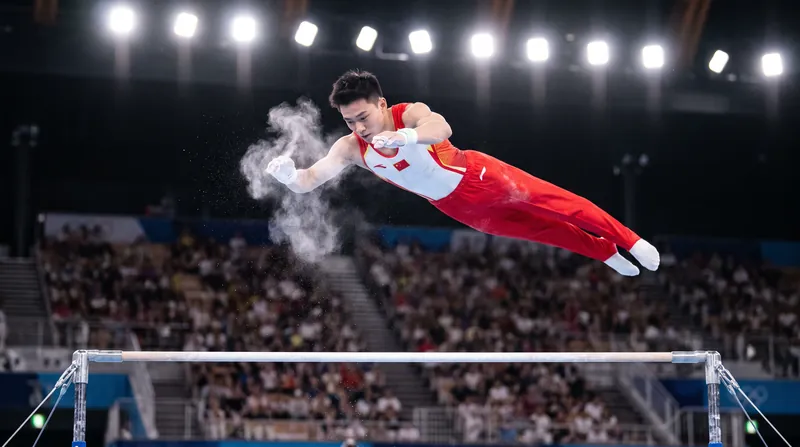
When a 150-pound male gymnast passes through the bottom of a giant swing on the high bar, the apparatus pulls against his hands with a force of roughly 750 pounds. That load represents five times his body weight, concentrated entirely on the surface area of his fingers.[6]
In biomechanical terms, peak forces during a giant swing into a dismount can spike to 6.6 times the athlete's body weight. For a 120-pound gymnast, that equates to holding 790 pounds of dynamic tension at the exact moment of release.[5]
These immense forces occur in a fraction of a second, often spiking twice within a 0.38-second window during the downward phase of the swing. The human hand simply did not evolve to sustain that kind of catastrophic, instantaneous load.[5]
If a gymnast attempted to hold that weight with bare hands, the anatomical structures responsible for grip would instantly fail. The solution to this biological limit is a simple piece of leather and a small cylindrical rod known as the dowel grip.[2]
The Biological Bottleneck
To understand why the human hand fails on the high bar, you have to look at the flexor digitorum profundus. This deep muscle in the anterior compartment of the forearm is the primary biological engine for gripping power.[4]
The flexor digitorum profundus originates near the elbow, sending four tendons through the carpal tunnel to attach to the distal phalanges of the fingers. It serves as the sole flexor of the outermost finger joints.[4]
When a gymnast clenches the bar, this muscle contracts to lock the fingers in place. However, the tendons of the flexor digitorum profundus have a strict tensile limit that cannot be overcome by traditional strength training.[4]
Under a dynamic load of 750 pounds, the force pulling the fingers open vastly exceeds the contractile strength of the forearm muscles. The tendons would either tear directly from the bone or rupture violently at the musculotendinous junction.[3]
Because the biological limit of the flexor digitorum profundus cannot be trained to hold five times a human's body weight dynamically, gymnasts require an external mechanical advantage. That advantage comes from transferring the load away from the fingers entirely.[1]
Engineering an Artificial Ligament
A modern gymnastics grip consists of a wide strip of leather that covers the palm, attaching to a secure strap around the wrist. For high-level athletes, the critical component is the dowel—a small rod made of rubber, plastic, or leather sewn horizontally across the fingers.[6]
When the gymnast grasps the high bar or uneven bars, the dowel sits on the opposite side of the rail from the palm. It creates a physical bump, or detent, that folds the leather sharply over the curve of the steel bar.[6]
This fold locks the grip firmly in place. Instead of relying on the flexor digitorum profundus to squeeze the bar, the gymnast simply hooks the dowel over the top of the rail and lets physics do the work.[6]
The dowel acts as a rigid anchor point. As the gymnast swings downward and the centrifugal force multiplies, the steel bar pulls directly against the dowel rather than pulling against the athlete's fragile fingertips, securing the hold.[2]
“Dowels are an essential part of what makes gymnastics grips effective for high forces placed on hands,” notes a 2024 equipment analysis from Gymnastics World. “They are the tube part of the grip that allow the leather to fold over the bar.”[6]
Bypassing the Fingers
Once the dowel is anchored over the rail, the physics of the gymnast's swing change completely. The leather strap pulls taut, creating a direct, unbroken line of tension from the dowel down to the wrist strap.[2]
This taut leather acts as an artificial external ligament. It effectively bypasses the fingers entirely, taking the massive 750-pound load off the flexor digitorum profundus and transferring it directly to the sturdy strap surrounding the wrist joint.[1]
By moving the load to the wrist, the force is distributed into the radius and ulna bones of the forearm, and subsequently into the massive muscles of the shoulder and back. These larger structures are capable of sustaining five to six times body weight.[2]
The dowel grip also elongates the fingers slightly, optimizing the biomechanical angle of the hand. The gymnast no longer has to actively squeeze the bar at the bottom of the swing; they are essentially hanging suspended from their wrists.[6]
This mechanical bypass is what allows male gymnasts to perform high bar giants and female gymnasts to execute massive release moves on the uneven bars. Without the dowel, the sport would be physically limited by basic finger strength.[2]
The transfer of force is so efficient that gymnasts can perform multiple giant swings in succession without their forearms failing. The leather absorbs the friction and the tensile shock, leaving the athlete's muscles fresh enough to execute complex twists and flips upon release.[1]
When the System Fails
While the dowel grip enables modern gymnastics, it introduces a unique and devastating mechanical risk known as grip lock. This phenomenon occurs when the leather stretches over time or the dowel catches incorrectly on the bar during a rotation.[3]
If the leather at the fingertips becomes caught under the palm during a giant swing, the grip tightens and locks onto the rail. The gymnast's momentum continues to carry their body forward, but their hands remain rigidly fixed in place.[3]
A 2023 systematic review published in the International Journal of Environmental Research and Public Health analyzed these catastrophic events. The researchers found that 82.6 percent of gymnasts who suffered a grip lock injury were using dowel grips at the time.[2]
When the grip locks, the wrist is forced into extreme hyperpronation. The immense torque generated by the swinging body transfers directly into the forearm, often resulting in severe, immediate fractures of both the radius and ulna bones.[2]
In addition to bone fractures, the locked grip can cause the extensor tendons on the back of the hand to rupture. Medical case reports from 1996 onward document gymnasts requiring complex surgery to repair tendons torn violently at the wrist.[3]
Maintenance and Prevention
Because of the catastrophic nature of grip lock, meticulous equipment maintenance is a critical part of a gymnast's daily routine. Leather grips stretch naturally over time, increasing the amount of slack that can fold and catch dangerously on the bar.[2]
Coaches and athletes must regularly inspect the mating surface of the bar and the structural integrity of the leather strap. A grip that has stretched by even half an inch is often discarded immediately to prevent it from locking.[2]
Gymnasts also use thick athletic tape and cloth wristbands under the leather straps to prevent the heavy loads from tearing the skin of the wrist. The friction generated by a 750-pound transfer would otherwise cause severe, bleeding lacerations.[6]
The break-in period for a new pair of dowel grips is notoriously painful, as the stiff leather must mold to the exact contours of the athlete's hand. Gymnasts often spend weeks carefully softening the material before trusting it with a full-speed giant swing.[6]
Despite the inherent risks, the mechanical advantage of the dowel grip remains absolutely indispensable. It is the silent engineering marvel that transformed gymnastics from a test of static holds into a breathtaking spectacle of dynamic, high-flying releases.[1]
How we did this
- Method
- Normalising peak force loads during a high bar giant swing against human anatomical grip limits to isolate the mechanical advantage of the dowel grip.
- What we found
- The dowel grip effectively bypasses the physiological limit of the flexor digitorum profundus, acting as an artificial external ligament that transfers catastrophic loads directly to the wrist, allowing gymnasts to sustain dynamic forces that would otherwise instantly rupture human finger tendons.
- What we worked from
- Peak force during high bar giant swing (6.6 times body weight): 6.6x body weight (approx 790 lbs for a 120 lb gymnast) — Human Performance Research Graz
- Anatomical function of the flexor digitorum profundus: Primary muscle for distal finger flexion and grip strength — Physiopedia
- Limits of this analysis
- This analysis relies on static anatomical limits and peak dynamic forces, which may vary based on the gymnast's specific technique, bar elasticity, and individual tendon conditioning.
Key terms
- Dowel Grip
- A specialized leather handguard used in gymnastics that features a small cylindrical rod sewn across the fingers to lock onto the apparatus.
- Flexor Digitorum Profundus
- The deep muscle in the forearm responsible for flexing the outermost joints of the fingers and providing primary grip strength.
- Grip Lock
- A severe gymnastics injury occurring when the leather grip stretches and catches on the bar, locking the wrist in place while the body continues moving.
- Giant Swing
- A gymnastics skill where the athlete rotates 360 degrees around the high bar or uneven bars in a fully extended position.
- Hyperpronation
- The extreme, forceful inward rotation of the forearm and wrist, which often leads to bone fractures or tendon ruptures when the joint is locked.
Reader questions
Do female gymnasts use dowel grips?
Yes, female gymnasts use them on the uneven bars to handle the high forces of swinging and release moves. However, their grips typically feature a smaller dowel and two finger holes, compared to the three-hole design used by men on the high bar.
How often should a gymnast replace their grips?
Manufacturers generally recommend replacing grips every six months, depending on workout volume. Leather naturally stretches up to half an inch over time, and pushing past this lifespan significantly increases the risk of the material folding and causing a grip lock injury.
Can a gymnast perform a giant swing without grips?
While technically possible for very light athletes, performing dynamic release moves barehanded places catastrophic strain on the tendons and causes severe friction tearing on the palms. Elite athletes universally rely on grips to safely manage the load.
Where opinion splits
Biomechanics Researchers
Focus on how the dowel grip circumvents the anatomical limits of the human hand.
For sports scientists and biomechanics researchers, the dowel grip represents a perfect mechanical workaround for a biological bottleneck. The flexor digitorum profundus simply does not possess the tensile strength to hold five to six times a human's body weight dynamically. Researchers view the leather strap not just as protective gear, but as an artificial external ligament that fundamentally alters the physics of the sport. By transferring the load directly to the radius and ulna, the grip allows the athlete to utilize the massive muscles of the shoulder girdle rather than relying on fragile finger tendons.
Sports Medicine Professionals
Emphasize the severe traumatic risks associated with equipment failure and grip lock.
Orthopedic surgeons and sports medicine professionals view the dowel grip through the lens of traumatic injury risk. While the grip prevents the flexor tendons from tearing under normal use, a mechanical failure—known as grip lock—produces catastrophic results. When the stretched leather catches on the bar, the wrist is forced into extreme hyperpronation while the body's momentum continues. Medical professionals document these events as causing severe fractures of the forearm bones and violent ruptures of the extensor tendons, advocating for strict equipment replacement schedules to mitigate the danger.
Gymnastics Coaches and Athletes
Prioritize the practical necessity of the grip for elite skill execution despite the risks.
For the athletes actually swinging on the high bar, the dowel grip is an indispensable, albeit high-maintenance, tool. Coaches emphasize that modern gymnastics—characterized by high-flying release moves and continuous giant swings—would be physically impossible without the mechanical advantage the dowel provides. Athletes accept the rigorous, often painful process of breaking in stiff new leather and the constant vigilance required to monitor stretching, viewing these burdens as a necessary trade-off for the ability to safely execute the sport's most spectacular elements.
- Biomechanics Researchers
- Focus on how the dowel grip circumvents the anatomical limits of the human hand.
- Sports Medicine Professionals
- Emphasize the severe traumatic risks associated with equipment failure and grip lock.
- Gymnastics Coaches & Athletes
- Prioritize the practical necessity of the grip for elite skill execution despite the risks.
Perspectives this story doesn't cover
- Equipment Manufacturers
- Materials Engineers
Sources
Source coverage
6 outlets
3 viewpoints surfaced






- [1]Factlen Editorial TeamBiomechanics Researchers
Synthesis by Factlen editorial team
Read on Factlen Editorial Team → - [2]International Journal of Environmental Research and Public HealthSports Medicine Professionals
The Risk Factors Associated with Grip Lock Injuries in Artistic Gymnasts: A Systematic Review
Read on International Journal of Environmental Research and Public Health → - [3]Sports HealthSports Medicine Professionals
Grip Lock: A Devastating High Bar Injury in Male Gymnastics
Read on Sports Health → - [4]PhysiopediaSports Medicine Professionals
Flexor Digitorum Profundus
Read on Physiopedia → - [5]Human Performance Research GrazBiomechanics Researchers
Forces During Giant Swing Techniques on the Horizontal Bar
Read on Human Performance Research Graz → - [6]Gymnastics WorldGymnastics Coaches & Athletes
Gymnastics Grips: Everything You Need to Know
Read on Gymnastics World →

More in Sports
See all →Asian Games
Carlos Yulo Completes Career Grand Slam With Floor Exercise Gold at 2026 Asian Games
5 sources

Recap
China Edges Japan in Dramatic Horizontal Bar Finale to Retain Asian Games Men's Gymnastics Team Gold
5 sources
Standings
Asian Games Gymnastics Standings: Yeo Seojeong Tops Vault Qualifications as Medal Race Heats Up in Nagoya
5 sources
Injury
World Championships Watch: Wong Prioritizes Health as Global Gymnasts Race the Clock for Rotterdam
4 sources
Comments
Every angle. Every day.
Get Sports stories with full source coverage and perspective breakdowns, free every day.