
Silver Diamine Fluoride Halts Tooth Decay Without Needles or Drilling
Silver diamine fluoride (SDF) is transforming global dentistry by chemically halting tooth decay without needles or drilling. As health authorities push for its widespread adoption, the 'medical management' of cavities is becoming the new standard of care.

Share this story
In short
- Silver diamine fluoride (SDF) chemically halts tooth decay without the need for needles or drilling.
- The liquid uses silver to kill bacteria and fluoride to harden and remineralize the compromised tooth structure.
- The World Health Organization recently issued guidelines recommending SDF to expand global access to noninvasive care.
For over a century, the standard treatment for a dental cavity has been entirely surgical: numb the area with an injection, use a high-speed drill to excavate the diseased tissue, and fill the resulting crater with amalgam or composite resin. It is a highly effective structural fix, but one that triggers profound anxiety in patients, requires specialized clinical settings, and often necessitates general anesthesia for young children.[4]
That surgical paradigm is now being aggressively challenged by a medical one. A brush-on liquid called silver diamine fluoride (SDF) is rapidly becoming the new standard of care for early and moderate tooth decay. Instead of cutting away the infection, SDF chemically neutralizes it, hardening the compromised tooth structure and stopping the cavity in its tracks without a single needle or drill.[4]
The momentum behind this shift reached a milestone in March 2026, when the World Health Organization (WHO) formally introduced global guidelines prioritizing the noninvasive management of dental caries. The WHO strongly recommended the biannual application of SDF to arrest moderate lesions, framing it as a critical tool to phase down the use of mercury-containing dental amalgams and expand global access to care.[1]
SDF is an odorless, colorless liquid composed of three primary ingredients, each playing a specific role in a dual-action mechanism. The first is silver, a potent antimicrobial agent. When applied to a carious lesion, silver ions penetrate the decayed tissue, breaking down the cell walls of cariogenic bacteria like Streptococcus mutans, halting their metabolism, and stopping acid production.[3]
The second active ingredient is fluoride, present in SDF at a massive 38 percent concentration—nearly 44,800 parts per million, which is the highest of any dental fluoride agent. While the silver kills the bacteria, the fluoride ions react with the tooth's remaining calcium and phosphate to form fluorapatite. This newly formed mineral matrix is significantly harder and more acid-resistant than the tooth's original hydroxyapatite enamel.[3]
The third ingredient, ammonia, acts as a stabilizing solvent. It forms a diamine-silver complex that keeps the silver ions suspended in solution at a highly alkaline pH, allowing the liquid to effectively penetrate deep into the microscopic tubules of the decayed dentin before reacting.[3]
The clinical evidence supporting this chemical intervention is overwhelming. Meta-analyses of multiple randomized controlled trials show that a 38 percent SDF solution is approximately 81 percent effective at arresting active cavities. Furthermore, patients treated with SDF develop roughly 77 percent fewer new cavities elsewhere in their mouth compared to control groups, as the treated lesions act as reservoirs that slowly release antimicrobial silver and remineralizing fluoride into the saliva.[3][4]
This efficacy is driving a quiet revolution in pediatric healthcare. Early childhood caries is the most common chronic disease of childhood, affecting over 20 percent of children ages 2 to 5. Traditionally, treating multiple cavities in a toddler requires deep sedation or general anesthesia—procedures that carry inherent medical risks and disproportionately high costs.[2]
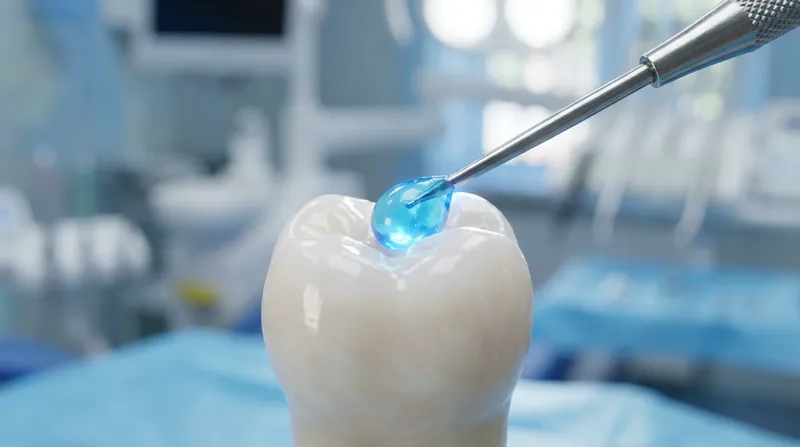
With SDF, treatment takes less than a minute. A clinician simply isolates the tooth with cotton, dries it, and paints a micro-drop of the liquid directly onto the cavity. Because the application is entirely painless and requires no cooperation beyond keeping the mouth open for a few seconds, the need for pediatric sedation drops dramatically.[2]
The simplicity of the procedure has also allowed cavity treatment to move beyond the dentist's chair. The American Academy of Pediatrics (AAP) recently issued guidance encouraging pediatricians to apply SDF during routine medical checkups. Because young children often see a pediatrician a dozen times before their first dental visit, empowering doctors to arrest decay early is viewed as a major public health victory.[2]
However, the treatment comes with one unavoidable aesthetic catch: as the silver neutralizes the bacteria and halts the decay, it oxidizes. This chemical reaction permanently turns the diseased portion of the tooth dark black. While healthy enamel remains perfectly white, the arrested cavity looks like a dark spot.[3]
For cavities on back molars, this discoloration is rarely an issue. But for lesions on highly visible front teeth, parents and patients must weigh the aesthetic drawback of a black spot against the trauma and cost of traditional drilling. Dentists report that when the alternative is putting a toddler under general anesthesia, the vast majority of parents readily accept the staining on primary teeth that will eventually fall out anyway.[4]
The benefits extend far beyond pediatrics. SDF is proving equally transformative for geriatric patients and individuals with severe cognitive or physical disabilities, for whom sitting through a lengthy restorative dental appointment is physically impossible. In nursing homes, where root cavities run rampant and access to mobile dental drills is scarce, SDF offers a fast, definitive way to stop infections and prevent tooth loss.
Governments are increasingly recognizing the economic logic of the treatment. In late 2025, Pharmac, New Zealand's medicine funding agency, announced it would fully subsidize SDF for public hospital patients and children, citing its ability to reduce suffering for vulnerable populations. In the United States, a growing number of state Medicaid programs have added billing codes to reimburse both dentists and medical doctors for the application.[2]
While SDF will not entirely replace the dental drill—large cavities with structural collapse still require physical fillings to restore chewing function—it has fundamentally altered the triage process. By turning a surgical crisis into a manageable medical condition, silver diamine fluoride is democratizing access to oral health and stripping the fear out of the dental chair.[1][4]
Jargon, explained
- Silver Diamine Fluoride (SDF)
- A topical liquid medication used to treat and arrest dental cavities non-surgically.
- Caries
- The clinical medical term for tooth decay or cavities.
- Fluorapatite
- A highly durable, acid-resistant mineral that forms on the tooth when fluoride reacts with calcium and phosphate, replacing weaker enamel.
- Medical Management of Caries
- Treating tooth decay with chemical and biological agents (like SDF) to halt the disease, rather than surgically cutting it out with a drill.
- Early Childhood Caries (ECC)
- The presence of one or more decayed, missing, or filled tooth surfaces in any primary (baby) tooth in a child under the age of six.
Common questions
Does SDF application hurt?
No. The liquid is simply painted onto the surface of the cavity with a tiny brush. There are no needles, no drilling, and no pain involved in the application.
Will SDF turn my whole tooth black?
No. SDF only stains the actively decaying, diseased portion of the tooth. Healthy enamel remains completely unaffected and white.
Is silver diamine fluoride safe for young children?
Yes. It has been cleared by the FDA and is strongly recommended by the American Academy of Pediatrics as a safe alternative to the risks associated with general anesthesia in toddlers.
Does SDF fix the hole in the tooth?
No. SDF hardens the decay and stops the infection, but it does not fill the physical crater. For very large cavities where food gets trapped, a traditional filling may eventually be needed to restore the tooth's shape.
Competing readings
Pediatric & Medical Professionals
View SDF as a critical tool to avoid the severe risks and high costs of putting young children under general anesthesia for routine dental work.
For pediatricians and pediatric dentists, the primary value of SDF is risk mitigation. Treating severe early childhood caries traditionally requires deep sedation or general anesthesia, which carries a small but catastrophic risk of complications in toddlers. By allowing clinicians to arrest decay in seconds while the child is awake and comfortable, SDF eliminates the need for the operating room. Medical professionals argue that empowering pediatricians to apply the liquid during routine well-child visits catches the disease months before a child ever sits in a dental chair.
Public Health Advocates
Emphasize SDF's low cost and ease of application as a way to close severe oral health disparities in underserved and global populations.
Public health experts view the drill-and-fill model as inherently exclusionary, requiring expensive equipment, highly trained surgeons, and stable electricity. SDF, costing only pennies per drop, can be applied in schools, nursing homes, and rural clinics by mid-level providers. Organizations like the WHO champion SDF because it democratizes oral care, allowing resource-strapped health systems to halt infections and prevent tooth loss at a population scale without building new surgical infrastructure.
Aesthetic-Conscious Patients
Acknowledge the medical benefits but remain hesitant to use the treatment on highly visible front teeth due to the permanent black staining.
Despite the clinical advantages, the aesthetic reality of SDF remains a significant barrier for many patients. Because the silver oxidizes as it neutralizes the bacteria, the treated cavity turns permanently black. While this is easily accepted on back molars or on baby teeth that will eventually fall out, adults and parents of older children often reject SDF for front teeth. This camp argues that while SDF is a medical miracle, the social stigma of visibly blackened teeth means traditional, color-matched composite fillings will remain necessary for cosmetic reasons.
- Pediatric & Medical Professionals
- View SDF as a critical tool to avoid the severe risks and high costs of putting young children under general anesthesia for routine dental work.
- Public Health Advocates
- Emphasize SDF's low cost and ease of application as a way to close severe oral health disparities in underserved and global populations.
- Aesthetic-Conscious Patients
- Acknowledge the medical benefits but remain hesitant to use the treatment on highly visible front teeth due to the permanent black staining.
Perspectives this story doesn't cover
- Traditional restorative dentists who rely heavily on drill-and-fill revenue models.
Sources
Source coverage
4 outlets
3 viewpoints surfaced



- [1]Compendium of Continuing Education in DentistryPublic Health Advocates
WHO plans to formally introduce guidelines on noninvasive management of dental caries
Read on Compendium of Continuing Education in Dentistry → - [2]American Academy of PediatricsPediatric & Medical Professionals
Guidance on the Application of Silver Diamine Fluoride (SDF) in the Pediatric Medical Setting
Read on American Academy of Pediatrics → - [3]National Institutes of HealthAesthetic-Conscious Patients
Mechanism of action of silver diamine fluoride in caries arrest
Read on National Institutes of Health → - [4]Factlen Editorial TeamAesthetic-Conscious Patients
Synthesis by Factlen editorial team
Read on Factlen Editorial Team →
More in Health
See all →Dental Tech
Landmark ADA/AAOMR Consensus Recommends Ending Use of Thyroid Shields in Dental X-Rays
4 sources
Genomic Testing
Landmark Phase 3 Trial Shows Genomic Test Safely Spares Two-Thirds of High-Risk Breast Cancer Patients from Chemotherapy
3 sources

Oral Microbiome
The End of the 'Scorched Earth' Mouthwash: How Microbiome Science is Rewriting Dental Care
8 sources

Regenerative Medicine
Toregem BioPharma's TRG035 Blocks USAG-1 to Stimulate Dormant Tooth Buds
2 sources
Comments
Every angle. Every day.
Get Health stories with full source coverage and perspective breakdowns, free every day.