
The Biomechanics of Pilates Equipment: Comparing Mat vs. Reformer for Resistance, Support, and Population Suitability
While Mat Pilates relies on gravity and body weight for resistance, the Reformer uses a spring-loaded carriage to provide both assistance and variable resistance. Clinical evidence suggests that while both improve core strength, the Reformer offers superior biomechanical support for rehabilitation, whereas Mat work demands higher unassisted baseline stability.
By Aylin Aksoy

Share this story
In short
- Mat Pilates relies entirely on gravity, requiring high baseline strength to stabilize the spine without external support.
- The Reformer uses variable spring tension to provide both resistance and assistance, altering the biomechanical load.
- EMG data shows Mat work heavily recruits superficial muscles, while the Reformer allows better isolation of deep core stabilizers.
At 45 pounds of spring tension, a Pilates Reformer carriage fundamentally changes how the human body interacts with gravity. For decades, practitioners have debated whether the traditional Mat repertoire or the machine-based Reformer provides a superior stimulus for strength, stability, and rehabilitation. While both modalities share the same foundational principles of breath, centering, and precision, they load the musculoskeletal system in entirely different ways.[10]
The answer to which is "better" lies in biomechanics. Understanding these mechanical differences allows practitioners to choose the right tool for their specific physical needs, rather than relying on preference or accessibility alone. Both methods are effective, but they ask fundamentally different questions of the nervous system.[4][5]
Mat Pilates is an exercise in unassisted gravity management. When a practitioner performs a movement like "The Teaser" or "The Hundred" on the floor, the resistance is provided entirely by the weight of their own limbs acting as levers against gravity. There is no external feedback to guide the movement, meaning the body must rely entirely on its internal proprioception.[9]
This creates a high barrier to entry for the neuromuscular system. Electromyographic (EMG) studies measuring muscle activation during Mat Pilates show significant spikes in the superficial back and abdominal muscles. Because the body lacks external support, it must recruit larger global movers to stabilize the spine and prevent shear forces during complex movements.[6][9]
For a healthy adult, this unassisted loading is highly effective for building baseline core endurance and functional strength. However, for individuals with movement dysfunctions or pain, the lack of external support can lead to compensatory movement patterns, where the body relies on the hip flexors or lower back rather than the targeted deep core stabilizers.[5][8]
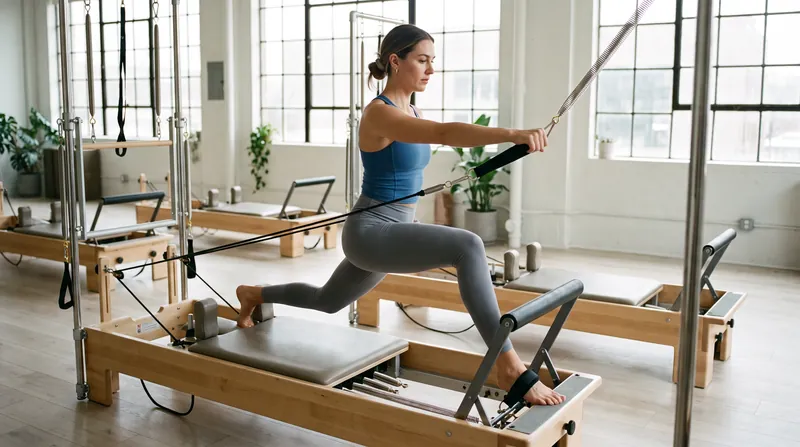
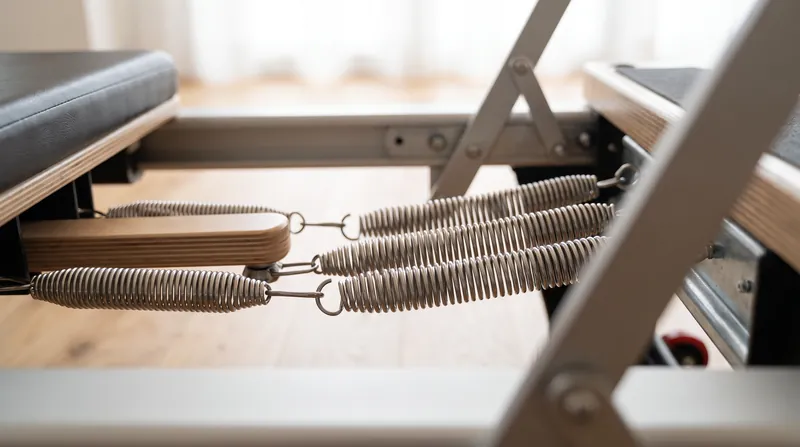
Enter the Reformer. Originally designed as a rehabilitation tool, the Reformer consists of a sliding carriage attached to a stationary frame by a series of color-coded springs. These springs provide variable resistance—meaning the tension changes as the spring stretches and recoils, matching the natural strength curve of human muscle.[4]
This variable resistance fundamentally alters the biomechanical load. Unlike gravity, which pulls straight down, the Reformer's pulleys and springs can provide resistance in multiple planes of motion. More importantly, the springs can act as assistance just as easily as they act as resistance, supporting the weight of the limbs.[6]
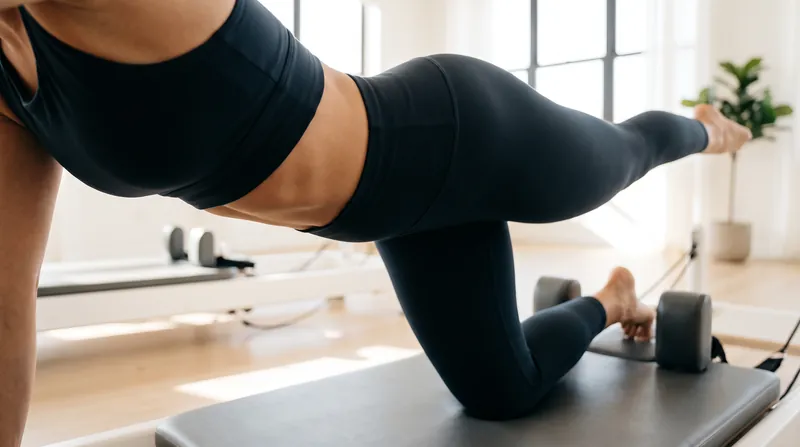
When a practitioner's feet are in the straps, the tension of the springs supports the weight of the legs. This offloads the superficial hip flexors and allows the nervous system to safely access and activate the deeper stabilizing muscles, such as the transversus abdominis and the pelvic floor, without the threat of spinal overload.[3][6]
This mechanical support translates directly into clinical outcomes. Research comparing the two modalities for non-specific lower back pain demonstrates that Reformer-based exercises yield significant improvements in pain reduction and functional mobility, largely because the equipment prevents the compensatory bracing that often exacerbates back pain.[2]
The Reformer's closed-kinetic-chain environment—where the feet or hands are pressed against a stable surface like the footbar—provides enhanced proprioceptive feedback. This tactile input helps the nervous system map the body's position in space, making it a highly effective tool for neuromuscular rehabilitation and motor learning.[8]
But what about body composition and muscle mass? For general fitness populations looking to change their physique, the evidence is nuanced. Studies tracking middle-aged sedentary women found that both Mat and Reformer Pilates effectively improve body composition and reduce waist-to-hip ratios over a 12-week period.[7]
However, the Reformer's ability to progressively overload the muscles via heavier spring tension provides a slight edge for inducing mechanical tension—a primary driver of muscle hypertrophy. While neither modality replaces heavy resistance training for absolute muscle mass, the Reformer offers a clearer pathway for progressive overload than the bodyweight-limited Mat.[1][7]
Proficiency also dictates the biomechanical response. Advanced practitioners show different functional movement patterns and core muscle activity compared to beginners, regardless of the equipment used. As neuromuscular control improves, the body becomes more efficient at distributing load across the kinetic chain, reducing the reliance on superficial muscles.[3]
For the general reader, the practical application is straightforward: if you are recovering from an injury, experiencing lower back pain, or struggling to "feel" your core without straining your neck or back, the Reformer provides the necessary mechanical support to retrain your movement patterns safely.[2][4]
Conversely, if you have a healthy spine, strong baseline body awareness, and want a highly accessible, travel-friendly way to challenge your core endurance against gravity, Mat Pilates remains an exceptionally potent stimulus that requires zero equipment.[5][9]
Ultimately, the two modalities are not mutually exclusive but rather complementary points on a biomechanical continuum. The Reformer teaches the nervous system how to move efficiently with support, while the Mat tests whether that efficiency can be maintained when the support is taken away.[10]
How we did this
- Method
- Synthesizing electromyographic (EMG) muscle activation data with clinical pain-reduction outcomes to map the mechanical load differences between unassisted gravity (Mat) and variable spring resistance (Reformer).
- What we found
- Although Mat Pilates often produces higher peak superficial muscle activation due to the lack of external support, the Reformer's spring system allows for greater isolation of deep stabilizing muscles by offloading the superficial movers, making it biomechanically superior for early-stage lower back pain rehabilitation despite 'feeling' less strenuous.
- What we worked from
- EMG back muscle activity during Mat Pilates: High peak activation in superficial stabilizers — PubMed
- Lower back pain functional improvement: Significant reduction via Reformer-based exercises — OpenUCT
- Core muscle activity by proficiency: Differential activation patterns based on equipment support — Frontiers in Physiology
- Limits of this analysis
- EMG data varies significantly based on practitioner proficiency and anatomy, and most clinical trials do not perfectly isolate the equipment's mechanical effect from the instructor's cueing quality.
Key terms
- Variable Resistance
- Resistance that changes throughout the range of motion, such as a spring that becomes harder to pull the further it is stretched.
- Closed-Kinetic-Chain
- Exercises where the hand or foot is fixed against a stationary object (like a footbar), providing greater stability and joint compression.
- Electromyography (EMG)
- A diagnostic technique that measures the electrical activity produced by skeletal muscles, used to determine how hard a muscle is working.
- Transversus Abdominis
- The deepest layer of abdominal muscle that wraps around the torso like a corset, crucial for spinal stabilization.
- Proprioception
- The nervous system's ability to sense the position, movement, and orientation of the body in space.
Frequently asked
Is Reformer Pilates harder than Mat Pilates?
Not necessarily. While the Reformer can provide heavier resistance, its springs also offer support that makes certain movements easier and safer than performing them unassisted on the Mat.
Which is better for lower back pain?
Clinical evidence heavily favors the Reformer for early-stage lower back pain rehabilitation, as the equipment supports the limbs and prevents the superficial back muscles from overcompensating.
Can I build muscle with Pilates?
Both modalities can improve muscle endurance and tone, but the Reformer offers a better pathway for progressive overload (adding heavier spring tension), which is a key driver of muscle hypertrophy.
Do I need to start with Mat before trying the Reformer?
No. In fact, many physical therapists recommend starting on the Reformer because the tactile feedback and spring support help beginners learn proper core engagement before attempting unassisted Mat exercises.
Viewpoints in depth
Clinical Rehabilitation Specialists
Focus on the Reformer as a superior tool for motor learning and safe tissue loading.
Physical therapists and clinical researchers emphasize the Reformer's closed-kinetic-chain environment. By keeping the hands or feet pressed against a stable surface like the footbar or straps, the nervous system receives constant tactile feedback. This proprioceptive input, combined with the springs supporting the weight of the limbs, allows patients to retrain dysfunctional movement patterns without triggering the pain spasms associated with unassisted gravity loading.
Traditional Contrology Instructors
Maintain that Mat work is the ultimate expression of Pilates mastery.
Classical Pilates instructors often view the Reformer as a teaching tool designed to prepare the body for the Mat, not the other way around. Because Mat Pilates removes all external assistance, it forces the practitioner to manage their own body weight entirely through internal muscular control. In this view, the Mat is the ultimate test of functional strength, as it mimics the unassisted reality of moving through daily life.
General Fitness Practitioners
Value the Reformer for its ability to provide progressive overload and a unique resistance stimulus.
For those focused on body composition and general strength, the Reformer is often preferred because it allows for progressive overload—the gradual increase of stress placed upon the body during exercise. By adding heavier springs, practitioners can induce greater mechanical tension on the muscles than bodyweight alone can provide, bridging the gap between traditional mind-body exercise and conventional resistance training.
- Clinical Rehabilitation Specialists
- View the Reformer as a superior tool for motor learning and safe tissue loading due to its closed-kinetic-chain environment and variable support.
- Traditional Contrology Instructors
- Maintain that Mat work is the ultimate expression of Pilates mastery, as it requires the practitioner to control their body in space without external assistance.
- General Fitness Practitioners
- Value both modalities but often lean toward the Reformer for its ability to provide progressive overload and a unique resistance stimulus not found in bodyweight training.
Perspectives this story doesn't cover
- Equipment Manufacturers
- Budget-Conscious Consumers
Sources
Source coverage
10 outlets
3 viewpoints surfaced









- [1]Quality in Sport
Reformer Pilates vs Mat Pilates and Muscle Mass: Current State of Knowledge
Read on Quality in Sport → - [2]OpenUCTClinical Rehabilitation Specialists
The effect of pilates reformer-based exercises compared to pilates mat-based exercises on general lower back pain and function in individuals suffering from non-specific lower back pain
Read on OpenUCT → - [3]Frontiers in PhysiologyTraditional Contrology Instructors
Comparisons of functional movements and core muscle activity in women according to Pilates proficiency
Read on Frontiers in Physiology → - [4]HealthlineGeneral Fitness Practitioners
Reformer vs. Mat Pilates: Pros, Cons, and How to Choose the Best One
Read on Healthline → - [5]Medical News TodayGeneral Fitness Practitioners
Reformer vs mat pilates: Differences, risks, and more
Read on Medical News Today → - [6]Quiform
Pilates Muscle Activation: EMG-Based Equipment Comparison
Read on Quiform → - [7]Progress in NutritionGeneral Fitness Practitioners
Comparison of the effect of the mat and reformer pilates exercises on the waist-hips ratio and body compositions of the middle-aged sedentary women
Read on Progress in Nutrition → - [8]PubMedClinical Rehabilitation Specialists
Is Pilates an effective rehabilitation tool? A systematic review
Read on PubMed → - [9]PubMedClinical Rehabilitation Specialists
Electromyographic effect of mat Pilates exercise on the back muscle activity of healthy adult females
Read on PubMed → - [10]Factlen Editorial TeamTraditional Contrology Instructors
Synthesis by Factlen editorial team
Read on Factlen Editorial Team →
More in Fitness
See all →Exercise Science
Multiomics Study Identifies Distinct Metabolic and Immune Signatures in Regular Exercisers
5 sources

Core Biomechanics
The 10-20% MVC Threshold: How Low-Level Deep Core Activation Maximizes Spinal Stiffness
7 sources
Core Biomechanics
The Accommodating Resistance: How Reformer Springs Drive Higher Deep Core Co-Contraction Than Mat Pilates
5 sources
Rehabilitation Timelines
The 5-to-8 Week Threshold: How Long Pilates Must Last to Improve Chronic Low Back Pain
9 sources

Comments
Every angle. Every day.
Get Fitness stories with full source coverage and perspective breakdowns, free every day.