
The Athletic Arbiters: How the World Cup Referee Evolved from Amateur to Elite Athlete
Once gentlemen amateurs who officiated in blazers and ties, World Cup referees have transformed into highly scrutinized, data-monitored professional athletes who cover more ground than the players they police.
By Omar Haddad

Share this story
On July 30, 1930, the first World Cup final kicked off in Montevideo. The man tasked with maintaining order between Uruguay and Argentina was Belgian referee John Langenus. He stepped onto the pitch wearing a tailored blazer, a collared shirt, a tie, and plus-fours. Looking more prepared for a leisurely afternoon of golf than the pinnacle of international football, Langenus represented the era of the gentleman amateur, where authority was derived from social standing rather than athletic prowess.[3]
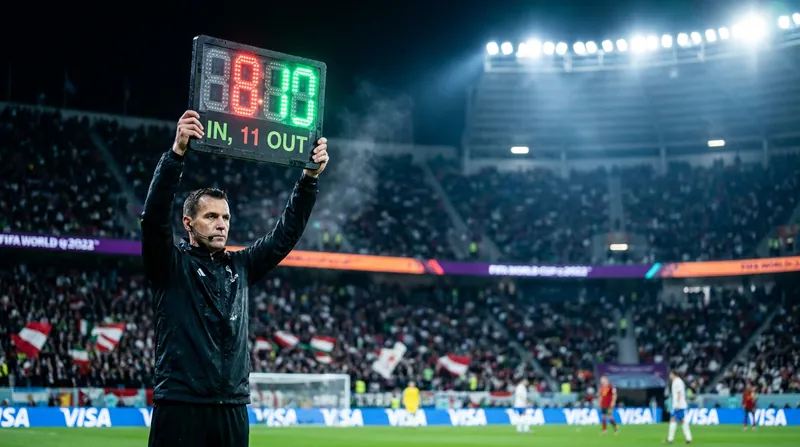
Fast forward to the modern era, and the contrast is jarring. Today’s World Cup referee is a highly tuned biometric machine. Beneath their neon, moisture-wicking jerseys lie GPS trackers and heart-rate monitors. They communicate via encrypted earpieces, undergo rigorous physiological testing, and are expected to cover more ground than the elite midfielders they police. The evolution of the official from an authoritative bystander to a professional athlete mirrors the explosive physical development of the sport itself.[2][3]
In the tournament's early decades, referees were often administrators, journalists, or local dignitaries who officiated part-time. Physical fitness was largely an afterthought; positioning relied on a slow jog, a keen eye, and an unquestioned respect for the whistle. The game was played at a methodical, walking pace, allowing officials to govern from a distance without needing to sprint end-to-end.[1]
The turning point arrived in the 1960s and 1970s. As tactical innovations increased the speed of transitions and the physical intensity of the players, referees found themselves physically outmatched. The governing bodies recognized that an official gasping for air could not make clear-headed, split-second decisions. The game had outgrown the amateur arbiter.[1][3]
This realization birthed the era of standardized fitness testing. By the late 20th century, rigorous aerobic assessments became the gatekeeper for international officiating. Referees were no longer just observers; they were required to be athletes in their own right, capable of sustaining high heart rates while maintaining cognitive clarity under immense global pressure.[2]
The 1994 World Cup in the United States marked a visual and cultural shift for the profession. For over sixty years, referees had worn austere black uniforms with white collars, earning them the universal moniker "the men in black." In America, vibrant burgundy, silver, and yellow kits were introduced, signaling a modernization of the role and ensuring officials were highly visible against the backdrop of color television broadcasts.[3]
This era also gave rise to the celebrity referee, epitomized by Italy's Pierluigi Collina. Officiating the 2002 final between Brazil and Germany, Collina demonstrated that the modern referee needed more than just fitness; they required immense psychological presence. His man-management skills, unmistakable aura, and elite competence proved that officials could command respect through personality and preparation, not just the threat of a card.[3]
Today, the physical demands placed on World Cup referees are staggering. Sports science data reveals that elite officials routinely cover between 10 and 13 kilometers per match. More crucially, they perform dozens of high-intensity sprints to keep up with rapid counter-attacks, often reaching speeds exceeding 25 kilometers per hour to maintain proximity to the play.[2]
Unlike players, who can pace themselves, rely on teammates to cover space, or be substituted when fatigued, the referee must always be within 15 to 20 meters of the ball to ensure an unobstructed view of the action. This requires a unique blend of aerobic endurance and explosive anaerobic capacity, all while maintaining a low enough heart rate to process complex tactical scenarios.[2][3]
The professionalization of the role has entirely transformed how referees prepare for the world stage. They now undergo rigorous, months-long training camps, working alongside sports psychologists, nutritionists, and vision specialists. They study team tactics and player tendencies meticulously, anticipating where the ball will go before a pass is even played to ensure optimal positioning.[2]
The 2022 tournament shattered another historic barrier, as France's Stéphanie Frappart led the first all-female officiating team in a men's World Cup match, overseeing Germany's group stage fixture. This milestone underscored that elite officiating is defined entirely by competence, physical readiness, and cognitive sharpness, proving that the highest levels of the game are accessible to anyone who meets the grueling standards.[3]
As the 2026 World Cup approaches, the referee's toolkit continues to expand. While technology assists with factual decisions, the human element remains irreplaceable. The referee must still manage the emotional temperature of 22 highly charged athletes, navigating cultural differences and language barriers in real-time.[1][3]
Ultimately, the history of the World Cup referee is a story of relentless adaptation. From the tailored blazers of 1930 to the biometric vests of today, the whistleblowers have transformed themselves into elite athletes, ensuring that the beautiful game, no matter how fast it becomes, remains fundamentally fair.[3]
Key points
- Early World Cup referees were amateurs who officiated in formal attire like blazers and plus-fours.
- The acceleration of football tactics in the 1970s forced FIFA to implement rigorous fitness testing for officials.
- Modern referees cover 10 to 13 kilometers per match, often outrunning the players they are officiating.
- The 1994 tournament modernized the profession visually by introducing colored kits instead of traditional black.
- Elite officials now train as professional athletes, utilizing sports science, biometrics, and tactical study.
How we got here
1930
John Langenus officiates the first World Cup final wearing a blazer and tie.
1970s
Increasing game speeds prompt the introduction of standardized fitness tests for international referees.
1994
FIFA introduces brightly colored referee kits, ending the era of the 'men in black'.
2002
Pierluigi Collina officiates the final, cementing the era of the highly visible, celebrity referee.
2022
Stéphanie Frappart becomes the first woman to referee a men's World Cup match.
- Sports Scientists
- Focuses on the physiological evolution of the role, viewing modern referees as elite endurance athletes who must manage extreme cognitive loads under physical duress.
- Football Historians
- Emphasizes the cultural shift from gentleman amateurs to professional arbiters, tracking how changes in the Laws of the Game necessitated a new breed of official.
- Tactical Analysts
- Argues that the referee's evolution was forced by the tactical development of the game, specifically the transition to high-pressing systems that require officials to sprint end-to-end.
Perspectives this story doesn't cover
- Current active referees discussing the mental toll of modern scrutiny
- Grassroots officials who face different challenges without elite technology
Sources
Source coverage
3 outlets
3 viewpoints surfaced



- [1]International Football Association Board (IFAB)Football Historians
History of the Laws of the Game and Match Officials
- [2]Journal of Sports SciencesSports Scientists
Match performance and physical capacity of elite soccer referees
Read on Journal of Sports Sciences → - [3]Factlen Editorial TeamTactical Analysts
Synthesis by Factlen editorial team
Read on Factlen Editorial Team →
More in Sports
See all →History
The Giant-Killers: The Anatomy and Evolution of the World Cup Upset
5 sources

History
The Tactical Metamorphosis: How the World Cup Forged Football's Greatest Formations
7 sources
History
The Canvas of Commerce: How the World Cup Mascot Evolved from a Five-Minute Sketch to a Billion-Dollar Empire
5 sources
History
The Apex Predator: How the World Cup Number 9 Evolved from Penalty-Box Poacher to Complete Forward
3 sources
Comments
Every angle. Every day.
Get Sports stories with full source coverage and perspective breakdowns, free every day.