
The Evolution of the Number 10: How the World Cup's Most Iconic Role Transformed
From Pelé's accidental branding to Maradona's dominance and the modern tactical hybrid, the World Cup's most revered jersey has constantly adapted to the changing geometry of the game.
By Meera Iyer

Share this story
In the iconography of global football, no symbol carries the weight, romance, and expectation of the number 10 jersey. At the FIFA World Cup, it is not merely a squad number stitched onto the back of a shirt; it is a declaration of intent and a mantle of immense responsibility.[1]
For over six decades, the player wearing the 10 has traditionally been the creative heartbeat of their nation. They are the artist tasked with turning rigid tactical structure into fluid poetry, the individual capable of unlocking a stubborn defense with a single, visionary pass.[3]
Yet, the way this revered role is interpreted on the pitch has undergone a radical, decades-long transformation. The history of the World Cup is, in many ways, the history of the playmaker's evolution, reflecting broader shifts in sports science, physical conditioning, and tactical philosophy.[3]
The mythology of the number 10 was born almost entirely by accident. Ahead of the 1958 World Cup in Sweden, the Brazilian football federation forgot to submit their squad numbers to the tournament organizers.[1]
A FIFA official randomly allocated the numbers, inadvertently handing the 10 to a relatively unknown 17-year-old prodigy named Pelé. By the end of that tournament, Pelé had not only lifted the trophy but had permanently immortalized the digits.[1][3]
In that early era, the 10 was typically an inside forward operating in a W-M or 4-2-4 formation. They were primarily goalscorers who operated high up the pitch, burdened with virtually no defensive responsibilities and given the freedom to attack at will.
As defensive tactics became more sophisticated and spaces tighter in the 1970s and 1980s, the role was forced to shift deeper into the midfield. This birthed the classic South American 'enganche'—literally the 'hook' connecting the midfield block to the striking line.
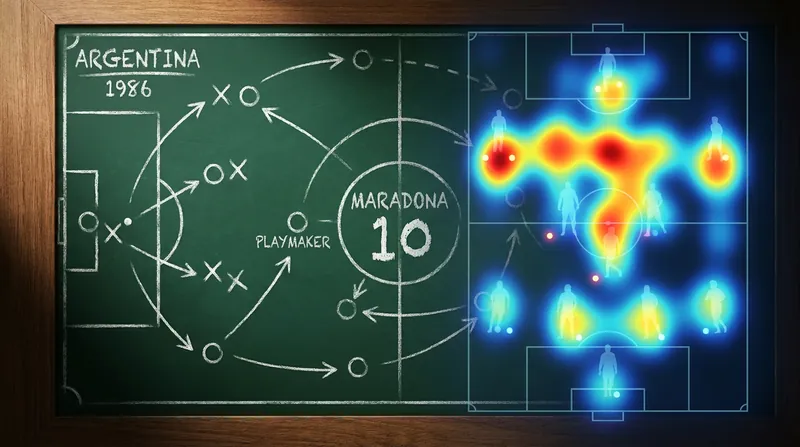
The absolute zenith of the enganche at the World Cup occurred on the sun-baked pitches of Mexico in 1986. Diego Maradona did not just wear the 10 for Argentina; he defined its physical, tactical, and spiritual dimensions for a generation.
Argentina's manager, Carlos Bilardo, constructed a pragmatic, hard-working team entirely designed to liberate Maradona. By absolving him of all defensive duties, Bilardo allowed Maradona to roam freely, dictate the tempo, and single-handedly drag his nation to ultimate glory.[3]
Throughout the 1990s and early 2000s, the European equivalent—the 'trequartista'—dominated the global stage. Players like Zinedine Zidane, Rivaldo, and Francesco Totti operated in the 'hole' behind the strikers, serving as the undisputed focal points of their respective attacks.
This era is often remembered as the golden age of the static playmaker. These maestros were given the ball at their feet and expected to unlock deep-lying defenses with a single, visionary pass, operating at their own deliberate, majestic tempo.[2]
However, the physical demands of the World Cup began to shift dramatically by the late 2000s and early 2010s. The rise of intense, synchronized high-pressing systems made the luxury of a static, non-defending playmaker a tactical liability.[2]
Spain's triumph in 2010 and Germany's victory in 2014 signaled a move toward 'distributed playmaking.' Instead of relying on one central creator, these champions utilized a collective of technically gifted midfielders who shared the creative burden across the pitch.
In these modern, suffocating systems, the traditional number 10 was often pushed out wide to the flanks or forced to play as a deeper, box-to-box midfielder simply to survive the intense physical congestion in the center of the park.[2]
Many tactical pundits began to declare the classic number 10 dead. The modern World Cup, they argued, demanded elite athletes who could press relentlessly for 90 minutes, leaving absolutely no room for the strolling, luxury artist of the past.[2][3]
Yet, the role did not die; it merely adapted to survive. The 2018 and 2022 World Cups showcased the emergence of the hybrid playmaker—players who combined the elite vision of a traditional 10 with the relentless engine and defensive grit of a holding midfielder.[3]
Antoine Griezmann's transformation for France perfectly encapsulated this shift. Operating nominally as a 10, he frequently dropped deep into his own penalty area to make crucial tackles, before instantly launching devastating counter-attacks with precise distribution.[2]
Even Lionel Messi, the ultimate modern 10, adapted his game in 2022. Surrounded by a 'biological engine' of hard-running midfielders, he meticulously picked his moments to walk, conserving his energy for devastating, decisive bursts in the final third.[3]
As the expanded 48-team format of the 2026 World Cup approaches, the tactical landscape will continue to evolve. The wider variety of defensive blocks and pressing traps will require even more versatility from the game's elite creators.[3]
The number 10s of the future will need to be tactical chameleons—capable of dropping deep to escape man-marking, drifting wide to find pockets of space, and pressing aggressively from the front. The iconic jersey remains the same, but the athletes wearing it have become the most physically and technically complete footballers in history.[3]
Key points
- The number 10 jersey became iconic almost by accident when randomly assigned to Pelé in 1958.
- The 1980s and 1990s saw the peak of the free-roaming playmaker, exemplified by Maradona and Zidane.
- Modern high-pressing tactics in the 2010s forced the classic, static playmaker out of the game.
- Today's number 10s are hybrid athletes who must combine elite creative vision with relentless defensive work rates.
How we got here
1958
Pelé is randomly assigned the number 10 jersey in Sweden, inadvertently birthing a global footballing icon.
1986
Diego Maradona perfects the free-roaming 'enganche' role, leading Argentina to glory in Mexico.
1998
Zinedine Zidane defines the European 'trequartista' era, operating as a majestic, static playmaker for France.
2010
Spain's tiki-taka system wins the World Cup, signaling a shift toward distributed playmaking across the midfield.
2022
The hybrid playmaker fully emerges, blending elite attacking vision with the defensive work rate of a holding midfielder.
- System Pragmatists
- Believe that modern high-pressing systems require all eleven players to defend, making the hard-working, hybrid 10 a necessary and superior evolution.
- Tactical Purists
- Argue that the systematic eradication of the free-roaming 10 has robbed global football of individual spontaneity and artistic expression.
- Cultural Historians
- Focus on how the number 10 remains a vital cultural artifact, representing a nation's footballing identity regardless of how the tactical geometry changes.
Perspectives this story doesn't cover
- Grassroots Youth Coaches
- Sports Scientists
Sources
Source coverage
3 outlets
3 viewpoints surfaced



- [1]FIFACultural Historians
The History and Mystique of the Number 10 Jersey
Read on FIFA → - [2]ESPNSystem Pragmatists
The Death and Rebirth of the Classic 10 on the Global Stage
Read on ESPN → - [3]Factlen Editorial TeamCultural Historians
Synthesis by Factlen editorial team
Read on Factlen Editorial Team →
More in Sports
See all →History
The Apex Predator: How the World Cup Number 9 Evolved from Penalty-Box Poacher to Complete Forward
3 sources
History
The First Attacker: How the World Cup Center-Back Evolved from Destroyer to Playmaker
2 sources
History
The Pursuit of Immortality: How the World Cup Golden Boot Evolved Across a Century of Football
4 sources

Storyline
The Wing-Back Evolution: How Defenders Became the World Cup's Primary Playmakers
7 sources
Comments
Every angle. Every day.
Get Sports stories with full source coverage and perspective breakdowns, free every day.