
The First Attacker: How the World Cup Center-Back Evolved from Destroyer to Playmaker
Once tasked solely with clearing danger into the stands, the central defender has transformed into the tactical hub and primary playmaker of the modern World Cup team.
By Meera Iyer

Share this story
For decades, the archetype of the World Cup center-back was etched in blood, mud, and brute force. The traditional 'stopper' had a singular, destructive mandate: neutralize the opposing center-forward by any means necessary, and clear the ball as far into the grandstands as humanly possible. They were the bouncers of the penalty area, celebrated for their grit rather than their grace.[2]
Today, that archetype is entirely obsolete. The modern central defender has undergone the most radical transformation of any position on the football pitch. In recent World Cup tournaments, the players registering the most touches, completing the most passes, and initiating the most attacks are not the glamorous number 10s or the tireless central midfielders—they are the center-backs.[1]
The seeds of this revolution were planted long before the modern era. In 1966, England's Bobby Moore offered a glimpse of the future, lifting the Jules Rimet trophy while demonstrating an elegance and anticipation that defied the era's reliance on crunching tackles. Moore read the geometry of the game, intercepting passes and calmly distributing the ball rather than simply destroying the play.
The true conceptual leap, however, arrived in 1974 with West Germany's Franz Beckenbauer. Operating as a 'libero' or sweeper, Beckenbauer played behind the main defensive line. Free from strict man-marking duties, he used his supreme technical ability to step out of defense and stride into midfield, effectively becoming an auxiliary playmaker. He proved that a defender could dictate the tempo of a World Cup match.
Yet, the libero system had a structural limitation: it required a spare man at the back, meaning the rest of the defense still had to play a rigid, reactive man-marking system. Throughout the 1980s, the game remained largely divided into two distinct castes: the destroyers at the back and the creators up front. The idea that every defender needed to be a technician had not yet taken hold.[2]
The tectonic plates shifted in the late 1980s and 1990s with the widespread adoption of zonal marking and the flat back four. Defenders were no longer tasked with following a single opponent around the pitch; instead, they guarded specific areas of space. This required a synchronized defensive line, rendering the deep-lying sweeper obsolete and demanding higher tactical intelligence from every member of the backline.
By the 1998 World Cup, teams like host nation France showcased a new defensive ideal. Center-backs like Marcel Desailly and Laurent Blanc combined immense physical power with the technical security required to build possession from the back. The ball was no longer treated like a hot potato; it was a tool to be managed and progressed.[1][2]
The definitive paradigm shift occurred in 2010. Spain's tiki-taka revolution, anchored by Gerard Piqué and Carles Puyol, essentially turned center-backs into deep-lying midfielders. Spain won the tournament by monopolizing possession, and their central defenders were the metronomes. The long, hopeful clearance was virtually eradicated from their playbook, replaced by patient, probing passes that exhausted the opposition.
Germany refined this blueprint further in 2014. Center-backs Mats Hummels and Jérôme Boateng didn't just pass the ball well; they did so while operating near the halfway line. The 'high line' became a mandatory requirement for any team harboring serious World Cup ambitions. By compressing the pitch, Germany suffocated their opponents, relying on the sweeping abilities of their goalkeeper to cover the vast space left behind.[1]
The data from recent tournaments underscores the totality of this evolution. According to technical reports, elite center-backs now routinely complete upwards of 90% of their passes. They are tasked with playing 'progressive passes'—line-breaking balls that bypass the first wave of the opposition's press and instantly transition the team from defense to attack.
This statistical dominance is born of tactical necessity. As modern forwards have become relentless pressing machines, the midfield has become a suffocating battleground. Consequently, the center-backs are often the only players on the pitch with the time and space to look up and survey the field. They have become the release valves and the primary architects of the attack.[1][2]
This dual responsibility has created a physical paradox. Today's center-backs must be taller and stronger than ever to defend set-pieces and crosses, yet they must also possess the sprint speed of a winger to recover when the high line is breached. They are asked to be gladiators in the air and ballerinas on the turf.[1]
Looking toward the 2026 World Cup, the tactical blueprint is universally established. Elite nations like Argentina, Brazil, and the Netherlands build their entire tactical identity around the ball-playing capabilities of their central defenders. A team with center-backs who panic under pressure simply cannot escape their own half against top-tier opposition.[2]
The training ground routines of national teams now reflect this reality. Center-backs spend as much time working on their first touch, their weak-foot passing, and their body orientation as they do on tackling and heading. The defensive arts have not been forgotten, but they are now merely the baseline requirement rather than the sole job description.[1]
Ultimately, the evolution of the center-back mirrors the evolution of the World Cup itself. The tournament has transitioned from a fragmented game of individual duels into a holistic, interconnected system where all 11 players must participate in every phase of play. The destroyer has been retired; the architect has taken their place.[2]
Key points
- The traditional 'stopper' role focused solely on destroying opposition attacks has become obsolete at the World Cup.
- Modern center-backs routinely lead their teams in touches and passes, acting as deep-lying playmakers.
- The shift to zonal marking and the flat back four eliminated the traditional sweeper role.
- High-pressing tactics force center-backs to be the primary release valve for building possession.
- Today's defenders must combine the physical traits of a traditional center-back with the technical skills of a midfielder.
How we got here
1966
Bobby Moore captains England to glory, demonstrating unprecedented defensive elegance and anticipation.
1974
Franz Beckenbauer redefines the Libero role, routinely stepping into midfield to dictate play for West Germany.
1998
France wins the tournament with a backline combining elite physical power and secure technical build-up play.
2010
Spain's center-backs anchor a possession-based revolution, virtually eliminating the long clearance from their playbook.
2014
Germany normalizes the extreme high defensive line, with center-backs operating near the midfield stripe.
- Positional Play Disciples
- Argue that all 11 players must participate in possession, making the ball-playing center-back the foundational piece of any successful attack.
- High-Press Innovators
- Focus on the physical evolution of the role, demanding defenders who can sprint fast enough to manage a high line with 40 yards of space behind them.
- Tactical Traditionalists
- Maintain that while passing is valuable, a center-back's primary duty remains penalty-box defending, aerial dominance, and keeping clean sheets.
Perspectives this story doesn't cover
- Goalkeepers who must adapt to sweeping behind high defensive lines
- Traditional target-man forwards who have been marginalized by modern defensive structures
Sources
Source coverage
2 outlets
3 viewpoints surfaced


- [1]The AthleticPositional Play Disciples
How the Nashville Zoo Became the Latest Face of Data Center Opposition
Read on The Athletic → - [2]Factlen Editorial Team
Synthesis by Factlen editorial team
Read on Factlen Editorial Team →
More in Sports
See all →History
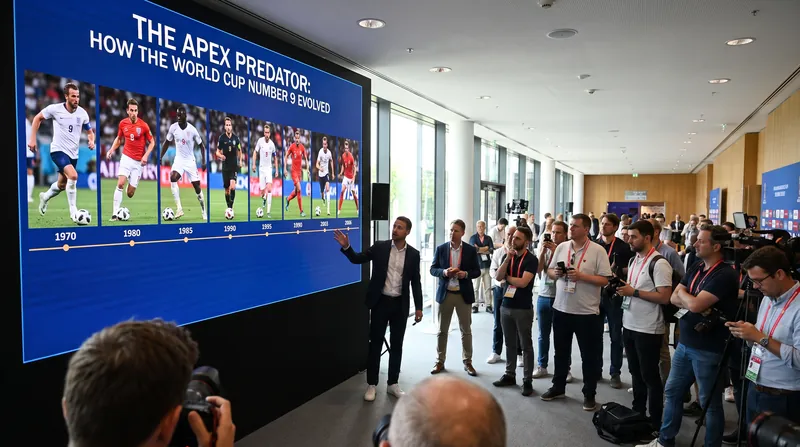
The Apex Predator: How the World Cup Number 9 Evolved from Penalty-Box Poacher to Complete Forward
3 sources
History
The Pursuit of Immortality: How the World Cup Golden Boot Evolved Across a Century of Football
4 sources

Storyline
The Wing-Back Evolution: How Defenders Became the World Cup's Primary Playmakers
7 sources

History
The Giant-Killers: The Anatomy and Evolution of the World Cup Upset
5 sources
Comments
Every angle. Every day.
Get Sports stories with full source coverage and perspective breakdowns, free every day.