
The 50,000-Hour Teardown: How Airlines Disassemble and Rebuild Commercial Jets
Commercial aircraft undergo a rigorous, mandated schedule of maintenance checks that range from overnight fluid top-offs to multimillion-dollar structural teardowns. Understanding the A, C, and D check system reveals how airlines balance passenger safety with the financial pressure of keeping fleets in the air.

Share this story
In short
- Commercial aircraft follow a strict, globally mandated maintenance schedule divided into A, C, and D checks.
- A-checks occur every 400 to 600 flight hours and are typically completed overnight at an airport gate.
- C-checks ground an aircraft for one to two weeks every 18 to 24 months for deep system diagnostics.
Airlines view heavy maintenance as a necessary financial hemorrhage, grounding revenue-generating assets for weeks at a time and costing millions of dollars per airframe. Safety regulators and aviation engineers, conversely, view those same weeks as the only thing keeping a pressurized aluminum tube from catastrophic fatigue at 35,000 feet. The tension between keeping planes in the air to generate yield and grounding them to keep them safe is resolved by a rigid, globally recognized schedule of inspections.[1][6]
This framework, mandated by regulatory bodies like the Federal Aviation Administration (FAA) in the United States and the European Union Aviation Safety Agency (EASA), divides aircraft maintenance into a strict hierarchy of intervals. Traditionally lettered A through D, these checks dictate exactly when an aircraft must be pulled from the flight line. While the intermediate "B check" has largely been absorbed into other intervals on modern aircraft in 2026, the A, C, and D checks remain the non-negotiable backbone of commercial aviation safety.[2][5]
The first major milestone in an airframe's maintenance cycle is the A-check, which serves as the aviation equivalent of a comprehensive physical examination. Occurring roughly every 400 to 600 flight hours—or every 200 to 300 flight cycles, depending on the specific aircraft model—this inspection is the airline's first line of defense against cumulative daily wear.[2]
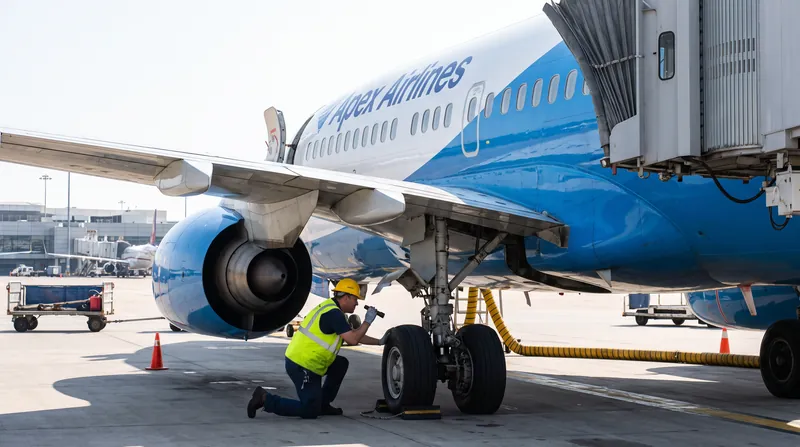
Because an aircraft only generates revenue when it is carrying passengers or cargo, A-checks are meticulously choreographed to minimize schedule disruption. They are typically performed overnight at an airport gate or a line maintenance hangar, taking anywhere from six to 24 hours to complete.
During this overnight window, technicians execute a highly specific checklist. They change oil and air conditioning filters, lubricate hinges and control linkages, and test emergency equipment like evacuation slides and life vests. They also perform detailed visual inspections of the fuselage, searching for minor dents, early signs of corrosion, or loose access panels. By morning, the aircraft is signed off and returned to the departure board.[2]
As the airframe ages and accumulates more flight cycles, the inspections grow exponentially more invasive. The C-check, which typically occurs every 18 to 24 months, marks the critical transition from routine line maintenance to "heavy maintenance."[3][4]
During a C-check, the aircraft is removed from commercial service for one to two weeks. This level of teardown cannot be completed at a standard airport gate; the plane must be flown to a specialized Maintenance, Repair, and Overhaul (MRO) facility equipped with the necessary tooling and hangar space.[3]
The scope of a C-check involves deep diagnostic work that requires up to 6,000 labor hours. Technicians open access panels to inspect flight-deck escape ropes, control-cable runs, and floor beams. They perform operational checks on flap asymmetry systems, hydraulic lines, and the auxiliary power unit (APU). Crucially, they also conduct non-destructive testing on high-stress areas like wing-box fittings and engine inlet ducts to detect micro-fractures invisible to the naked eye.[3]
But the ultimate test of an aircraft's structural longevity is the D-check, widely known in the industry as a heavy maintenance visit. Occurring every six to 12 years, this is the most exhaustive, expensive, and time-consuming inspection a commercial airliner will ever undergo.[4]
"The D Check, sometimes called a 'heavy visit' or 'structural check,' happens every 6–10 years. It's the most exhaustive inspection, refurbishment, and replacement cycle in any aircraft maintenance checklist," notes aviation maintenance provider GFA Aero.
A D-check is less of an inspection and more of a complete deconstruction. The aircraft is systematically stripped down to its bare metal shell. The entire cabin interior—including passenger seats, overhead bins, galleys, lavatories, and wall insulation—is removed to expose the inner fuselage.[4]
Engines, landing gear, and primary flight controls are detached and often sent to specialized shops for their own separate overhauls. In many cases, the exterior paint is completely stripped away using chemical solvents, allowing engineers to inspect the bare aluminum or composite skin for microscopic fatigue cracks, delamination, and deep-seated corrosion.[5]
The logistical scale of a D-check is staggering. The process requires between 30,000 and 50,000 labor hours and keeps the aircraft grounded for four to eight weeks, depending on the condition of the airframe and the availability of replacement parts.[4][5]
The financial toll is equally massive, routinely costing several million dollars per aircraft. Because of this extreme capital outlay, the D-check forces airlines to make a critical financial calculation regarding the future of the airframe.[4][5]
As an aircraft approaches its second or third D-check—typically around 20 to 24 years of age—the combined cost of the overhaul and any required structural repairs can easily exceed the residual market value of the plane itself. When the math no longer works, airlines frequently choose to retire the aircraft, selling it for scrap parts or converting it into a dedicated freighter rather than funding the teardown.[4][5]
To manage these massive logistical and financial hurdles, airlines and MROs plan their heavy maintenance schedules years in advance. Supply chain bottlenecks, such as long lead times for specialty aerospace parts or a shortage of licensed aviation technicians, can easily delay a D-check.[4]
"Each D Check costs several million dollars and takes about three to six weeks, but it's almost like a brand new plane by the end of it," explains Qantas, highlighting the massive capital and time investment required to keep aging airframes in the sky.[4]
The sheer volume of documentation required during these checks is another massive undertaking. Every single task, from a lubricated hinge during an A-check to a replaced floor beam during a D-check, must be meticulously logged, signed off by a certified mechanic, and made available for regulatory audit.[4][5]
This unbroken chain of traceability ensures that if a component fails in flight, investigators can track exactly when it was last inspected, who inspected it, and what tools were used. It is a system built entirely around accountability and the elimination of single points of failure.[6]
The next time a passenger boards a 15-year-old commercial jet, they are stepping into a machine that has been continuously disassembled, inspected, and rebuilt. The A, C, and D check system guarantees that the aircraft pushing back from the gate is structurally as sound—and often technologically more advanced—than the day it first left the factory.[6]
Definitions
- Airframe
- The mechanical structure of an aircraft, excluding the engines and instrumentation.
- Flight Cycle
- One complete sequence of an aircraft taking off, pressurizing at altitude, depressurizing, and landing.
- MRO
- Maintenance, Repair, and Overhaul; specialized third-party facilities equipped to perform heavy aircraft teardowns.
- Non-Destructive Testing
- Inspection techniques, such as ultrasound or x-ray, used to detect microscopic cracks in metal without damaging the component.
- Metal Fatigue
- The progressive weakening of an aircraft's structural components caused by the repeated stress of cabin pressurization.
Questions & answers
What happened to the B-check?
On older aircraft, the B-check was an intermediate inspection performed every six to eight months. On modern airframes, improved component reliability has allowed regulators to absorb B-check tasks into the A-check and C-check intervals, reducing unnecessary downtime.
How much does a D-check cost?
A standard D-check routinely costs several million dollars per aircraft, depending on the size of the plane and the amount of hidden corrosion or metal fatigue discovered during the teardown.
Do airlines perform their own heavy maintenance?
While most airlines handle their own overnight A-checks at airport gates, heavy C and D checks are frequently outsourced to specialized Maintenance, Repair, and Overhaul (MRO) facilities located around the world.
What happens if an airline skips a check?
Maintenance intervals are legally mandated by aviation authorities like the FAA. If an aircraft exceeds its allowed flight hours or calendar limit without completing the required check, its airworthiness certificate is suspended and it cannot legally fly.
Analysis by camp
Airlines and Operators
Balancing safety compliance with the financial need to maximize aircraft utilization.
For commercial airlines, an aircraft only generates yield when its engines are running and its cabin is full. Maintenance represents a massive dual cost: the direct expense of parts and specialized labor, and the opportunity cost of lost revenue while the airframe is grounded. Consequently, operators invest heavily in predictive maintenance software and optimized scheduling to ensure that A-checks happen during natural overnight layovers, and that C and D checks are planned years in advance to avoid disrupting route networks.
Regulatory Authorities
Enforcing strict, non-negotiable intervals to prevent catastrophic structural failure.
Bodies like the FAA and EASA view the maintenance schedule as a rigid, non-negotiable safety net. Their primary concern is metal fatigue, corrosion, and component wear that naturally occurs over thousands of pressurization cycles. Regulators mandate that every maintenance action is meticulously documented, creating an unbroken chain of traceability that ensures no single point of failure goes uninspected, regardless of the financial burden it places on the operator.
MRO Facilities
Managing the logistical bottlenecks of heavy aircraft teardowns.
Maintenance, Repair, and Overhaul (MRO) providers are the specialized facilities that actually execute the C and D checks. Their challenge is primarily logistical: securing massive hangar space, sourcing highly specific aerospace parts with long lead times, and retaining licensed aviation technicians. MROs must constantly balance the unpredictable nature of heavy maintenance—where stripping a plane often reveals hidden corrosion that requires extra weeks of work—with the strict delivery timelines demanded by their airline clients.
- Airlines and Operators
- Focused on minimizing downtime and maximizing the revenue-generating hours of the fleet.
- Regulatory Authorities
- Focused on enforcing rigid inspection intervals to prevent structural failure.
- MRO Providers
- Focused on the logistical execution and technical realities of tearing down and rebuilding airframes.
Perspectives this story doesn't cover
- Aircraft Leasing Companies
- Aviation Parts Suppliers
Sources
Source coverage
6 outlets
3 viewpoints surfaced






- [1]Simple FlyingMRO Providers
The Different Types Of Aircraft Maintenance Checks
Read on Simple Flying → - [2]Ava AeroMRO Providers
A, B, C and D Checks in Aviation Maintenance: What They Mean and the Ground Support Equipment That Makes Them Possible
Read on Ava Aero → - [3]305 SkyMRO Providers
Aircraft C-Check: What Happens During Heavy Maintenance
Read on 305 Sky → - [4]QantasAirlines and Operators
The A, C, D of aircraft maintenance
Read on Qantas → - [5]WikipediaRegulatory Authorities
Aircraft maintenance checks
Read on Wikipedia → - [6]Factlen Editorial Team
Synthesis by Factlen editorial team
Read on Factlen Editorial Team →
More in Travel
See all →Aviation Safety
Preventing Call Sign Confusion With Alphanumeric Identifiers and Digital Clearances
4 sources
Aviation Safety
Why Transport Aircraft Must Dump Fuel Before Emergency Returns
7 sources

Aviation Safety
FAA Finalizes Rule Mandating Interference-Tolerant Radio Altimeters to Mitigate 5G Risk
7 sources
Aviation Safety
Why the FAA Proposed Inspections of 31,000 Improperly Anchored Boeing 737 MAX Seats
6 sources
Comments
Every angle. Every day.
Get Travel stories with full source coverage and perspective breakdowns, free every day.