
The 400 km/h Illusion: How Aerodynamic Drag Strips the Badminton Smash of Its Power
Elite badminton players generate record-breaking racket speeds through a flawless kinetic chain, but the shuttlecock's unique feather design destroys nearly 90% of that velocity in less than a second.
By Ryder James

Share this story
The outcome of a badminton rally is often determined in the fraction of a second before the racket strikes the shuttlecock, specifically during the rapid forearm pronation and wrist flexion that caps the kinetic chain. This specific biomechanical sequence is the only window a player has to impart energy, because the moment the shuttlecock leaves the stringbed, the sport's unique aerodynamics impose a severe and unavoidable speed penalty.
Players spend years perfecting this exact rotational movement, knowing that any inefficiency in the transfer of power cannot be corrected once the shuttlecock is in flight. The jump smash, the most aggressive offensive weapon in the sport, relies entirely on this explosive convergence of bodily forces.
Badminton is widely recognized as the fastest racket sport on Earth, with elite players routinely generating initial smash velocities that exceed 400 km/h. According to a 2025 analysis by Selenite Sports, modern professional smashes can exceed 490 km/h, outpacing the top speeds of Formula 1 cars.
A 2021 biomechanical study published in the Journal of Physical Education, Sport, Health and Recreations noted that Chinese doubles specialist Fu Haifeng set a famous benchmark in 2005 with a 332 km/h strike, a record that has since been shattered as racket technology and physical conditioning have advanced. These staggering numbers highlight the sheer explosive capability of the human body when leveraged correctly through a lightweight carbon-fiber frame.[3][5]
Generating these extreme velocities requires a precise sequencing of joint movements, a process biomechanists refer to as the kinetic chain. The 2021 biomechanical analysis evaluated 18 elite male players from the Indonesian national team to quantify the exact contributors to smash speed.
Using high-speed cameras and motion analysis software, the researchers found that "the main contribution to upper limb motion during overhead backhand and forehand smashes was the internal rotation velocity of the shoulder joint, elbow angular extension, and wrist palmar flexion." Every segment of the arm must fire in perfect sequence, accelerating the racket head to its absolute maximum velocity precisely at the point of impact.[3]
The power for a jump smash does not originate in the arm, but rather travels through it from the ground up. The body acts as a complex lever system, transferring kinetic energy from the legs pushing off the floor, through the rotational torque of the core, and up into the shoulder.
The final, explosive whipping motion of the wrist and forearm supination maximizes the racket's angular momentum. If a player relies solely on arm strength without engaging the lower body and core, the resulting smash will lack the necessary penetration to challenge a professional defense.[3]
However, the immense energy transferred to the shuttlecock is immediately contested by its highly unusual design. Unlike the spherical, pressurized projectiles used in tennis or baseball, a standard feather shuttlecock features an open conical shape constructed from 16 overlapping water-bird feathers glued and stitched to a rounded cork base.
This specific geometry makes the shuttlecock highly stable in flight, preventing it from tumbling end-over-end, but it also subjects the object to extreme aerodynamic drag. The feathers act as a natural parachute, catching the air and creating a massive braking force the instant the shuttlecock leaves the racket.[5]
"A shuttlecock experiences significantly higher air resistance than a regular ball, causing it to decelerate rapidly after being struck," notes the Selenite Sports review. This drag force is essential for keeping the projectile within the 13.4-meter confines of the standard badminton court, but it fundamentally alters the physics of the smash.
Without this rapid deceleration, a 400 km/h strike would be physically impossible to return and would easily sail past the baseline. The sport's entire tactical landscape is built around this rapid velocity decay, forcing players to account for how quickly their most powerful shots will lose their lethal edge.[5]
A 2022 wind-tunnel and flight-trajectory study conducted by researchers at Purdue University quantified this severe deceleration. Tracking the flight of feather shuttlecocks hit by players in a controlled indoor facility, the researchers recorded an initial velocity of 405.68 km/h immediately after the smash.
Just 0.5 seconds later, that speed had plummeted to 55.15 km/h. The high-speed cameras capturing the flight at 1,000 frames per second revealed that "the initial and final velocity of feather shuttlecock for player 1 was 405.68 km/h and 55.15 km/h respectively," confirming that the vast majority of the kinetic energy is burned off almost instantly.[1]
A separate 2020 study published in the journal MDPI observed a similar phenomenon at slightly lower speeds, noting that a shuttlecock projected at an initial speed of 67 meters per second (roughly 241 km/h) rapidly decelerates to just 7 meters per second (25 km/h) in 0.6 seconds. The researchers focused on the aerodynamic stability of the shuttlecock during its flip movement, confirming that the overlapping feather structure creates a highly stable but incredibly drag-heavy flight path. This consistency across different testing environments underscores the inescapable physics governing the sport.[2]
When comparing the initial and final velocity measurements across these distinct studies, a stark physiological limit emerges. Regardless of whether a player generates an elite 405 km/h smash or a standard 241 km/h strike, the shuttlecock's aerodynamic drag strips away between 86.4% and 89.5% of its initial speed within the first 0.6 seconds of flight.
This means that a player expending the massive biomechanical effort required to add 100 km/h to their initial smash speed will only see a fraction of that velocity translate to the opponent's side of the net.[1][2][6]
This massive energy loss means that exponential increases in biomechanical effort yield only marginal gains in the shuttlecock's terminal velocity by the time it reaches the defender. Interestingly, the drag coefficient is not static throughout the flight.
The Purdue researchers found that the drag coefficient actually decreased by 73% as the shuttlecock slowed from 300 km/h to 200 km/h. This reduction occurs because the flexible feather skirt deforms inward under the extreme air pressure of the initial strike, temporarily reducing the shuttlecock's cross-sectional profile and allowing it to cut through the air more efficiently.[1]
As the shuttlecock slows and the air pressure drops, the feather skirt expands back to its natural, wider shape, increasing the drag coefficient once again. This dynamic deformation allows the shuttlecock to travel incredibly fast during the first few meters of flight before hitting an aerodynamic wall and dropping steeply toward the floor.
Synthetic nylon shuttlecocks exhibit a different deformation pattern, which is why professional players exclusively use natural feather shuttles; the precise expansion and contraction of the goose feathers provide a specific flight trajectory that synthetic materials have yet to perfectly replicate.[1][2]
Because raw power suffers from such severe diminishing returns over the length of the court, elite badminton relies heavily on placement, deception, and the steepness of the smash angle. The biomechanical perfection of the kinetic chain is necessary simply to overcome the shuttlecock's natural braking system, turning a game of pure force into one of aerodynamic management.
A perfectly executed jump smash is not just about hitting the shuttlecock as hard as possible; it is about driving it downward at an angle that exploits the brief window of high velocity before the feathers deploy their inevitable parachute.
Where opinion splits
Sports Biomechanists
Focus on the precise joint sequencing and kinetic chain optimization required to maximize energy transfer at impact.
For biomechanists, the badminton smash is a problem of rotational physics and lever mechanics. Researchers analyzing the kinetic chain emphasize that arm strength is secondary to the angular momentum generated by the core and shoulder. By measuring the internal rotation velocity of the shoulder joint and the rapid palmar flexion of the wrist, biomechanists seek to identify the exact milliseconds where energy transfer peaks. Their work suggests that refining the sequence of these movements—ensuring no energy is leaked before the racket strikes the shuttlecock—is the only reliable way to increase terminal velocity.
Aerodynamics Researchers
Study the fluid dynamics and drag coefficients that govern the shuttlecock's unique deceleration and flight stability.
Aerodynamics experts view the shuttlecock as a unique projectile that defies the standard physics of ball sports. Their wind-tunnel testing reveals that the feather skirt acts as a dynamic parachute, deforming inward at high speeds to reduce drag before expanding outward as velocity drops. This camp focuses on how the 16 overlapping feathers create a highly stable but drag-heavy flight path, stripping away nearly 90% of the shuttlecock's kinetic energy in less than a second. For these researchers, the shuttlecock's design is the ultimate equalizer, imposing a hard physical limit on human power.
Elite Coaches
Apply these scientific principles to court strategy, emphasizing placement and deception over raw, diminishing power.
At the coaching level, the scientific realities of drag and deceleration dictate match strategy. Because a 400 km/h smash will inevitably slow to a returnable speed by the time it crosses the net, coaches train players to prioritize the steepness of the angle and the deception of the setup. The goal is not simply to hit through the opponent, but to force them to return the shuttlecock from a compromised position. Coaches use the limits of aerodynamics to teach players that raw power is a tool for creating angles, rather than a guaranteed method for scoring points.
- Sports Biomechanists
- Focus on the precise joint sequencing and kinetic chain optimization required to maximize energy transfer at impact.
- Aerodynamics Researchers
- Study the fluid dynamics and drag coefficients that govern the shuttlecock's unique deceleration and flight stability.
- Elite Coaches
- Apply these scientific principles to court strategy, emphasizing placement and deception over raw, diminishing power.
Sources
Source coverage
6 outlets
3 viewpoints surfaced






- [1]Purdue University e-PubsAerodynamics Researchers
Aerodynamic Characteristics of the Badminton Shuttlecock Shortly After Smash
Read on Purdue University e-Pubs → - [2]MDPIAerodynamics Researchers
Aerodynamic properties between the feather shuttlecock and the synthetic shuttlecock
Read on MDPI → - [3]Journal of Physical Education, Sport, Health and RecreationsSports Biomechanists
Biomechanical analysis of overhead backhand and forehand smash stroke techniques in a badminton game
Read on Journal of Physical Education, Sport, Health and Recreations → - [4]arXivAerodynamics Researchers
Trajectories and velocity decay of feather and plastic shuttlecocks after smash shots
Read on arXiv → - [5]Selenite SportsElite Coaches
The Science of the Smash: Generating Maximum Power
Read on Selenite Sports → - [6]Factlen Editorial Team
Synthesis by Factlen editorial team
Read on Factlen Editorial Team →
More in Sports
See all →Standings
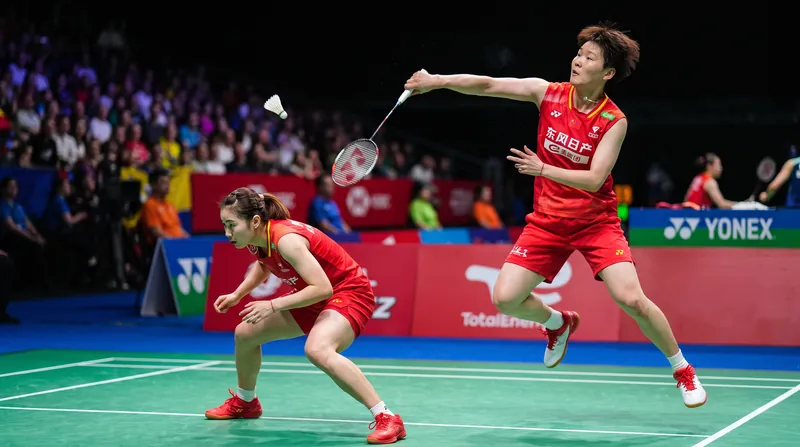
Shi Yuqi and An Se-young Command BWF Standings as Race to Hangzhou Enters High-Stakes World Championships
5 sources
Standings
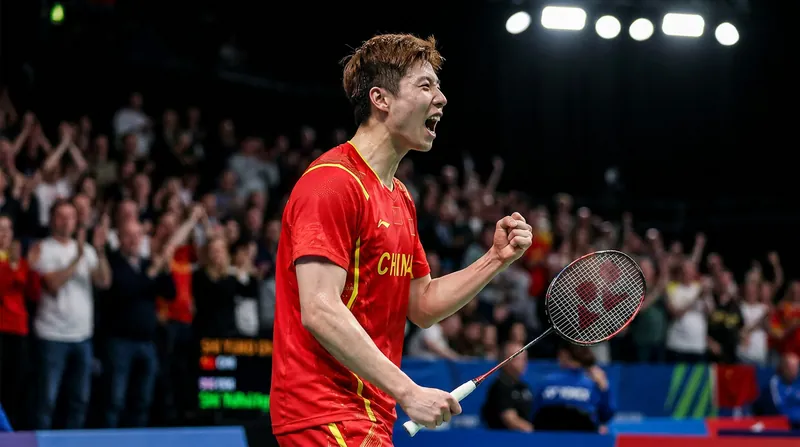
Historic French Surge Shakes Up BWF Men's Singles Standings as Popov and Lanier Crack Top 10
6 sources
Standings
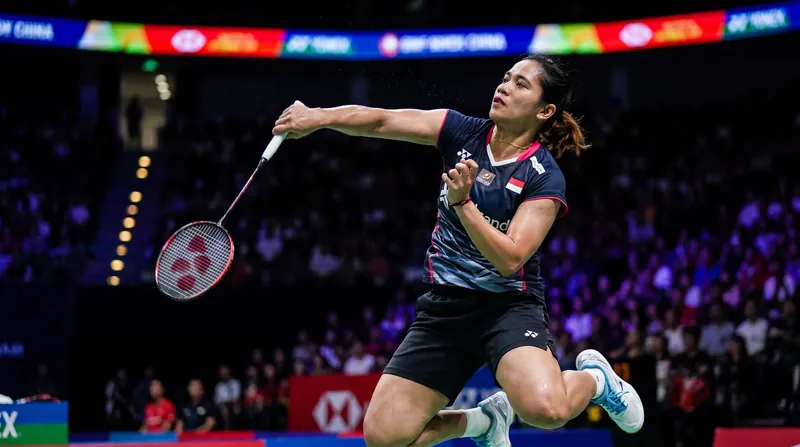
Viktor Axelsen and Anders Antonsen Secure Historic Danish 1-2 Atop BWF Race to Hangzhou Standings
1 sources

Injury
Kong Hee Yong Caps Knee Surgery Comeback With Dramatic 30-29 Japan Open Title Victory
6 sources

Comments
Every angle. Every day.
Get Sports stories with full source coverage and perspective breakdowns, free every day.