
Physicists Repurpose Earth's Magnetic Field as a Planet-Sized Dark Matter Detector
By analyzing a decade of geomagnetic data from Scotland, researchers have set new limits on ultralight dark matter particles and isolated 65 unexplained signal candidates.
By Mateo Ramos

Share this story
The conversion of a theoretical ultralight dark matter particle into a measurable electromagnetic wave requires a magnetic field larger than any laboratory can build. That interaction—where a particle strikes a magnetic field and sheds a photon—is the bottleneck for detection. Because laboratory magnets cover too small an area to capture these low-frequency waves, physicists have turned to the planet itself.
Earth's molten iron core generates a global magnetic field, while the non-conducting atmosphere sandwiched between the surface and the ionosphere acts as a natural resonant cavity. If ultralight dark matter candidates like axions or dark photons drift through this space, they should oscillate and produce a faint, steady electromagnetic hum.[3]
"We asked ourselves whether we could use the Earth itself as a giant detector in the search," says Atsushi Taruya, a physicist at Kyoto University. "The Earth-ionosphere cavity acts as a natural resonator that amplifies electromagnetic waves right around the mass range we wanted to probe."
To test the mechanism, researchers from Kyoto University, Hiroshima University, and Nihon University analyzed a decade of geomagnetic data from the British Geological Survey's Eskdalemuir Observatory in Scotland. The dataset spanned from September 2012 to November 2022.
The team sliced the ten-year record into 9,909 eight-hour chunks. They combed through each segment looking for a persistent, razor-sharp frequency spike. While ordinary electromagnetic noise fluctuates over time, a genuine dark matter signal would sit at the exact same frequency for years, tied directly to the particle's mass.
The theoretical framework developed by the team accounts for the atmosphere's electrical conductivity, demonstrating that the Earth-ionosphere cavity amplifies signals near 8 Hz and allowing reliable predictions up to 30 Hz. In this range, the targeted particles would be 19 to 21 orders of magnitude lighter than an electron.[3]
The data yielded two distinct sets of findings. First, the absence of a dominant, unmistakable signal allowed the team to set limits on how strongly axions couple to light that are roughly 100 times tighter than previous ground-based experiments.[1]
Second, the search isolated 65 persistent signal candidates that survived filtering and remain unexplained. The parallel analysis for dark photons also turned up several unconfirmed signal candidates.[2]
The evidence that these 65 anomalies represent dark matter remains thin. The signals could still be unidentified terrestrial or atmospheric noise. Because axions require Earth's magnetic field to generate electromagnetic waves, an authentic axion signal should vary by location, peaking in Southeast Asia. Dark photons, which do not require an external magnetic field, should produce a consistent signal globally.
Confirming the nature of these signals requires cross-referencing the Eskdalemuir data with other observatories worldwide. The theoretical framework now exists to process data from a global network of magnetometers, which will determine whether these 65 spikes are local interference or the first direct signature of the universe's missing mass.[1]
Perspectives explored
Particle Physicists' view
Focuses on the constraints placed on axion and dark photon models.
For theorists, the absence of a massive, undeniable signal is just as valuable as a detection. By ruling out certain interaction strengths, the Eskdalemuir data narrows the parameter space where ultralight dark matter can hide. The 100-fold improvement in the axion-photon coupling limit forces models to adapt, proving that planetary-scale data can test theories that laboratory magnets cannot reach.
Experimental Dark Matter Hunters' view
Emphasizes the 65 unexplained signals and the shift to planet-scale transducers.
Experimentalists view the 65 persistent signal candidates as the primary targets for the next phase of research. Because laboratory haloscopes are limited by the physical size of their magnets, repurposing the Earth-ionosphere cavity represents a massive leap in detector volume. The focus now shifts to verifying whether these specific frequency spikes appear in independent datasets.
Geophysicists' view
Focuses on the challenge of isolating cosmic signals from terrestrial electromagnetic noise.
Earth's magnetic environment is extraordinarily noisy, filled with lightning strikes, solar wind interactions, and human-made interference. Geophysicists emphasize that while the theoretical framework accounts for the atmosphere's electrical conductivity, proving that an 8 Hz to 30 Hz signal originates from a galactic dark matter halo requires ruling out every possible terrestrial source first.
Key points
- Physicists repurposed Earth's magnetic field and ionosphere as a giant dark matter detector.
- The team analyzed 10 years of geomagnetic data from an observatory in Scotland.
- The search established limits on axion-photon coupling 100 times tighter than previous ground-based experiments.
- Researchers isolated 65 unexplained frequency spikes that require further global verification.
Open questions
- Whether the 65 signal candidates are dark matter or unidentified terrestrial noise.
- The exact mass of the axion or dark photon, if they exist.
- Whether the signals will appear consistently across a global network of magnetometers.
Timeline
September 2012
Geomagnetic data collection begins at the Eskdalemuir Observatory in Scotland.
November 2022
The ten-year data collection period concludes, yielding 9,909 eight-hour chunks.
May 2026
Researchers publish the theoretical framework for low-frequency terrestrial magnetic fields.
August 2026
The team announces the results of the decade-long data analysis, including the 65 signal candidates.
- Particle Physicists
- Value the 100-fold improvement in coupling limits, narrowing the theoretical parameter space for ultralight dark matter.
- Experimental Dark Matter Hunters
- Emphasize the 65 unexplained signals and the methodological shift from small laboratory magnets to planet-scale transducers.
- Geophysicists
- Focus on the challenge of isolating genuine cosmic signals from the complex, noisy electromagnetic environment of the Earth-ionosphere cavity.
Perspectives this story doesn't cover
- Southern Hemisphere Observatories
Sources
Source coverage
3 outlets
3 viewpoints surfaced



- [1]Science DailyExperimental Dark Matter Hunters
A mysterious signal around Earth could be dark matter
Read on Science Daily → - [2]Physical Review DParticle Physicists
Searching for dark photon dark matter from terrestrial magnetic fields
Read on Physical Review D → - [3]Progress of Theoretical and Experimental PhysicsParticle Physicists
Signature of Axion Dark Matter in Low-Frequency Terrestrial Electromagnetic Fields: Formulation and Predictions
Read on Progress of Theoretical and Experimental Physics →

More in Science
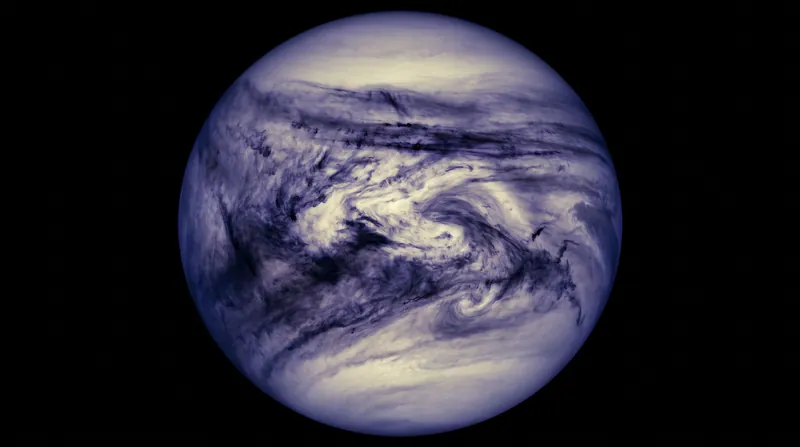
See all →Venusian Atmosphere
Venus's Pale Clouds Hide a Substance as Dark as Tar, New Optical Model Shows
4 sources
Orbital Mechanics
The Two-Burn Maneuver: How a Hohmann Transfer Orbit Minimizes Fuel for Interplanetary Travel
6 sources
Venus Moon Mystery
Venus Likely Had a Moon That Was Destroyed by the Planet's Own Gravity, Models Show
3 sources

Cosmic Acceleration
New Analysis Confirms the Universe Is Still Accelerating, Debunking 'Cosmic Slowdown' Claims
5 sources
Comments
Every angle. Every day.
Get Science stories with full source coverage and perspective breakdowns, free every day.