
Israelis Vote in First Post-October 7 General Election Amid Referendum on Netanyahu
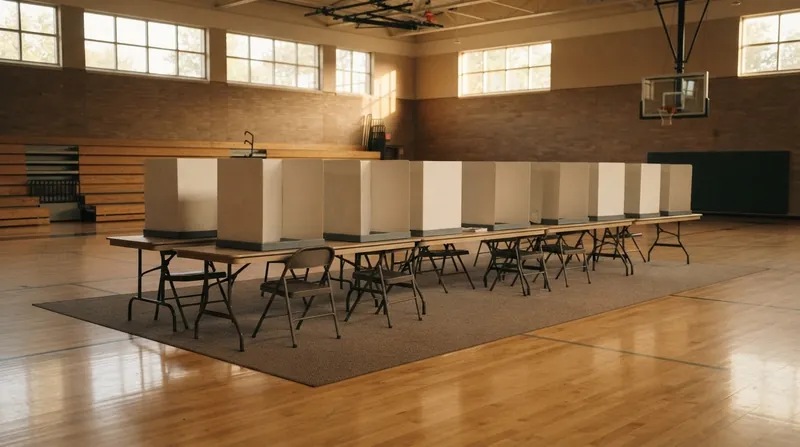
Polling stations opened across Israel on Tuesday for the 26th Knesset elections, marking the first national vote since the 2023 attacks. The election serves as a direct referendum on Prime Minister Benjamin Netanyahu's wartime leadership and his right-wing coalition.
By Adel Khoury

Share this story
Polling stations opened across Israel at 7:00 a.m. local time on Tuesday for the 26th Knesset elections. This marks the first time Israeli voters have cast national ballots since the Hamas attacks of October 7, 2023.[4][6]
The vote serves as a direct referendum on Prime Minister Benjamin Netanyahu and his right-wing coalition. More than 7.2 million eligible voters will determine the composition of the 120-seat parliament.[1][2]
Security at polling locations remains exceptionally tight, with thousands of police officers deployed nationwide. The Central Elections Committee reported steady early turnout in major cities like Tel Aviv and Jerusalem.[6]
"This election is fundamentally about who can secure the state's future in an era of multi-front conflict," a senior Likud official told CBS News on Monday.[2]
A Referendum on Wartime Leadership
Netanyahu's political survival hinges on whether his traditional base turns out despite the ongoing security challenges. His coalition has faced sustained criticism over the intelligence failures preceding the 2023 attacks.[1][2]
Opposition leaders, including Benny Gantz and Yair Lapid, have framed the election as a necessary reset for the nation's democratic institutions. They argue that new leadership is required to rebuild international alliances and domestic trust.[1]
"Israelis are voting today for the soul of their country, not just a new parliament," opposition figures emphasized in their final pitches, as reported by CNN.[1]
The electoral threshold remains at 3.25 percent, meaning smaller parties must secure at least four seats to enter the Knesset. This threshold often forces last-minute mergers and strategic voting among ideological blocs.[3]
The Mechanics of Coalition Building
No single party has ever won an outright majority of 61 seats in Israel's history. The victor will need weeks of intense negotiations to form a governing coalition from a fragmented political landscape.[2]
Foreign Affairs notes that regardless of the prime minister's identity, Israel's broader security posture is unlikely to shift dramatically. The military establishment continues to operate under consensus directives regarding border security.[3]
The inclusion of far-right factions in the previous government complicated relations with Washington and regional partners. Centrist challengers have promised to form a broader, more moderate unity government if given the mandate.[1][2]
Voting concludes at 10:00 p.m. local time, at which point major television networks will release their exit polls. Official results will trickle in overnight, with the final certified count expected by Thursday.[6]
Regional and International Stakes
The Biden administration is closely monitoring the outcome, given its implications for ongoing diplomatic initiatives in the Middle East. US officials have maintained a neutral public stance throughout the campaign period.[1]
European leaders are similarly attentive, as the next Israeli government will dictate the pace of post-war reconstruction efforts. Euronews highlighted the election's prominence in European diplomatic circles on Tuesday morning.[4]
"The international community is waiting to see if the Israeli public endorses the current trajectory or demands a pivot," a diplomatic source told CBS News.[2]
Voter turnout in the Arab sector remains a critical variable that could swing the overall bloc math. Historically, higher participation from Arab-Israeli citizens has bolstered the center-left's chances of blocking a right-wing majority.[3]
Economic Pressures on the Electorate
While security dominates the headlines, economic concerns are heavily influencing voter behavior. The cost of living and the financial strain of prolonged military mobilization have eroded support for the incumbent government in working-class districts.[1][3]
Credit rating downgrades earlier in 2026 have amplified opposition arguments that the current administration is mismanaging the state budget. Finance ministry data indicates a widening deficit driven by defense expenditures.[2]
Netanyahu has countered these economic critiques by pointing to Israel's resilient tech sector and historical recovery patterns. He argues that only a stable, right-wing government can implement the necessary post-war economic reforms.[1]
The Jerusalem Post published images of political leaders casting their ballots early Tuesday, projecting confidence to their respective bases. President Isaac Herzog voted in Jerusalem, urging all citizens to exercise their democratic right.[5]
The Path Forward
Once the final votes are tallied, President Herzog will consult with party leaders before tasking a candidate with forming a government. That candidate will have an initial 28 days to assemble a 61-seat majority.[2][5]
If the first candidate fails, the mandate can be passed to another leader, or the Knesset can attempt to find a consensus figure. Failure at all stages would trigger yet another round of snap elections.[2]
Key points
- Polling stations opened Tuesday for the 26th Knesset elections, the first national vote since October 2023.
- More than 7.2 million eligible voters will decide the fate of Prime Minister Benjamin Netanyahu's right-wing coalition.
- No single party has ever won an outright 61-seat majority, guaranteeing weeks of intense coalition negotiations.
- The election outcome will heavily influence Israel's post-war economic reforms and its diplomatic relations with the US and Europe.
Open questions
- Whether the final voter turnout in the Arab sector will be high enough to block a right-wing majority.
- Which smaller ideological parties will fail to cross the 3.25 percent electoral threshold.
- How long coalition negotiations will take, and whether a consensus candidate will emerge if bloc leaders fail to secure 61 seats.
Timeline
Nov 2022
Benjamin Netanyahu's right-wing coalition secures a majority in the 25th Knesset elections.
Oct 2023
Hamas launches unprecedented attacks on southern Israel, fundamentally altering the nation's security and political landscape.
Early 2026
Economic pressures and credit rating downgrades amplify calls for early elections.
Oct 27, 2026
Over 7.2 million Israelis head to the polls to elect the 120 members of the 26th Knesset.
- Likud Coalition Base
- Argues that Benjamin Netanyahu is the only leader capable of managing Israel's complex multi-front security challenges and resisting international pressure.
- Centrist Opposition
- Maintains that new leadership is essential to repair democratic institutions, rebuild international alliances, and restore public trust following the 2023 intelligence failures.
- Security Establishment
- Focuses on the continuity of military operations and border security, noting that broad strategic directives will likely remain unchanged regardless of the political victor.
Perspectives this story doesn't cover
- Arab-Israeli Voters
- Working-Class Economic Advocates
Sources
Source coverage
6 outlets
3 viewpoints surfaced






- [1]CNNCentrist Opposition
Israel is holding its most important election in years. Here's what's at stake
Read on CNN → - [2]CBS NewsLikud Coalition Base
Here's what could decide Netanyahu's political fate
Read on CBS News → - [3]Foreign AffairsSecurity Establishment
What Israel's Election Won't Change
Read on Foreign Affairs → - [4]EuronewsCentrist Opposition
Europe Today: Israel votes on Netanyahu's future as Orbán is floated for UN chief
Read on Euronews → - [5]Jerusalem Post
In Photos: Israel's political leaders cast their ballots in 26th Knesset election
Read on Jerusalem Post → - [6]The Times of Israel
Live Updates: Israelis head to the polls for 26th Knesset
Read on The Times of Israel →
More in News & Politics
See all →Alberta Separatism
Alberta Voters Overwhelmingly Reject Independence Referendum to Remain in Canada
5 sources

Senate Elections
Czech Senate Elections Deal Blow to Prime Minister Andrej Babis' Governing Coalition
3 sources

Electoral Systems
How District Magnitude Caps Electoral Disproportionality Across Parliaments
8 sources

Constitutional Law
The Caretaker Convention: Why Outgoing Governments Cannot Sign Contracts or Appoint Officials
6 sources

Comments
Every angle. Every day.
Get News & Politics stories with full source coverage and perspective breakdowns, free every day.