
Iran Strikes Commercial Ship in Strait of Hormuz, Halting UN Evacuation Route
Iran's Revolutionary Guard struck a Singapore-flagged cargo ship with a drone, prompting the UN to suspend a newly established evacuation route for stranded seafarers.

Share this story
Iran's Islamic Revolutionary Guard Corps (IRGC) launched a drone strike against a commercial cargo ship in the Strait of Hormuz on Thursday, abruptly halting a United Nations-backed effort to evacuate thousands of stranded seafarers.[1]
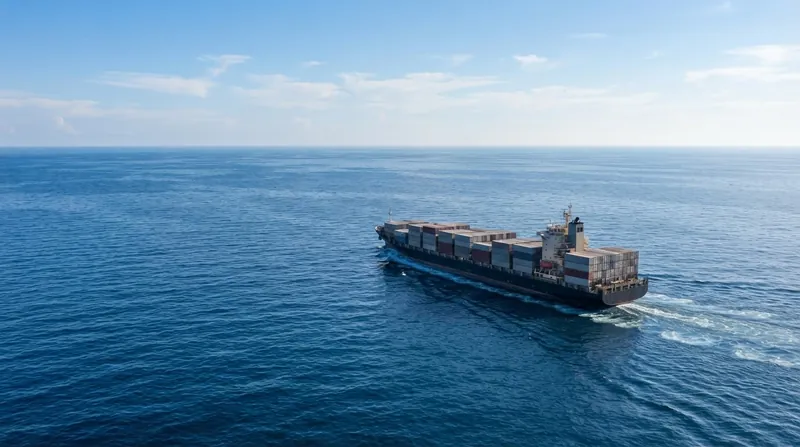
The vessel, identified as the Singapore-flagged Ever Lovely, was struck by a one-way attack drone approximately 7.5 nautical miles off the coast of Oman. The ship suffered damage to its bridge, but no casualties were reported among the crew, and the vessel was able to continue its journey through the waterway.[3]
Owned by Taiwan-based Evergreen Marine, the Ever Lovely had been trapped in the Persian Gulf for more than 100 days due to the ongoing U.S.-Iran conflict. It was attempting to exit the region using a newly designated southern shipping lane established by the UN's International Maritime Organization (IMO) and Omani officials.[2]
In response to the strike, IMO Secretary-General Arsenio Dominguez announced an immediate pause to the evacuation framework, which was designed to rescue more than 11,000 sailors stranded since February. "To ensure a coordinated approach and navigational safety, the evacuation plan will be paused until further clarity is obtained," Dominguez stated, noting that the targeted vessel was not officially traveling under the IMO's specific evacuation list at the time.[3]
The attack serves as a stark warning from Tehran regarding who controls the vital waterway. Following the strike, Iran's newly established Persian Gulf Strait Authority declared that any transit outside of routes explicitly designated by Iran "will not be covered by the guarantee of safe passage."[1]
The IRGC echoed this sentiment, calling the UN and Oman-backed alternative routes "unacceptable and completely dangerous." According to maritime intelligence, several tankers that were heading toward the strait on the southern Omani route abruptly turned back or diverted north toward the Iranian coastline following the incident.[1][2]
The strike casts immediate doubt on the viability of a fragile ceasefire agreement reached last week between the United States and Iran. Under that memorandum of understanding, the U.S. agreed to lift its naval blockade in exchange for Iran ensuring freedom of navigation through the strait for a minimum of 60 days.[1][4]
U.S. officials confirmed the drone strike, with the White House stating it is closely monitoring the situation. The incident presents a major diplomatic test for the administration, as Secretary of State Marco Rubio tours the Gulf to reassure allies that the peace framework remains intact.[1]
Prior to the attack, the UN-backed route had seen a brief surge in activity. On Wednesday, nearly 50 cargo vessels successfully navigated the strait—the highest single-day volume since the conflict escalated, moving an estimated 13.4 million barrels of oil.[2]
Where opinion splits
Iranian Authorities
Iran asserts sovereign control over the Strait of Hormuz and rejects unauthorized transit routes.
Tehran views the Strait of Hormuz as its primary strategic leverage and insists that all maritime traffic must coordinate with its newly established Persian Gulf Strait Authority. Iranian officials argue that the UN and Omani-backed southern route was established without their consent, making it an "unacceptable and completely dangerous" violation of their security protocols. By striking a vessel on this route, the IRGC demonstrated its willingness to enforce its own transit rules by force.
International Maritime Organization
The UN agency prioritizes the immediate safety and evacuation of stranded seafarers.
For the IMO, the crisis is fundamentally humanitarian. With over 11,000 sailors trapped in the Persian Gulf for months, the agency sought to establish a safe, depoliticized corridor along the Omani coast to bypass mined areas and geopolitical friction. The suspension of this evacuation framework reflects the IMO's mandate that seafarer safety remains paramount, refusing to risk civilian lives in a contested military zone.
U.S. and Western Allies
Western powers view the strike as a breach of the recent ceasefire and a threat to global trade.
U.S. officials see the drone strike as a direct violation of the 60-day freedom of navigation agreement signed just last week. From Washington's perspective, Iran is using the stranded ships and global oil markets as hostages to institutionalize its control over the strait. The attack raises alarms that Tehran may eventually attempt to charge formal tolls for vessels, a move the U.S. has vehemently opposed.
Key points
- Iran's Revolutionary Guard struck the Singapore-flagged cargo ship Ever Lovely with a drone off the coast of Oman.
- The vessel suffered bridge damage but reported no casualties and continued its journey.
- The attack prompted the UN to suspend a new evacuation route meant to rescue 11,000 stranded sailors.
- Iran declared that any ships using routes not approved by Tehran will not be guaranteed safe passage.
Unanswered questions
- How the United States will formally respond to the strike and whether it will declare the recent peace agreement void.
- When or if the UN's International Maritime Organization will be able to resume the evacuation of the 11,000 stranded sailors.
- Whether Iran intends to begin charging formal tolls for vessels using its designated northern route.
How we got here
February 2026
Escalating U.S.-Iran conflict traps hundreds of ships and over 11,000 sailors in the Persian Gulf.
Mid-June 2026
The U.S. and Iran sign a memorandum of understanding to lift the naval blockade in exchange for 60 days of free navigation.
June 24, 2026
The UN and Oman open a temporary southern shipping lane to evacuate stranded vessels, resulting in a surge of 50 ships passing through.
June 25, 2026
Iran strikes the Ever Lovely with a drone, prompting the UN to halt the evacuation framework.
- U.S. Security & Strategic View
- Emphasizes the breach of the U.S.-Iran truce and the military threat posed by the IRGC.
- International Maritime & Humanitarian View
- Focuses on the safety of the 11,000 stranded seafarers and the disruption of the UN evacuation plan.
- Regional Diplomatic View
- Highlights the friction between Iran and Oman over the management of the strait and the collapse of the UN-backed corridor.
Perspectives this story doesn't cover
- The 11,000 stranded seafarers
- Omani government officials
- Commercial shipping insurers
Sources
Source coverage
4 outlets
3 viewpoints surfaced




- [1]The GuardianRegional Diplomatic View
UN-backed plan to free ships trapped in strait of Hormuz rejected by Iran
Read on The Guardian → - [2]The Washington PostU.S. Security & Strategic View
Iran strikes cargo ship on U.N.-backed route in Strait of Hormuz
Read on The Washington Post → - [3]BBCInternational Maritime & Humanitarian View
UN pauses Strait of Hormuz evacuation plan after cargo ship attacked
Read on BBC → - [4]AxiosU.S. Security & Strategic View
UN pauses Hormuz sailor evacuations after attack in strait
Read on Axios →

More in News & Politics
See all →High Seas Jurisdiction
Flag State Jurisdiction Prevents Coastal Interceptions of Foreign Vessels Under UNCLOS Article 92
3 sources
US-Israel Relations
US Defense Secretary Hegseth Makes Unannounced Visit to Israel Ahead of Election
6 sources

Humanitarian Aid
WFP Halts Gaza Food Aid for 500,000 People Citing Severe Funding Shortage
4 sources
Presidential Runoff
Lula and Flávio Bolsonaro Clash in First Presidential Runoff Debate
5 sources

Comments
Every angle. Every day.
Get News & Politics stories with full source coverage and perspective breakdowns, free every day.