
How Lidar, Radar, and Camera Sensor Fusion Overcomes the Limitations of Each for Autonomous Driving
By combining the high-resolution vision of cameras, the weather resilience of radar, and the precise 3D mapping of lidar, sensor fusion allows autonomous vehicles to navigate environments where any single sensor would fail.
By Noor Saidi

Share this story
Human driving relies on two eyes and a brain to infer depth, speed, and trajectory, but autonomous sensor fusion differs in one fundamental respect: it physically measures these metrics across three distinct electromagnetic spectrums simultaneously. When a buyer drives a modern vehicle off the lot in 2026, they are no longer just purchasing an engine and a chassis; they are acquiring a rolling perception engine designed to see what human biology cannot.[6]
The primary challenge of autonomous driving is not steering or accelerating, but perception. A vehicle must build a flawless, real-time 3D model of its surroundings in all weather conditions, a task that has historically paralyzed single-sensor systems. Relying on a single modality leaves critical blind spots that can lead to catastrophic failures, such as phantom braking for shadows or failing to detect a white truck against a bright sky.[1]
To solve this, the automotive industry is converging on sensor fusion—the integration of cameras, radar, and lidar. SearchEnterpriseAI notes that this triad forms the standard sensor suite for Level 4 and Level 5 autonomous cars, ensuring that the weaknesses of one sensor are covered by the strengths of another. For a consumer, this means the vehicle's computer is constantly cross-referencing three different versions of reality to decide whether to hit the brakes.[5]
Cameras serve as the foundational layer of this perception stack. They are inexpensive, offer high resolution, and are the only sensors capable of reading color and texture. This allows them to interpret stop signs, lane markings, and traffic lights. However, as the ROSA P comparative analysis details, cameras are passive sensors that rely entirely on ambient light.[2]
If a driver is caught in a blizzard, driving into direct glare, or navigating a pitch-black rural road, the camera's reliability plummets. Furthermore, cameras lack native depth perception. They must infer distance using binocular setups or machine learning algorithms, which can be easily fooled by two-dimensional images. This vulnerability is exactly where radar steps in to anchor the system.[2]
Radar (Radio Detection and Ranging) emits radio waves and measures their reflection, making it entirely immune to lighting conditions, fog, rain, or snow. It excels at measuring the velocity of moving objects using the Doppler effect. Radar can see through a heavy downpour and instantly calculate that a vehicle three hundred feet ahead is braking aggressively.[4]
Yet, radar carries a glaring limitation: low spatial resolution. Automotive IQ points out that while radar knows an object occupies a specific space, it struggles to classify whether that metallic reflection is a stalled car, a bridge overpass, or a discarded soda can. This classification failure is why radar-heavy systems sometimes ignore stationary objects at highway speeds, assuming they are irrelevant background clutter.[4]
To bridge the gap between the camera's high resolution and the radar's weather immunity, engineers introduce lidar (Light Detection and Ranging). Lidar fires millions of laser pulses per second to create a highly precise, 3D point cloud of the environment. It provides the exact distance and shape of every object within its range, down to the centimeter.[1]
Lidar does not need to guess if an object is a pedestrian or a shadow; the physical laser return proves the object's volume. A recent review in arXiv highlights that integrating lidar into the fusion stack drastically reduces false positives and provides the deterministic depth map that neural networks need to validate camera data. As the researchers note, integrating multi-modal sensors is essential to overcome the inherent limitations of individual modalities.[3]
However, lidar is not a flawless solution. It remains historically expensive, mechanically complex, and its optical lasers can be scattered by heavy rain, snow, or dense fog—the exact conditions where radar thrives. Therefore, true sensor fusion is not just bolting three distinct sensors to a roof; it is the algorithmic orchestration of their data streams in real time.[2]
This fusion process happens in the vehicle's central computer, which must align the data temporally and spatially. The technical challenge for Level 4 and Level 5 autonomy lies in processing terabytes of multi-modal data in milliseconds. The system must decide which sensor to trust in any given microsecond, dynamically adjusting weights based on environmental conditions.[4]
For example, if the camera sees a clear road, but the radar detects a stationary metallic mass and the lidar confirms a 3D obstruction, the fusion algorithm must override the camera and apply the brakes. This redundancy is what transforms a driver-assist feature into a system capable of taking legal liability for the driving task. For the everyday owner, it promises a vehicle that will not abruptly disable its safety features the moment a storm rolls in.[5][6]
Competing readings
Sensor Fusion Advocates
Argue that redundancy across different physical spectrums is mandatory for safety.
Proponents of multi-modal fusion argue that no single sensor can handle the infinite edge cases of the real world. Because cameras fail in glare, radar lacks resolution, and lidar struggles in snow, only a combined suite can guarantee that a vehicle will not blindly accelerate into a stationary object. They view the added hardware cost as a non-negotiable requirement for removing the human driver.
Vision-Only Proponents
Believe that high-resolution cameras and advanced neural networks are sufficient.
This camp argues that since human beings drive using only vision (eyes) and a neural network (the brain), autonomous vehicles should be able to do the same. They contend that adding radar and lidar creates conflicting data streams that can confuse the vehicle's computer, and that relying purely on cameras reduces manufacturing costs and simplifies the software architecture.
Regulatory Safety Bodies
Focus on deterministic safety guarantees and fail-safe redundancies.
Regulators and safety auditors emphasize that autonomous systems must have overlapping fail-safes. They favor sensor fusion because it provides deterministic, physics-based measurements (like radar's Doppler effect or lidar's laser returns) that do not rely entirely on the probabilistic guessing of machine learning image classifiers.
- Sensor Fusion Advocates
- Argue that hardware redundancy across multiple spectrums is the only path to true autonomy.
- Vision-Only Proponents
- Believe that advanced neural networks processing high-resolution camera data can solve autonomy without expensive lidar.
- Regulatory Safety Bodies
- Prioritize deterministic fail-safes and verifiable redundancy over single-sensor machine learning.
Sources
Source coverage
6 outlets
3 viewpoints surfaced






- [1]Sensors (MDPI)Sensor Fusion Advocates
Sensor and Sensor Fusion Technology in Autonomous Vehicles: A Review
Read on Sensors (MDPI) → - [2]ROSA PSensor Fusion Advocates
Perception Technologies for Autonomous Transportation: A Comparative Analysis of LiDAR, Radar, Camera, and Sonar
Read on ROSA P → - [3]JournalSensor Fusion Advocates
Integrating Multi-Modal Sensors: A Review of Fusion Techniques for Intelligent Vehicles
Read on Journal → - [4]Automotive IQSensor Fusion Advocates
Sensor Fusion: Technical challenges for Level 4-5 self-driving vehicles
Read on Automotive IQ → - [5]SearchEnterpriseAISensor Fusion Advocates
Sensor Suite: How Cameras, LiDAR, and RADAR Work Together in Autonomous Cars
Read on SearchEnterpriseAI → - [6]Factlen Editorial TeamRegulatory Safety Bodies
Synthesis by Factlen editorial team
Read on Factlen Editorial Team →
More in Automotive & Transportation
See all →Autonomous Navigation
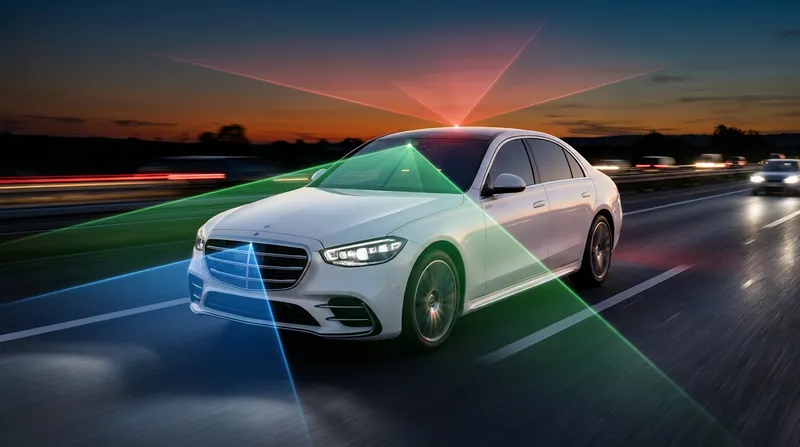
Urban Canyon Multipath Skews Satellite Fixes by Tens of Meters, Forcing Autonomous Vehicles to Localize via LiDAR Map Matching
8 sources
Autonomous Safety
The 10-Second Rule: Why Level 3 Autonomous Vehicles Must Drive While the Brain Reboots
4 sources
Sensor Fusion
Lacking Elevation Resolution to Distinguish Overpasses From Stopped Cars, Automotive Radars Filter Stationary Returns to Prevent Phantom Braking
4 sources
AV Safety
The Minimum Risk Condition: How Autonomous Vehicles Are Programmed to Fail Safely
6 sources
Comments
Every angle. Every day.
Get Automotive & Transportation stories with full source coverage and perspective breakdowns, free every day.